Courbet painted 35 oils in one autumn, and in this one the sea is a thin strip

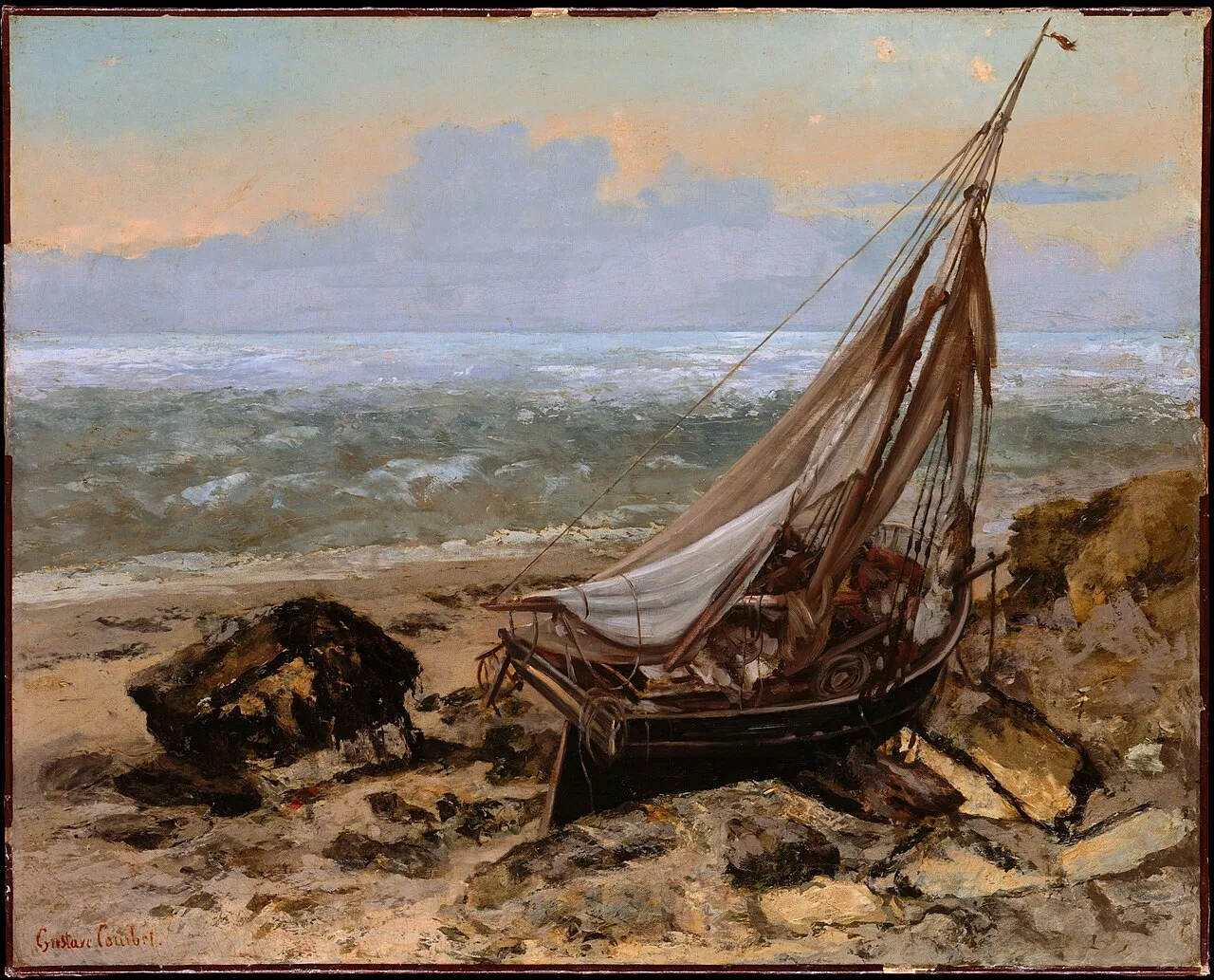
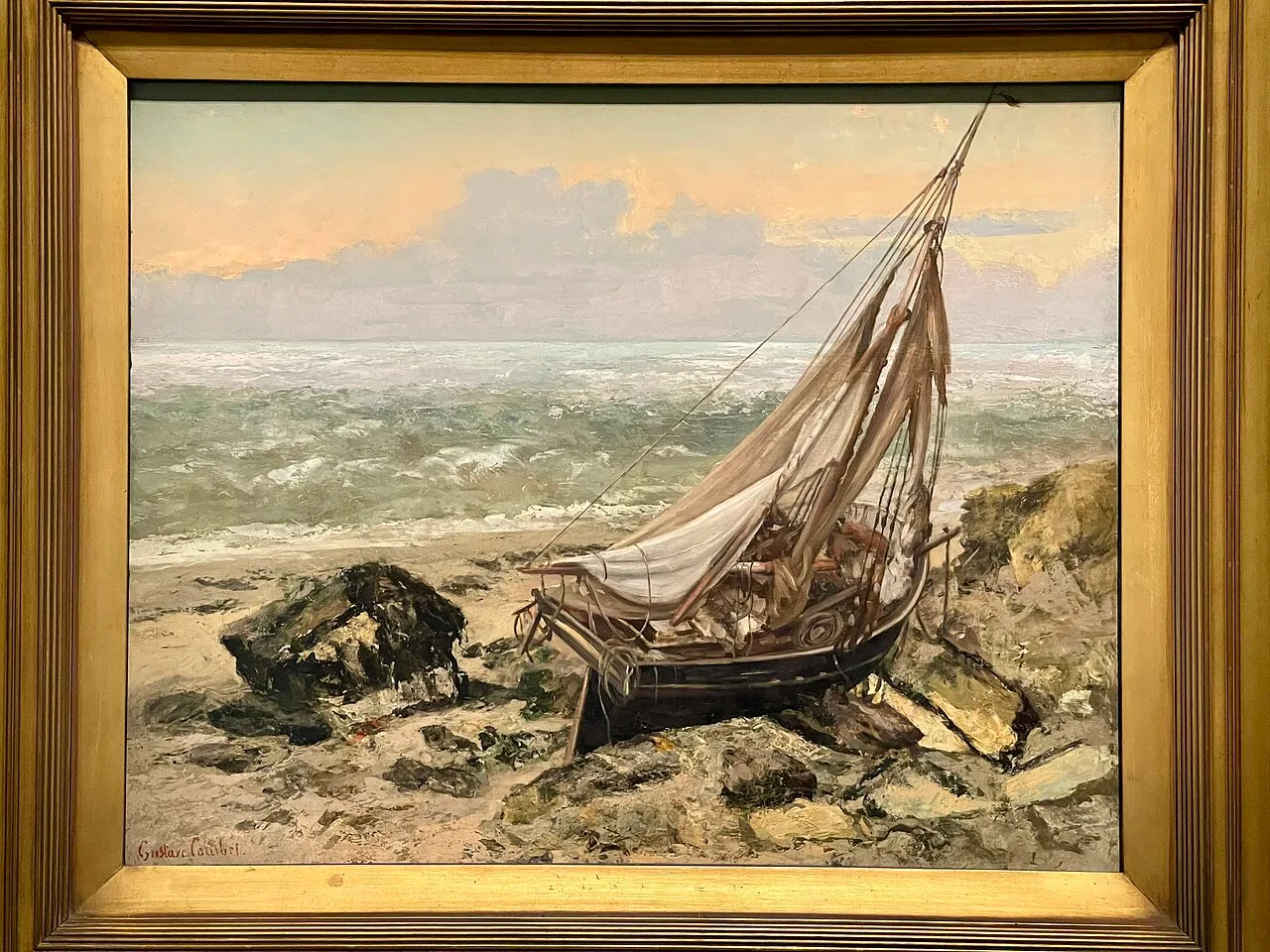
In the autumn of 1865 Gustave Courbet painted 35 oils in quick succession on the Normandy coast. In The Fishing Boat, now at the Metropolitan Museum of Art, the boat hauled out of the water fills the whole lower front of the canvas while the sea is squeezed into a narrow band along the top. The painting is oil on canvas, 64.8 by 81.3 cm, about the size of a large suitcase, made at Trouville.
Start at the hull. A tarred wooden fishing boat lies beached and propped, its curved side running almost the full width of the picture. Courbet lays the paint on in flat slabs, the kind of mark you get from a palette knife, a flat trowel-like blade used instead of a brush, and the smeared planes suit the planking. Working outdoors at speed pushes a painter toward what is actually in front of him: a heavy object at rest, not a horizon. The Met's entry notes that, unlike many marine paintings of the time, "the boat is the central feature of the composition rather than a minor element" (metmuseum.org/art/collection/search/43601…).
That reversal is the nerve of the picture. Marine painting in the 1860s usually meant a wide sea with a small vessel somewhere in it, the boat an incident in the view. Courbet puts the order the other way round: the working thing first, the water as a strip of weather behind it. The result reads less like a seascape than a portrait of an object that has just been dragged out of the water and left to dry.
Courbet (1819-1870) was the French realist who painted ordinary, unglamorous subjects at full scale and made a career of it, and by 1865 he was established and selling. The Met bought this canvas in 1899, its first Courbet. The source gives the count of 35 oils but not how many survive, or whether this one was finished on the beach or in the studio; the catalogue entry is where that would be settled.
What holds a viewer now is the weight of the thing. The tarred curves, the props holding it upright, the flat planes of paint that make the planks feel solid: all of it says the boat is the subject, and the sea is only the background it came out of.