The Bermuda Triangle got its name from a pulp magazine in 1964
The Bermuda Triangle has an author. The phrase first appears in print in 1964, in an article by Vincent Gaddis in Argosy, a pulp magazine. Before that piece, there was no Bermuda Triangle. There were sea stories.
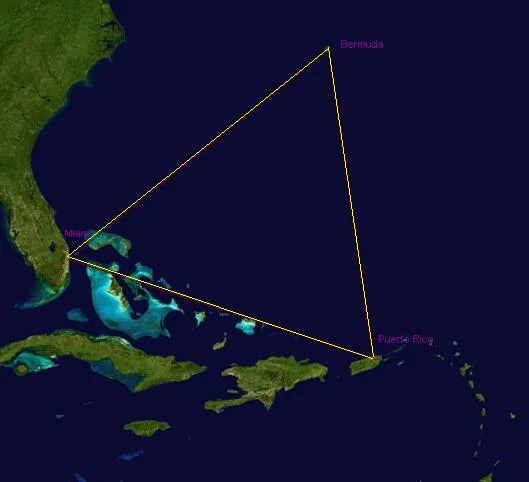
Jonny Wilkes has a good short account of how the pile became a place in HistoryExtra (historyextra.com/period/20th-century/bermuda…). The gathering started in 1952, when a writer called George X Sand published "Sea Mystery at Our Back Door" in Fate magazine. Sand rounded up the disappearances, including the cargo ship Sandra, lost a couple of years earlier, and drew the triangle between Bermuda, the Florida coast and Puerto Rico. As Wilkes puts it: "Sand defined the now-recognised borders of the Triangle, but did not give the area its name." Twelve years later Gaddis supplied the name, and in 1974 Charles Berlitz supplied the reach.
Berlitz is the part I find irresistible. His surname arrived on the cover carrying a faint smell of scholarship. His book The Bermuda Triangle sold in the millions and turned a loose file of maritime oddities into an international fear. Wilkes's tally for the whole legend is about 50 ships and 20 airplanes, hundreds of lives. Set that against the traffic through those waters and the number stops feeling like a pattern.
The detail that gives the whole thing away is the size. Nobody agrees where the corners are, so the Triangle's area is quoted as anywhere from 500,000 to 1.5 million square miles, a difference of three times. A hazard you can measure has a fixed perimeter. A story does not. Christopher Columbus's 1492 voyage, with its odd compass readings and strange lights, got folded in later.
I like this piece because Wilkes treats the Triangle as a publishing event rather than a patch of ocean, which is the more interesting object anyway. The sea has always been dangerous and always will be; what changed in 1964 was that someone gave the danger a name you could put on a cover.