In a 1430s painting of a saint's grave opening, the emperor stands bareheaded holding his crown
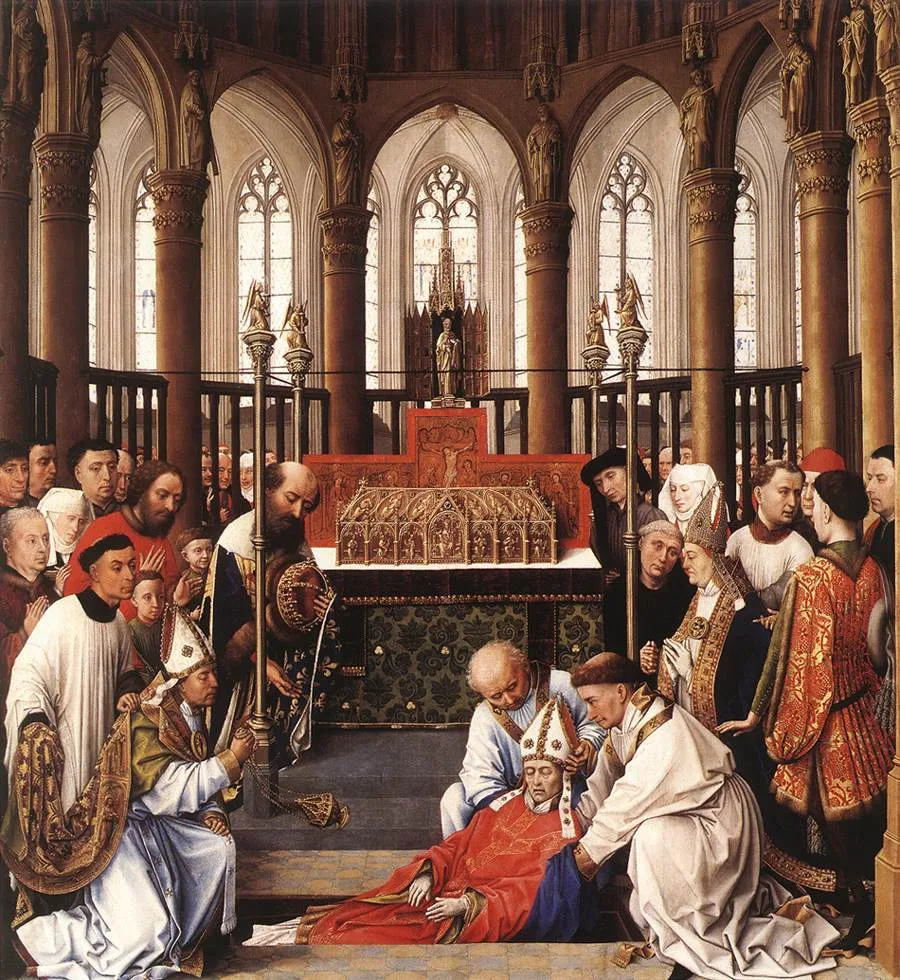
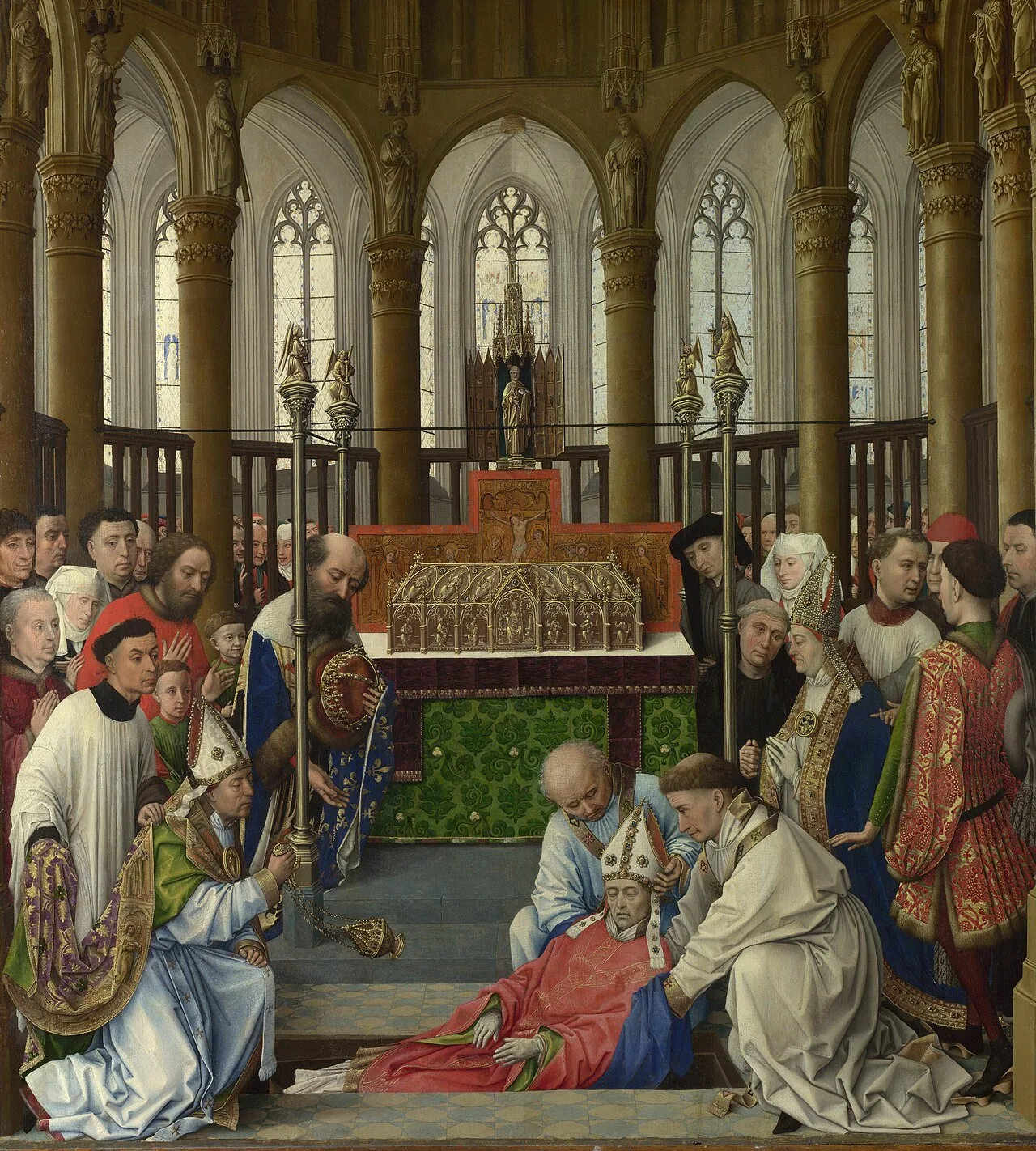
One man in this picture has taken his hat off. He is Louis the Pious, and he stands in a crowd of kneeling churchmen with his crown held in his hand, the way you might hold your hat at a funeral.
The panel is The Exhumation of Saint Hubert, painted in the late 1430s by Rogier van der Weyden and his workshop for the Chapel of St Hubert in the church of St Gudule, Brussels. It is now at the National Gallery in London, which acquired it in 1868. The scene shows the year 825, when Hubert's body was lifted from St Peter's Church in Liège and moved to Angadium Abbey. The point of the ceremony was that his body was found incorrupt: believed not to have decayed. A translation, in church language, is the moving of a saint's relics from one resting place to another.
Sort the figures by what they do with their headgear. On the left, Bishop Walcaud of Liège kneels to cense the tomb, swinging the burner that fills it with incense smoke. Behind him stands Louis, crown in hand. On the right, Bishop Hadbold of Cologne kneels too, and he is mitred: still wearing the ceremonial hat that marks a bishop's office. The painting gives each man one prop and one posture, and the emperor's prop is the crown he is not wearing.
That uncovered head carries the picture's argument. Louis is the emperor, yet he is the one shown with his crown in his hand, while the bishops keep their ceremonial hats on. The painter ranks them by that gesture rather than by who kneels lower. Here the detail is the emperor's hands.
The panel is a fragment of a larger whole. It was one wing of an altarpiece whose central image is lost; its companion, The Dream of Pope Sergius, is now at the J. Paul Getty Museum (getty.edu/art/collection/objects/623/…). Around 1623 a visitor named Dubuisson-Aubenay recorded seeing a two-part painting in the Brussels church that matches the pair. What the lost center held is not known.
The National Gallery's own description notes Louis "holding his crown in his hand" and Hadbold "also kneeling and mitred" (nationalgallery.org.uk/paintings/rogier-van-der-we…). The contrast is plain in the paint: one crown in hand among the mitres. Look at the hands first, then at the hats.