A Dutch still life where the books are empty and the lute case holds no lute
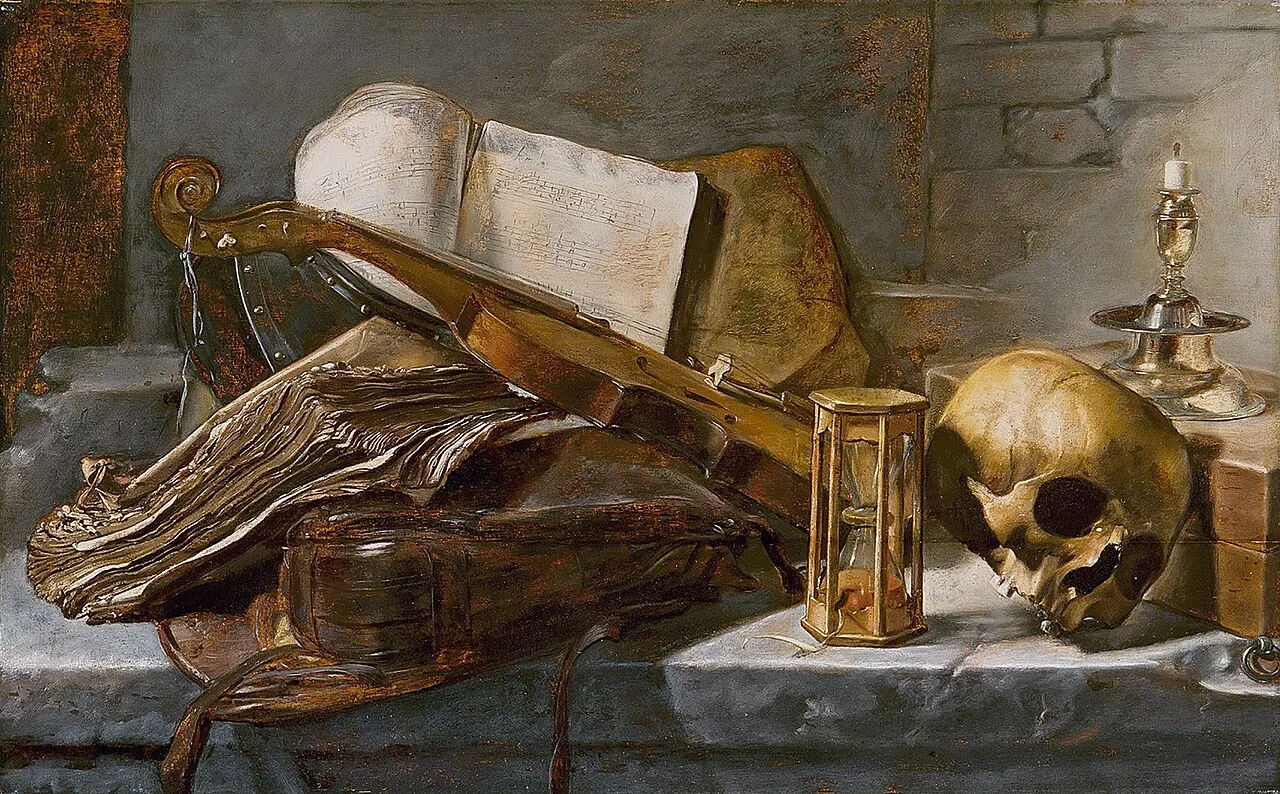
In the Rijksmuseum's Still Life with Books, painted around 1627 or 1628, the object that stops you is a lute case. It has the swelling pear-shaped body and the curved neck of a lute, and there is no lute in it. The books are empty too: they are ledgers, the soft leather and parchment bindings used for keeping bills and documents, and Lievens shows them as shells with nothing inside. The painting is named for the hollowest things on the table.
The painting is by Jan Lievens, a Dutch artist who shared a studio with Rembrandt. The shared studio may be how the picture came to be attributed to Rembrandt. It was privately owned, appeared at the art dealer Basil Wheeler, was sold to P. Potter by Montpellier Galleries in London, and was acquired by the Hague dealer Han Jüngeling on 28 April 1960, after which it was loaned to the Dordrechts Museum from 1960 to 1963. The Rijksmuseum bought it in 1963, and most experts now give it to Lievens. Most experts now attribute the work to Lievens, though not all do. It was displayed at the Milwaukee Art Museum from 6 February 2009 to 26 April 2009 in an exhibition titled Out of Rembrandt's Shadow, which is about as direct as a wall label gets.
Look at the stack of ledgers. Several are limp, with no structure to the binding, and two have laced-in supports, the cords that sew a book's pages to its cover. The ledger on the bottom with laced supports has deteriorated. What reads at first as a pile of old books is a set of specific objects worn in specific ways, and the Dutch art historian Pieter J.J. van Thiel pointed out that bindings like these almost never appear in a 17th-century painting. He called the lute case the oddest item in the picture, noting that many still lifes have lutes but they never have a lute case. It is the container without the thing contained, sitting in a painting where the books are containers without contents.
X-radiographs, pictures made by passing X-rays through the wood panel to show the paint layers underneath, reveal that the pewter jug was painted over an incomplete book. Objects which appear to the left were added later. The composition changed as he worked. Evidence like that turns a still life from an arrangement into a record of decisions, and it means the jug is covering a book in a painting whose subject is books that hold nothing.
Step back and the whole table sorts itself. Worn, discarded things sit at the back. The fresh bread roll and the newer items sit in front. That is the vanitas idea, the still-life tradition about how possessions and pleasures do not last, arranged as depth rather than stated as a moral. A Berkemeyer glass, two globes, a palette, a pewter plate: all of it is the stuff of a life, and the worn items sit at the back while the fresh bread sits in front. The Rijksmuseum's record is here: web.archive.org/web/20230126135514/https://…