The Venice church in this painting was demolished in 1810
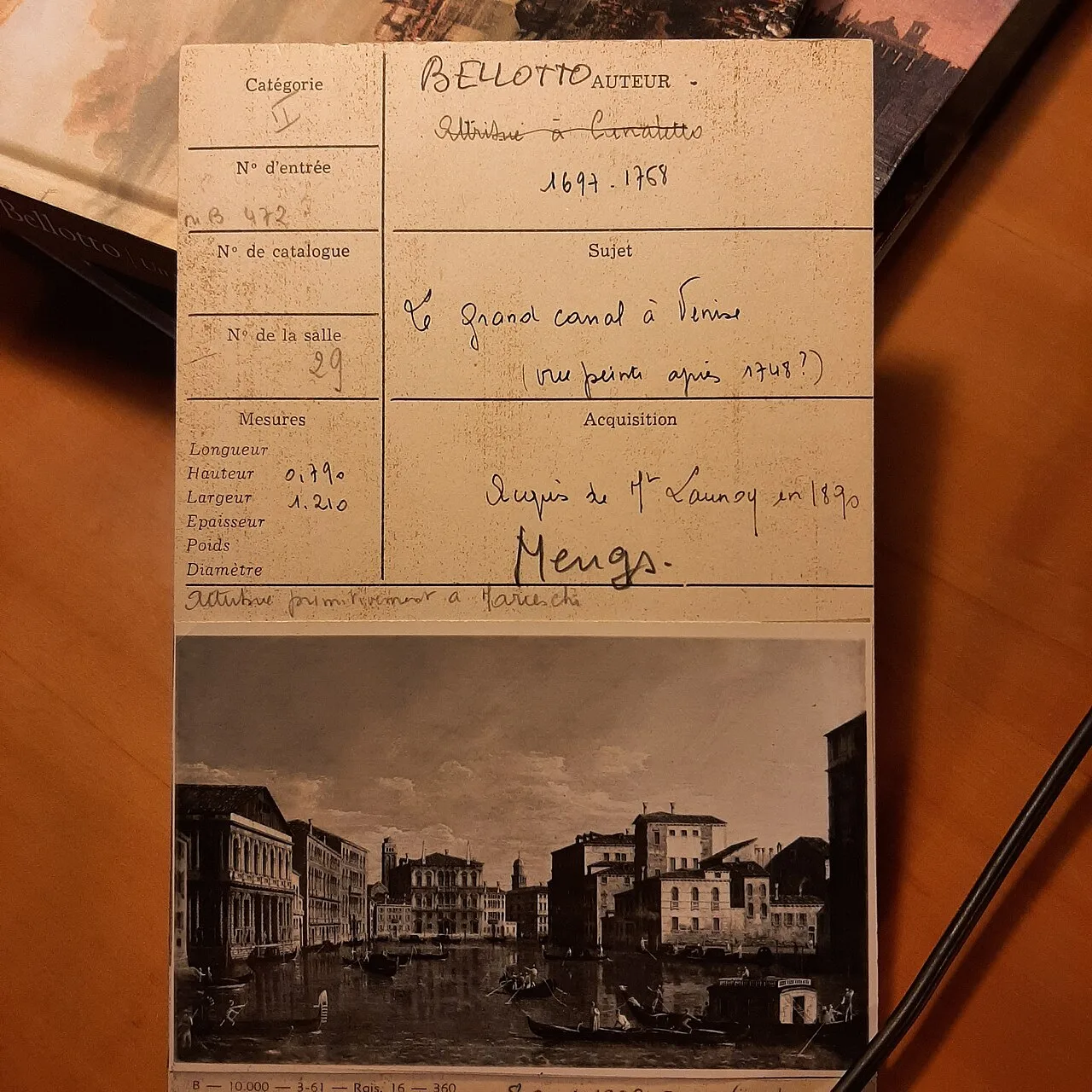
The church that gives this painting its name no longer exists. Santa Croce, the building in the right foreground of Bernardo Bellotto's view of the Grand Canal, no longer stands. So the canvas in the National Gallery in London records a Venice building you cannot visit.
Look at the right foreground first. That facade, low and wide along the water, is Santa Croce. The reason it can be identified at all is the kind of picture this is: a veduta, a view painted to be topographically accurate. Canaletto's studio produced views of this kind, and this one comes from it. Because the buildings are painted as they stood, not as an ideal arrangement, a veduta doubles as evidence.
Now move left along the canal. Further off, the green dome of San Simeon Piccolo. On the left, behind high walls, only the tops of facades rise: the church of Corpus Domini and the Scuola dei Nobili, then Santa Lucia and degli Scalzi, and the view closes under the bell tower of San Geremia. Among the boats is the Burchiello, the passenger service that ran between Venice and Padua. The picture reads as a map of a city that has since changed.
The attribution is where things stand open. The painting is attributed to Bernardo Bellotto, Canaletto's nephew and pupil. It probably dates to about 1738, when Bellotto was only 16 years old, and it is believed to have been based on a drawing by Canaletto at Windsor Castle. The same entry also says it was produced after Canaletto's death, decades later. Both statements sit in the same entry.
So what you are looking at is a picture whose maker is uncertain and whose date sits awkwardly against its own catalogue entry. The case for Bellotto rests on that Canaletto drawing. A similar view in the Royal Collection was copied in an engraving by Antonio Visentini, and the right-hand part of this painting also appears in Santa Croce on the Grand Canal, in the National Gallery, attributed to an unknown member of Canaletto's studio. The painting remains, and even its authorship is still open.