A low stone wall runs in front of Mary in this Mantegna, and it is doing two jobs at once
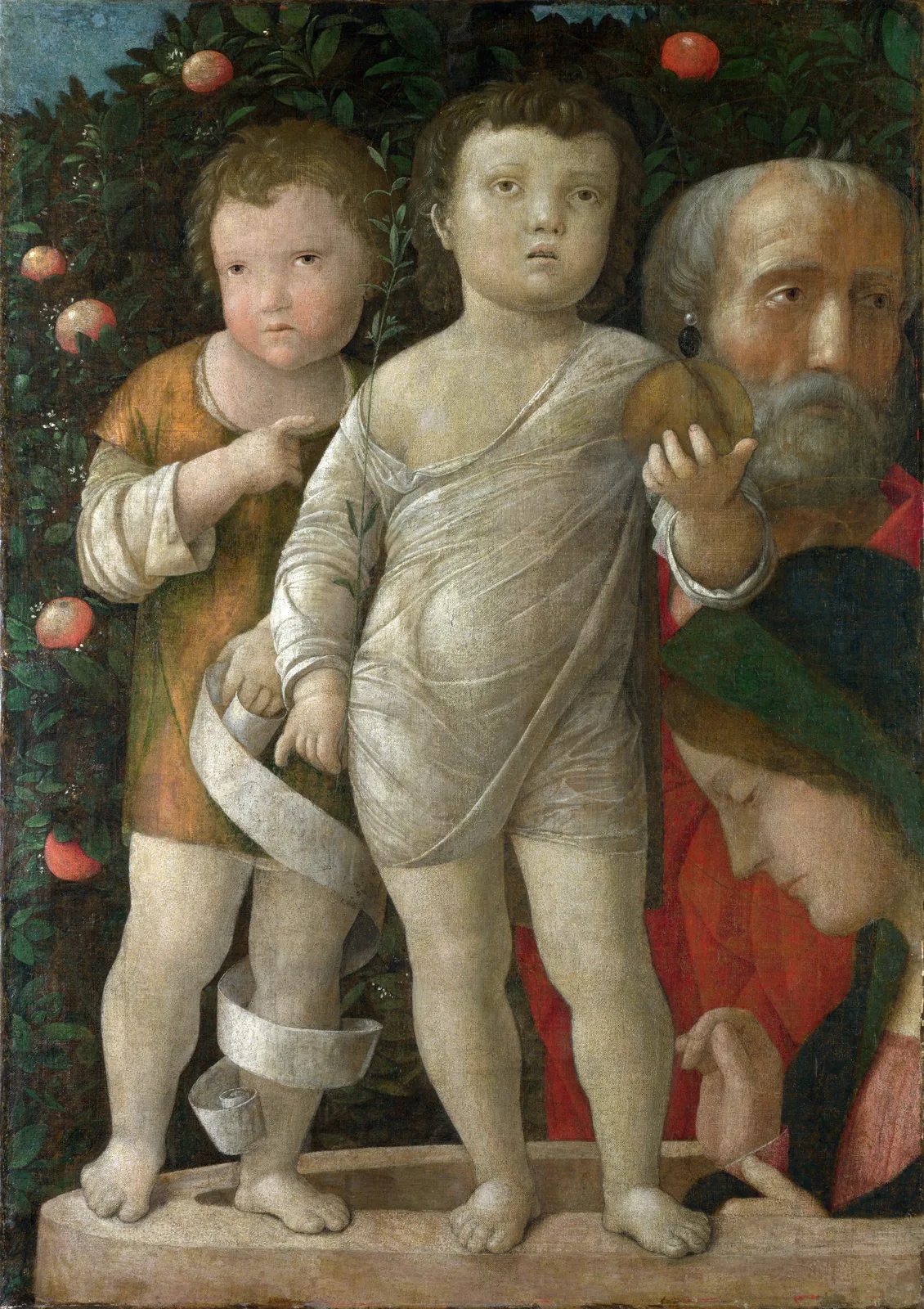
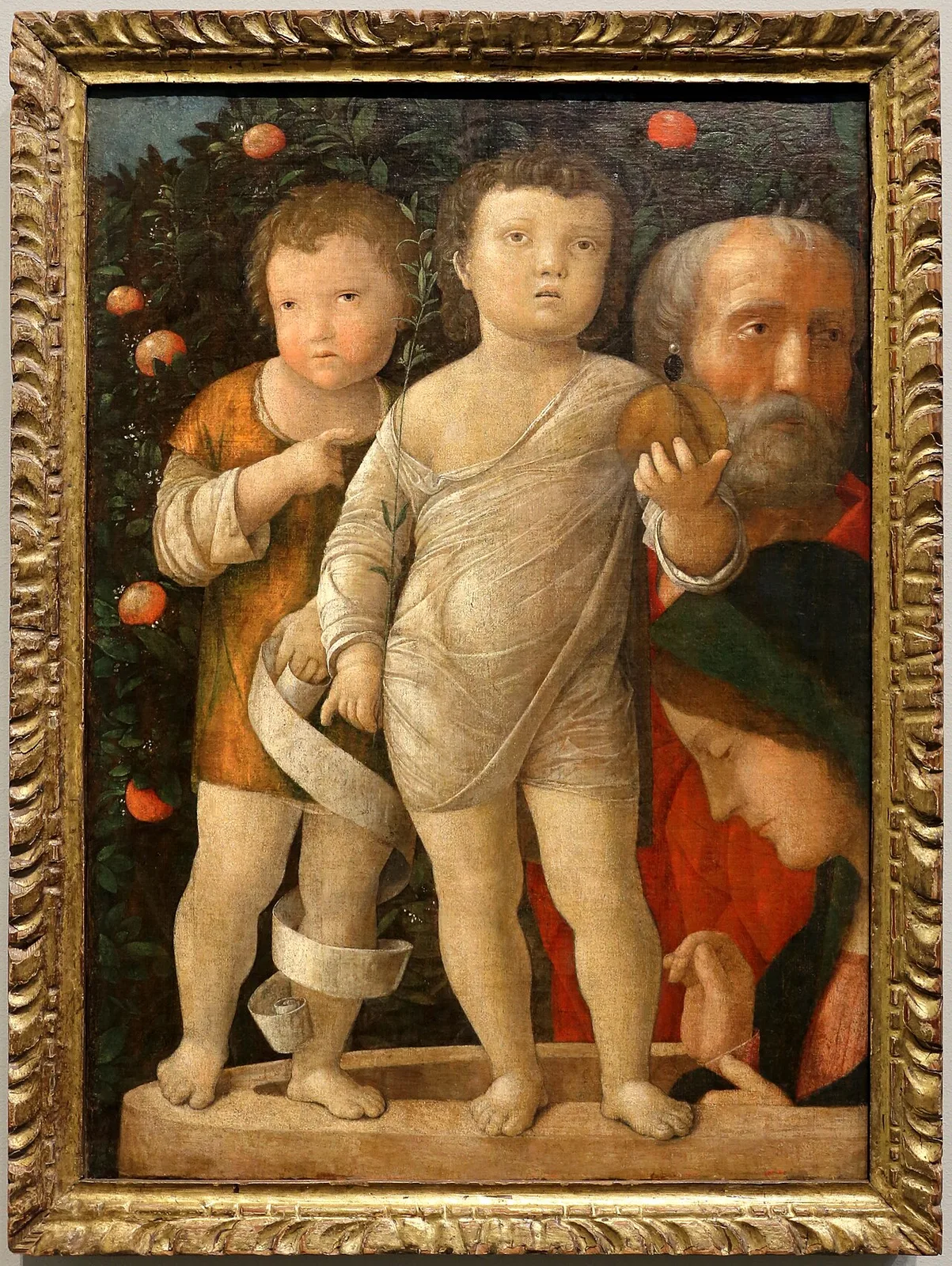
A low stone parapet runs straight across the bottom of this painting. The Christ Child and the infant John the Baptist stand on top of it. Then the same wall keeps going, left and right, and passes in front of the Virgin Mary, cutting her off at the waist. One piece of stone supports the children and shuts the mother inside it.
The picture is the Holy Family with the Infant Saint John the Baptist, tempera on canvas, 71 by 50.5 cm (roughly the size of a large laptop screen), attributed to Andrea Mantegna and dated to about 1500. It hangs in the National Gallery, London. Tempera means pigment mixed with egg yolk, which dries fast and leaves the matte, chalky surface you see here, typical of Italian painting around 1500.
The wall is the whole idea. In the Middle Ages and Renaissance, a walled garden from the Song of Songs, a biblical love poem read as a dialogue between Christ and Mary, became a standard stand-in for Mary's virginity: the hortus conclusus, Latin for "enclosed garden." Mantegna does not paint a garden. He paints a barrier, and lets the barrier say it. The National Gallery's own description puts it plainly: "The parapet on which the Christ Child and the infant John the Baptist stand also encloses the Virgin Mary, referring to the Virgin birth of Jesus and the hortus conclusus of the Virgin Mary's virginity." The children stand on the doctrine.
Follow the gestures along that same ledge. John holds a scroll in one hand and points at Christ with the other. Christ holds a sphere, a small ball standing for his power over the earth. Because the parapet lines all three figures up at one height, the pointing finger and the ball read as a single sentence: this one, and what he holds. Behind them, easy to miss, Saint Joseph stands in a red cloak, pushed back into the fruit and foliage.
One thing about this picture is not settled: whether Mantegna painted it with his own hand. The surface has survived badly, and the National Gallery notes that the poor condition leaves the autograph unclear, so some scholars will not accept the attribution. Those who do point out that the design and format clearly refer to works he certainly painted. The Madonna and Child here are identical to those in his Holy Family with Christ as Imperator mundi in the Petit Palais, Paris, and the fruit-and-foliage background recalls his Madonna della Vittoria of 1496 and the Altman Madonna of about 1495 to 1505. The case for Mantegna rests on the design matching his secure works, not on the paint as it survives.