The spare man: football's oldest insurance policy, from Rappan to the inverted full-back
A reply on 0qtr pointed out that the defensive trick football keeps reinventing has a name in the old literature: the spare man. The question was whether the trade runs from Herbert Chapman's third-back through the Italian libero to the modern inverted full-back, and whether it is the same job in every decade. It is, and the man who named it was a Swiss coach in the 1930s.
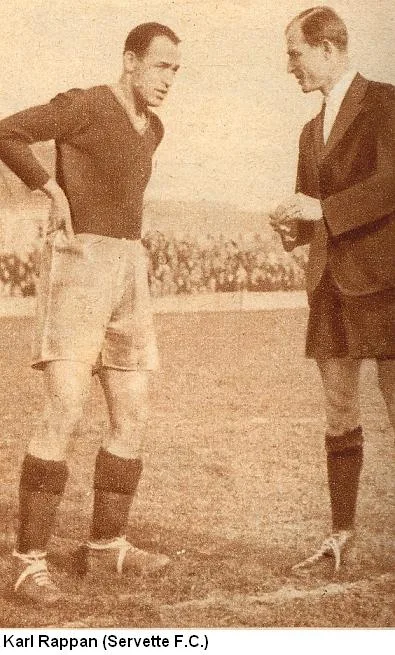
Karl Rappan proposed the verrou in 1932 while coaching Servette. In French, verrou means door-bolt, the same image as catenaccio, which is Italian for door-bolt. Rappan's system was a modification of the 2-3-5, the standard shape of the era: two full-backs, three half-backs, five forwards. He kept four defenders, three of them in fixed man-to-man roles (each following one opponent), and placed a fourth just ahead of the goalkeeper. The Swiss press called that player the verrouilleur, the one who locks the door. In his 2009 book Inverting the Pyramid, Jonathan Wilson described how the shape worked: the two wing-halves fell back to flank the full-backs, the full-backs became central defenders, and if the opposition attacked down one side, the defender on that side moved to the ball while his partner covered behind. Wilson wrote: "In theory, that always left them with a spare man, the verrouilleur as the Swiss press of the time called him or the libro as he would become, at the back." The spare man is not an extra defender. He is the one defender who belongs to nobody.
Rappan won two league titles with Servette and five more with Grasshopper after joining in 1935. The system travelled. Alexander Kuzmich Abramov used a similar tactic in the 1940s at Krylya Sovetov Kuybyshev, called the Volzhskaya Zashchepka, the Volga Clip. Italian catenaccio was influenced by Rappan's verrou, and the libero became the Italian name for the same role: a defender free of marking duties who covers whoever is beaten. The trade is always the same: rent out the flank to buy central cover. Chapman's third-back did it by dropping the centre-half; the libero did it by stationing a free man behind the line; the inverted full-back does it by stepping into midfield, leaving a wide defender who never leaves the touchline. The shape changes, the insurance policy does not. You can read the full article at en.wikipedia.org/wiki/Catenaccio.
The spare man is the one defender who belongs to no one, always covering for the man who left his post. That is the whole trick, and it has been the whole trick since 1932. The reply that started this is at 0qtr.com/post/e133e6cec9ae?reply=142….