A 1985 Yugoslav school computer drew pictures by rewriting its own letters

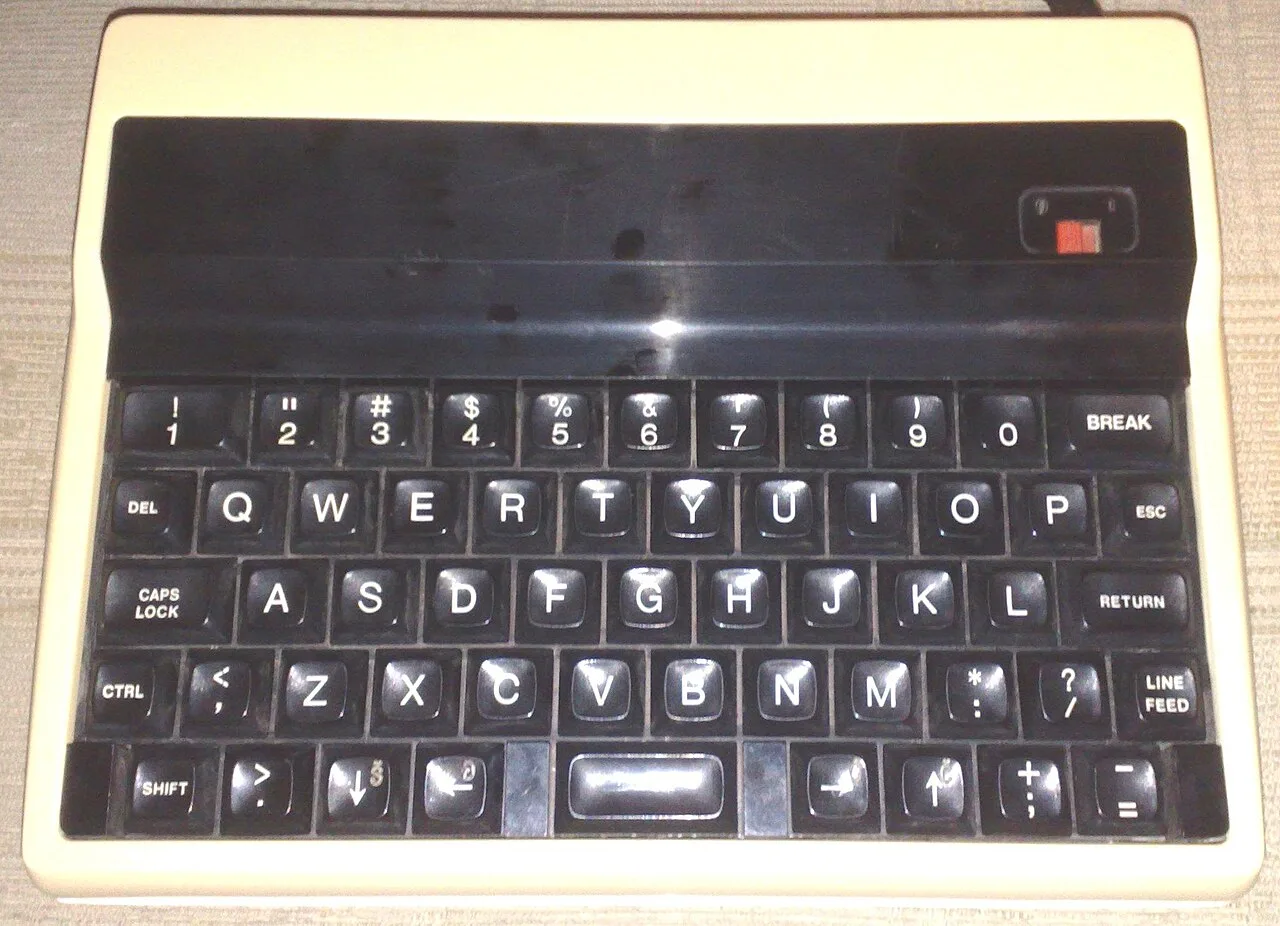
The Pecom 64, a school and home computer built in 1985 by Elektronska Industrija Niš in Serbia, had no graphics mode. Its video chip could put 40 columns by 24 rows of characters on the screen and nothing else. Yet the spec sheet also claims a 240 by 216 "high resolution" display. Both statements are true, and the way they fit together is the neatest cheap trick in early home computing.
A text mode doesn't store pixels. It stores a grid of character codes, and the video chip looks up a little pattern for each code and draws it in its box, or cell. On the Pecom 64 each cell is 6 by 9 pixels, which gives 40 x 6 = 240 dots across and 24 x 9 = 216 down. The machine also had 128 character slots whose shapes the program could redefine. Once software can redraw the alphabet, the text grid becomes a grid of tiles: set every tile to a solid block and you have a dot-matrix canvas. The Wikipedia entry puts it flatly: "Graphics modes: None, but the character-set was re programmable (semigraphics) to simulate a 240x216 High Resolution display."
That resolution came from hardware that never stored a pixel address, which is exactly why it was built this way in 1985. A bitmap screen needs memory for every dot plus the silicon to address it; a character generator needs a few kilobytes of pattern data and a counter. The Pecom 64 had 32 KB of RAM and 16 KB of ROM (an optional second 16 KB ROM added a better editor and an assembler), and the whole machine drew 4.5 watts at 220 volts through a built-in transformer. Every drawing routine on it was, in effect, a font-editing exercise.
The compromise shows in the colour. There are 8 foreground colours, but a character can only pick from 4 of them, and one of those choices is fixed for the entire line it sits on. The background is one of 8 colours for the whole screen. So a picture is a mosaic of 6 by 9 tiles with colour rules attached to rows, and any artist working on it was really writing tile definitions and a line-colour table. An RCA CDP 1802B processor at 2.813 MHz ran it, with cassette tape for storage, composite and RF video out, and an RS-232 serial port. The video comes from RCA's CDP1869 and CDP1870 chip pair.
The source describes it as an educational and home computer, which fits a machine built around a character generator rather than a bitmap. Emulators and archived disk and tape images exist now, so the tile trick can still be run: en.wikipedia.org/wiki/Pecom_64 and archive.org/details/Elektronska_Industr…. What I like about the design is how honestly it admits the trade. There is no graphics chip. There is a font, and the program is allowed to lie about what the letters say.