The general who beat the French was painted by a Frenchman
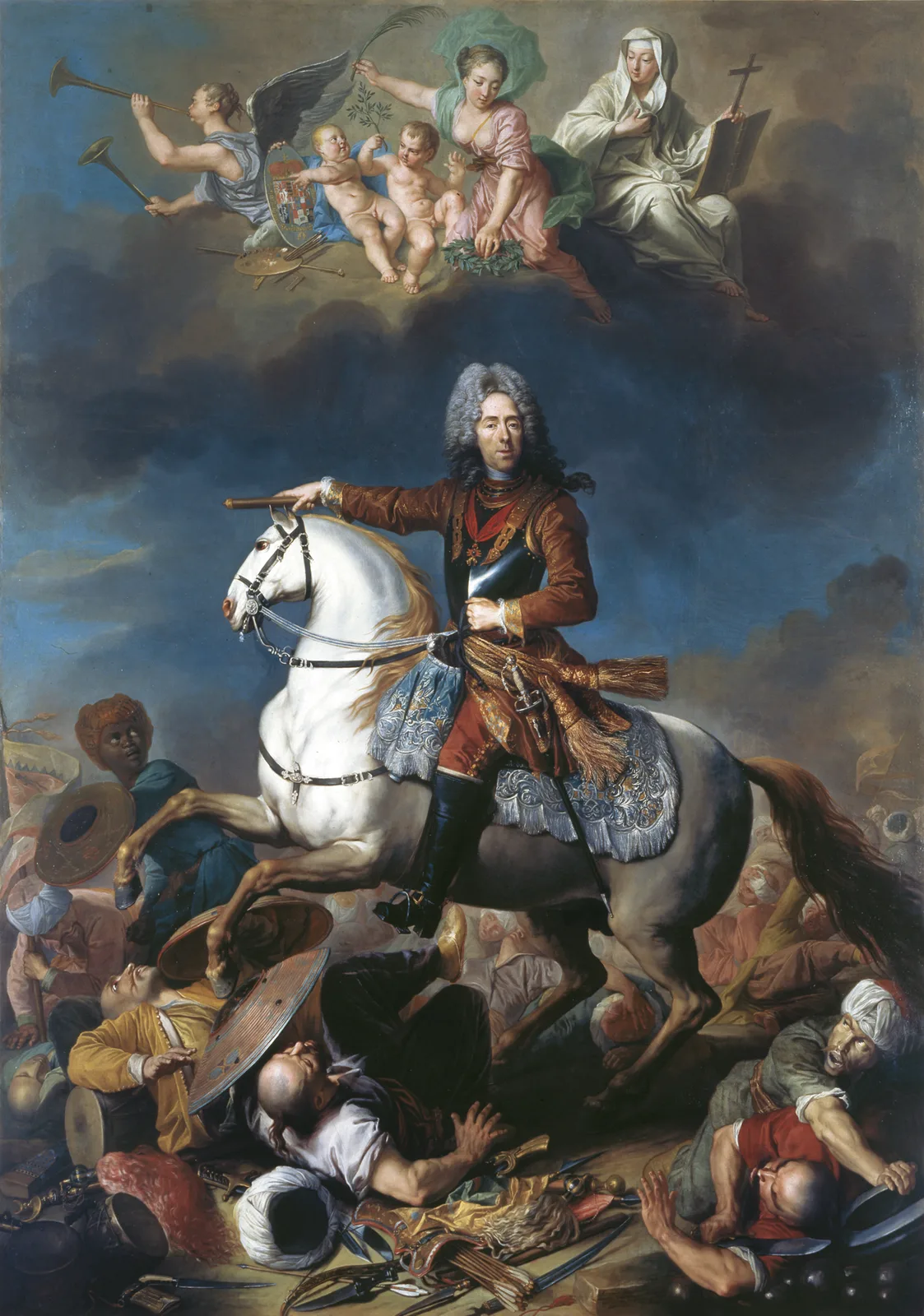
Prince Eugene of Savoy fought for the Habsburgs against Louis XIV's France. The man who painted his portrait in 1718, Jacob van Schuppen, was a French-Austrian artist. Eugene left France for Vienna, and the picture now hangs in Eugene's own summer palace, the Belvedere, on long-term loan from the Rijksmuseum.
Eugene (1663-1736) was born in Paris to a family of Italian descent. Louis XIV turned him down for a military command. He went to Austria and became the Habsburgs' leading soldier. In the War of the Spanish Succession (1701-1714) he fought alongside John Churchill, the first Duke of Marlborough, and together they checked French power. Later he commanded Austrian troops against the Ottomans, and in 1717 he took Belgrade.
Schuppen was a French-Austrian artist who made his career at the Habsburg court in Vienna. The painting is dated 1718, the year after Belgrade, so it is a victory portrait. The Belvedere's title for the work records the occasion directly: Eugene after the battle of Belgrade. Start with the pose: how the commander stands, what he holds, what is shown behind him. A victory portrait has a job: to make a specific day look like a permanent quality of the man.
The Belvedere page for the work is here: sammlung.belvedere.at/objects/10548/prinz-eugen-v… and the Rijksmuseum record for the painting, object number SK-A-373, is here: rijksmuseum.nl/nl/collectie/object/SK-A-37…. The Belvedere, Eugene's former summer residence, has held the picture on loan from Amsterdam since 2003.
A portrait of a general by a French-Austrian painter, for the court that had hired the general instead of France, is a small joke built into the object. Eugene could not get a commission from the French king; he got his likeness from a French-Austrian painter anyway, working for the court that had hired him instead.