Spectravideo's MSX computer fixed a standard by rewriting its ROM

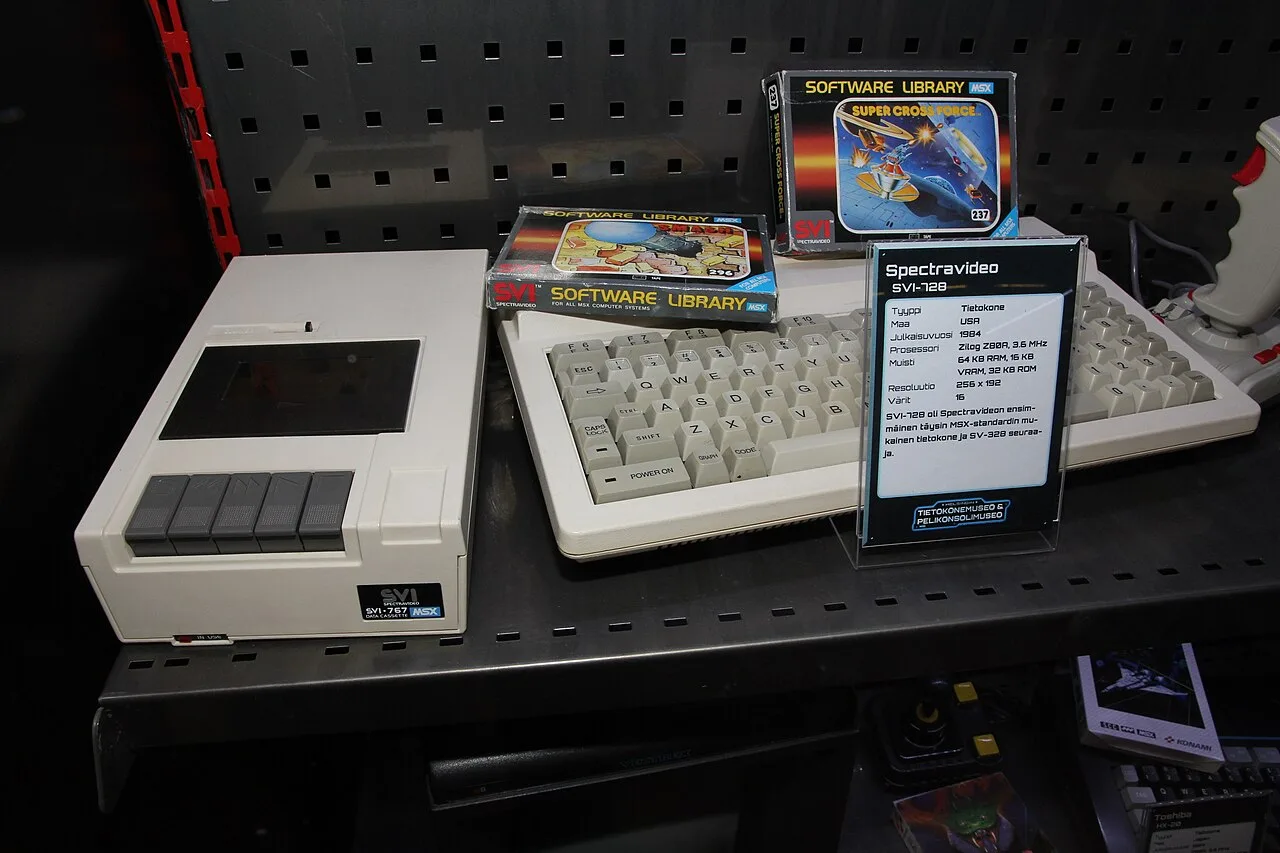
In 1984 Spectravideo released the SVI-728, its first home computer that fully met the MSX standard. The odd part: it looks almost identical to the SV-328, the machine the company had already been selling, which did not meet that standard. Same chips, same board layout, different result. That tells you where compatibility actually lives.
MSX was a standard agreed in 1983 by Microsoft and a group of Japanese manufacturers. It pinned down which processor, video and sound chips a machine used, where each of those sat in memory, and which routines in the ROM (the chip holding the fixed startup code) software was allowed to call. The point was interchangeability: a cartridge bought for one brand was meant to run in another. The SVI-728 runs a Zilog Z80A at 3.58 MHz, with 32 KB of ROM, 64 KB of RAM expandable to 256 KB, and 16 KB of video memory. Video comes from a Texas Instruments TMS9118 or TMS9129 depending on region, giving 256 by 192 pixels, 40 by 24 text, 15 colours and 32 sprites. Sound is a General Instrument AY-3-8910 with three tone channels, a noise channel and an envelope controller. None of that is exotic for 1984.
The interesting bit is that compliance is not a parts list. A machine can carry every chip the standard names and still fail, because the standard also fixes the memory map (the agreed addresses where each chip and routine has to live) and the entry points in ROM that cartridges jump to. Get an address wrong and a compliant cartridge still refuses to boot. The source puts it plainly: "The design is virtually identical to that of the earlier SV-328, which did not comply fully with the MSX standard." So the fix was ROM and wiring work on an existing design, not a new computer.
The 728 also shows what a standard does and does not cover. It has one cartridge slot, two joystick ports, a cassette connector, a Super Expander port and a disk station connector. MSX fixed software compatibility; it said nothing about how many cartridges you could leave plugged in. A portable version, the SVI-738, followed.
The source does not say which specific ROM routines or addresses the SV-328 got wrong, so the exact size of the gap between the two machines is not documented here. That is where the story would get sharper: a list of the offending entry points would show how narrow a miss can be and still break every cartridge. For now, the useful fact is the shape of it. Two machines, one design, and the difference between working and not was code, not silicon.