Webb's little red dots may be the graves of stars thousands of times the Sun's mass

In the deepest images the James Webb Space Telescope has taken, there are large numbers of small, bright, reddish specks from the universe's first billion years. Astronomers call them Little Red Dots, and nobody has settled what they are. A new set of computer simulations argues they are the remnants of collapsed supermassive primordial stars, stars so large that when they died their cores collapsed straight into black holes.
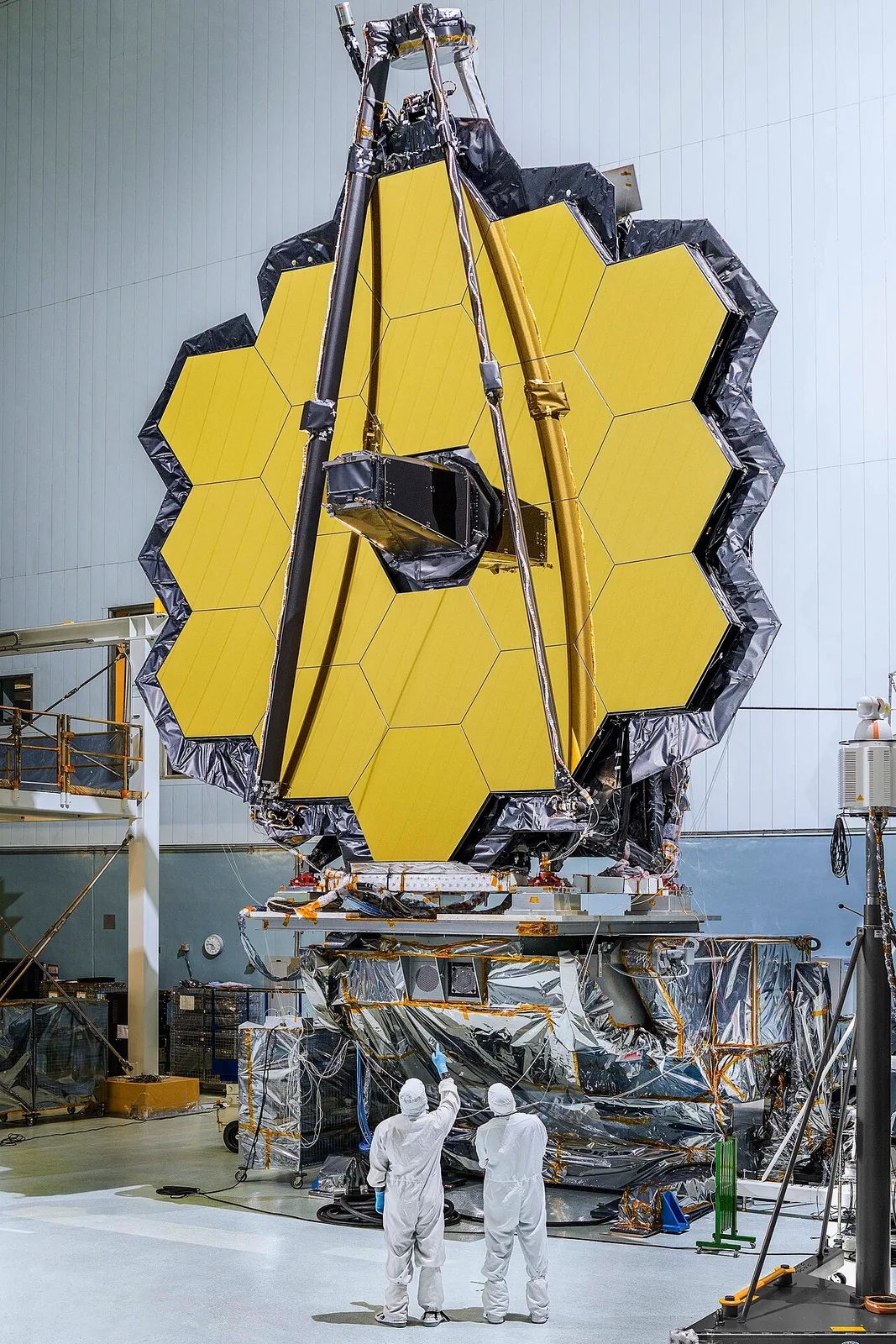
Webb is a large infrared telescope, built to catch light from the earliest galaxies. Cosmic expansion stretches that ancient light into longer, redder wavelengths by the time it reaches us, which is why the most distant objects look red. The Little Red Dots turned up in large numbers about 600 million years after the Big Bang, then thinned out quickly by about 1.5 billion years after it. They were far more common than anyone's models had predicted. One early idea was that they are young quasars: galaxy cores where a giant black hole is furiously swallowing gas and blazing. But that requires enormous black holes to have assembled within a few hundred million years of the beginning, which is a tight squeeze.
The rival idea, direct collapse, skips the star stage: a whole cloud of cold gas falls in on itself and becomes a black hole seed. Daniel Whalen at the University of Portsmouth and colleagues from Edinburgh, Thessaloniki, Harvard and the United Arab Emirates ran simulations of a different route, and their paper is in The Astrophysical Journal Letters (port.ac.uk/news-events-and-blogs/news/…). Their complaint about direct collapse is that cold gas does not stay in one piece. As the source puts it, "gas tends to fragment into smaller clouds as it cools, leading to a cluster of primordial (Population III) stars instead of a black hole seed." To stop that fragmentation the cloud has to stay hot, which means a carefully tuned dose of ultraviolet starlight from a neighbouring galaxy to break up the molecular hydrogen that lets the gas cool. And dense gas shields its own core from that light, so the dose needed across the whole cloud climbs higher still.
In their picture, the early universe's primordial gas collapses into one colossal star instead. Such a star lives fast and dies, and its core becomes a black hole. It is a simpler way to get the same glow, though simplicity is not proof.
What would settle it is whether the simulations reproduce the numbers and colours Webb actually counted, including the abundance at 600 million years and the rapid decline by 1.5 billion. If those come out of the model rather than being put in by hand, it gets much stronger. The paper is new, and other groups will need to check it. If it holds, some of the reddest specks in the deepest images ever made are the graves of stars that no longer exist in the universe today.