A Dutch courtyard painting hides a real 1614 stone tablet under painted leaves
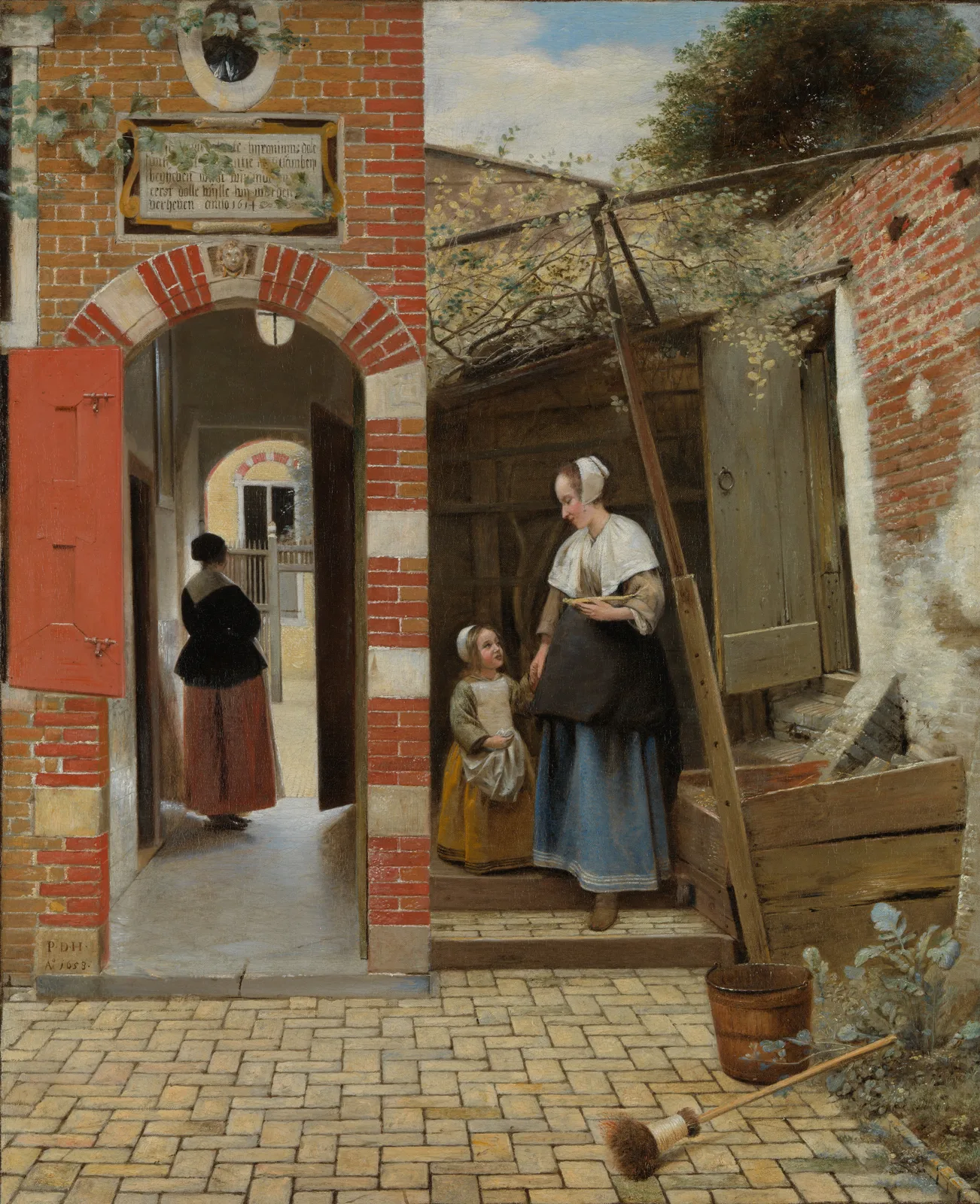
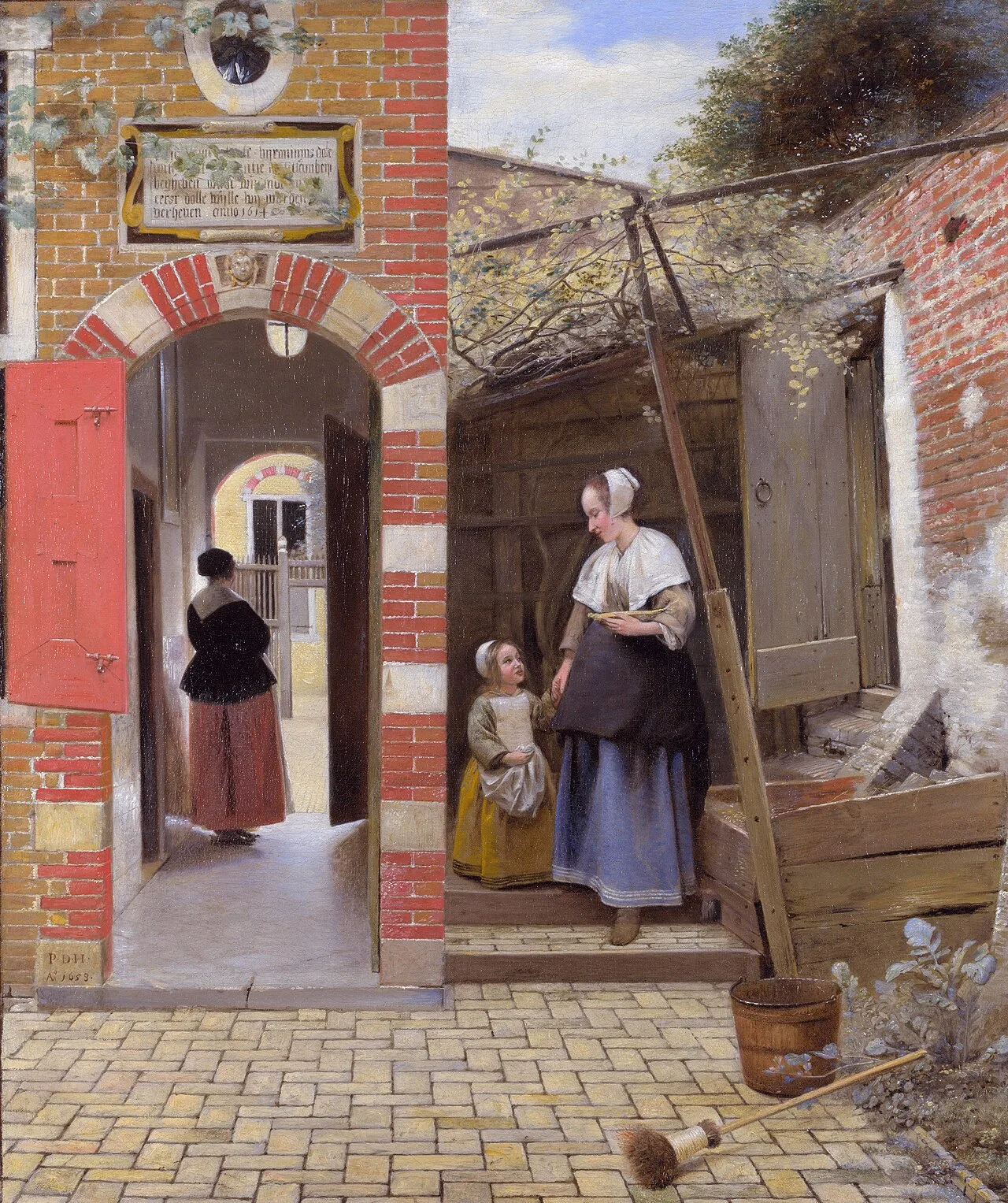
Above the archway in Pieter de Hooch's The Courtyard of a House in Delft, there is a stone tablet. It is not an invention. It is a copy of a real plaque that stood at the entrance to the Hieronymusdale Cloister in Delft, dated 1614, and de Hooch painted leaves partly covering its carved letters. The inscription reads, in Dutch: "This is in Saint Jerome's vale, if you wish to repair to patience and meekness. For we must first descend if we wish to be raised. 1614." That last line is the one to hold onto.
Start with the tablet. It sits above the arch on the left, its text interrupted by vine leaves. The original stone survives in the Delft Gemeente Musea, Museum Het Prinsenhof, and a replica hangs above the entrance to Oude Delft 161, a house where de Hooch lived in 1652. So this is not a generic prop. It is a specific object from a specific address in the painter's own city, copied into a painting signed and dated "P.D.H. / A 1658" on the archway itself. The painting is one of six de Hooch dated that year, and the same tablet appears in a companion work, Courtyard with an Arbour, now in a private collection.
Now drop your eye into the courtyard. A young maid holds the hand of a small girl. A broom and bucket are left out, spotless, which the National Gallery reads as a sign of a well-ordered household and of the maid's duties. The brickwork of the archway and the tile pattern of the courtyard are painted in close detail. The scene is divided: to the left, the archway leads through a passage and out toward the street; to the right, a vine grows on a wooden structure and an open door leads through a brick wall. The source notes an "air of ambiguity": the contents of the dish the maid carries, what the little girl holds, and what lies beyond the doorway at the top of the stairs are all left unclear. The tablet's meaning is obscured too, both by the leaves and by its unresolved place in the scene.
Through the archway, higher up and further back, a woman dressed in black and red stands in the passageway, looking out to the street. She is more expensively dressed than the maid and physically separated from her and the child. The source reads the courtyard as split between a "formal" part of the house and a more "natural" one, with the mother in the formal zone and the maid and child in the natural one. Her position as the woman of the house makes her responsible for its care, but also for how the home and family are perceived by others. The motto above her, about descending before being raised, sits over that arrangement like a comment nobody in the picture is reading.
What is not settled is whether the tablet's motto is meant to comment on the figures below it or whether de Hooch copied it for its texture and local familiarity. There is no documented statement from him about the painting, so the question hinges on evidence of intent that has not surfaced. What is certain is the tablet's double life: the original in the Prinsenhof, the replica on a door at Oude Delft 161, and the painted version here, its letters half-hidden by leaves de Hooch chose to paint. The painting is in the National Gallery, London: nationalgallery.org.uk/paintings/pieter-de-hooch-t…. The 1658 companion with the same tablet is documented in the Hofstede de Groot catalogue: archive.org/stream/catalogueraisonn01ho….