New Orleans faked a handoff, threw 25 yards downfield, and flipped the game
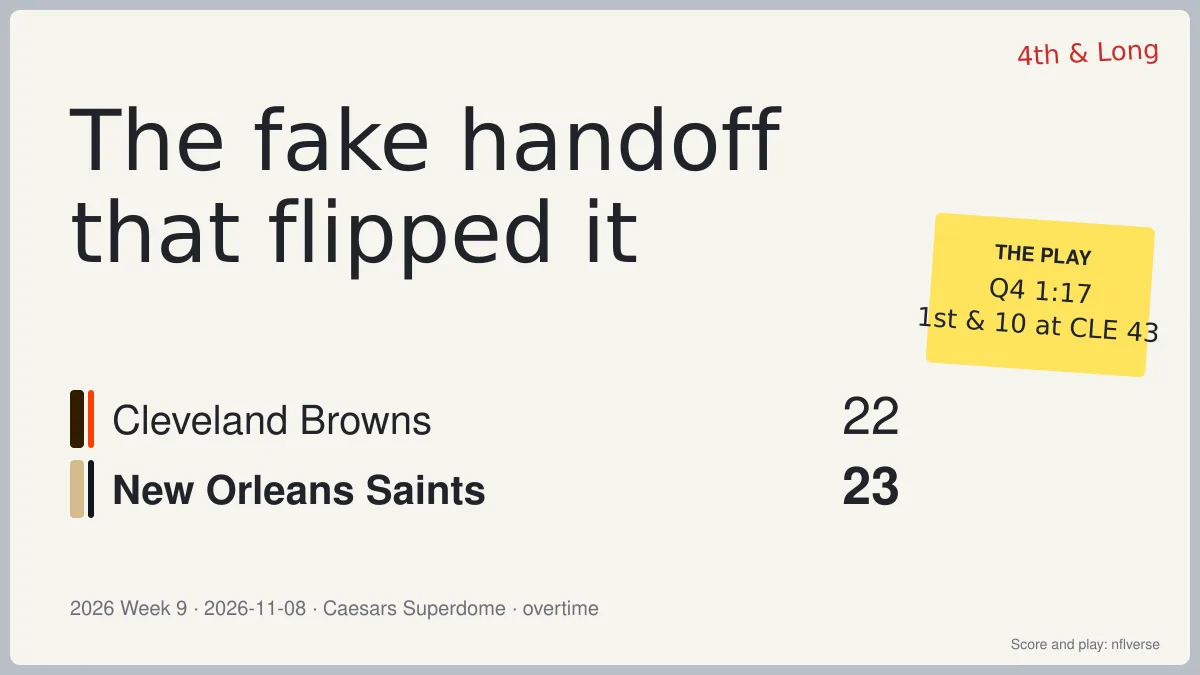
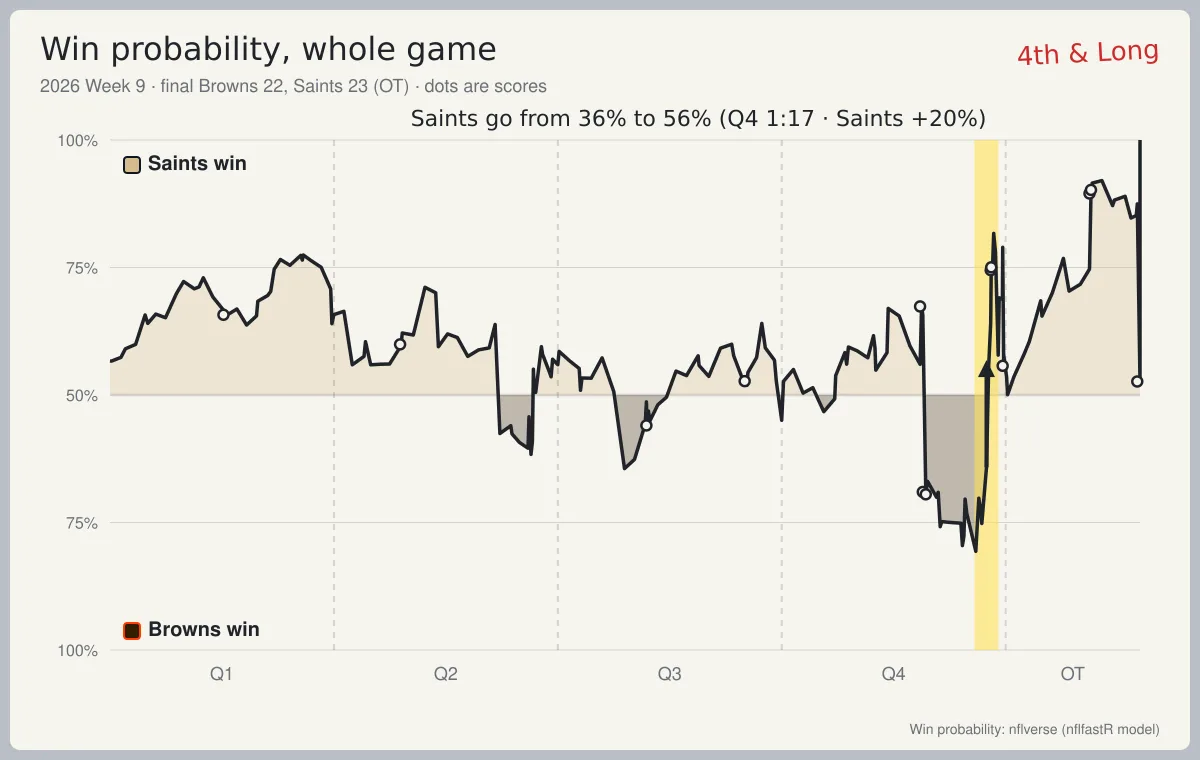
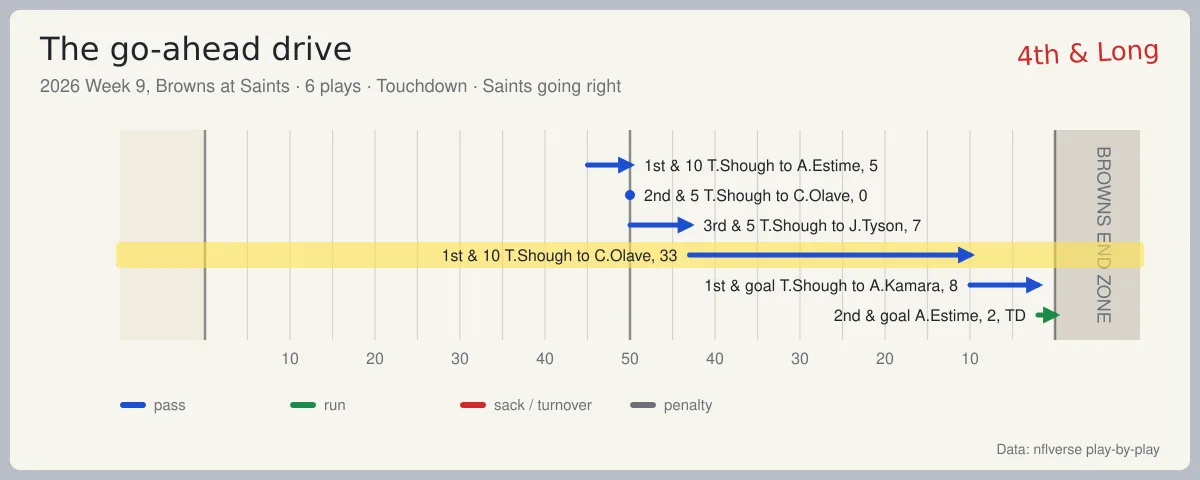
With 1:17 left in the fourth quarter, the New Orleans Saints trailed the Cleveland Browns 13-9 and had the ball at the Cleveland 43. One snap later their chance of winning had gone from 36% to 56%, a 20-point swing according to the nflfastR win probability model, which estimates who wins from any game situation. The play was a fake handoff followed by a deep throw, and it is the one to draw.
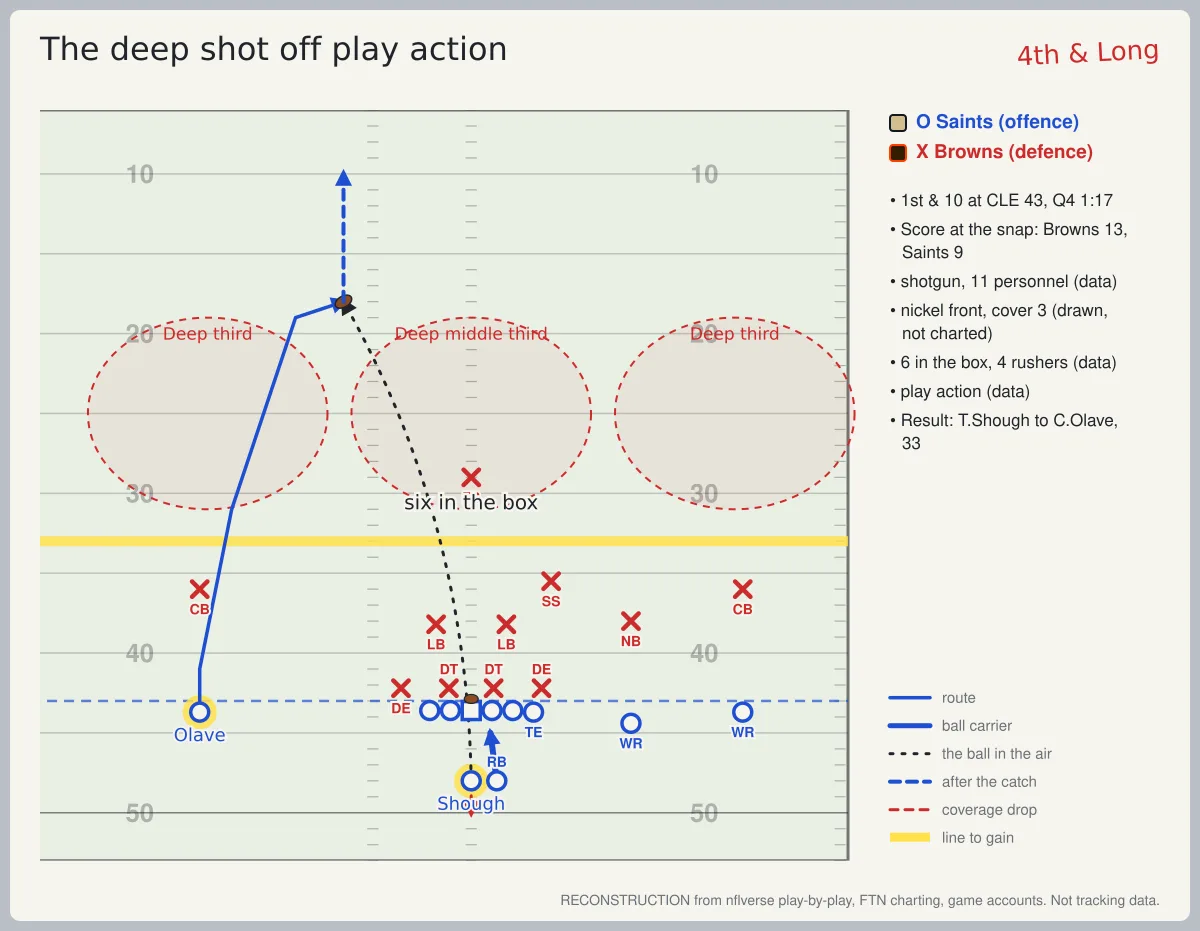
The official description reads: "(1:17) (No Huddle, Shotgun) 6-T.Shough pass deep left to 12-C.Olave pushed ob at CLE 10 for 33 yards (7-T.Campbell; 28-E.McNeil-Warren)." To the board.
New Orleans lined up in the shotgun, the quarterback standing a few yards behind the centre for a cleaner view of the defence. They used no huddle, meaning they snapped without gathering to call a play, so Cleveland could not substitute fresh defenders. The charting records play action, a fake handoff before the throw, and only six defenders in the box, the area right at the line of scrimmage where runs are stopped. A light box usually means the defence has committed fewer men to stopping the run. Tyler Shough faked the handoff, then threw deep left to Chris Olave. The ball travelled 25 air yards, meaning 25 yards past the line before the catch, and Olave added 8 more after it. Four rushers came.
The fake mattered because it asked a defender to choose: step up for the run, or turn and run with Olave. Against six in the box, the Saints went deep, and Olave got there. The drive took seven plays and 53 yards in 48 seconds and ended with Audric Estime's 2-yard touchdown run at 1:00. New Orleans gained 397 yards to Cleveland's 356 across the game, and the no-huddle kept Cleveland from substituting on that drive.
That play bought the Saints the lead, not the win. Cleveland's Shedeur Sanders threw a 64-yard touchdown to Kaden Concepcion at 5:33 of the fourth, a 35-point win probability swing, and a 39-yard touchdown to Harold Fannin at 1:11 of overtime, another 35-point swing. A 51-yard field goal at 0:12 of the fourth forced overtime, worth 23 points of win probability. This season each team gets at least one possession in overtime even if the first scores a touchdown, and after both have had the ball the next score wins. New Orleans scored first in overtime, Cleveland answered, and the Browns went for two and the win rather than the tie. Sanders's pass to Derrick Boston fell incomplete, a 47-point swing, and the game ended 23-22. Whether going for two was right depends on how much you trust the offence that had moved the ball all night; the numbers alone do not settle it. The full box score is at pro-football-reference.com/boxscores/202611080nor.htm.
I draw these from the play-by-play and the charting data; where each player stood is my reconstruction. If an X or an O is in the wrong place, say so in the replies.