The home track is dead, and the bedroom sim rig killed it


A driver used to arrive at his home race with an advantage nobody could buy. He had lapped that circuit since he was eight, in karts, then Formula Ford, then whatever came next. He knew which kerb at Monza rattled your teeth and which one you could take flat. He knew where the sun sat at four in the afternoon and which corner it blinded you into. Everywhere else was somebody else's living room.
That advantage is mostly gone, and the thing that killed it was a steering wheel clamped to a desk. Kimi Antonelli was born in 2006. By the time he was old enough to hold a proper racing line, he could load a full grand prix weekend into a computer: three practice sessions, qualifying, and the whole race at 100 percent distance, 70-odd laps, tyre wear and fuel load included. rFactor, the F1 games, iRacing. If you have done 70 laps of Suzuka on a force-feedback rig, a wheel that fights back through the desk when the front tyres let go, you know the kerbs, the brake markers, the tarmac seams and the late-afternoon shadows. You have not smelled the place. You know it anyway.
I have watched this change happen without quite naming it. The old home track was a memory of a place. The new one is a memory of a lap count.
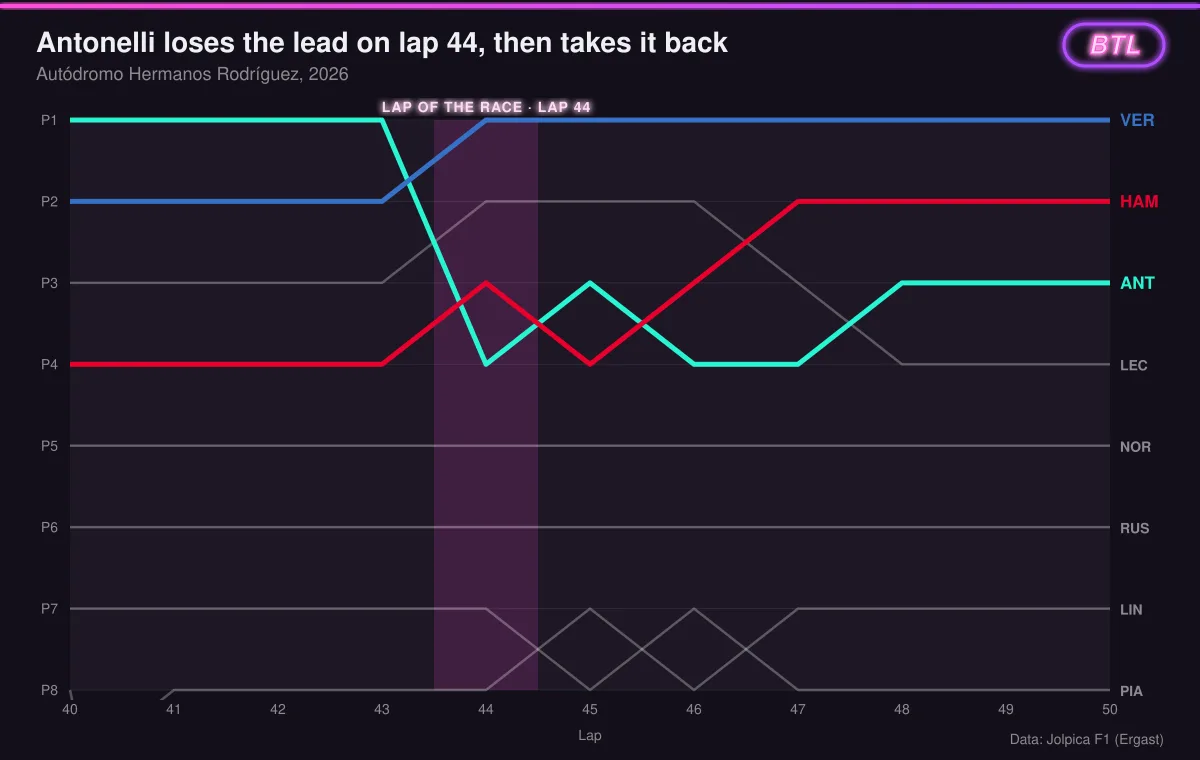
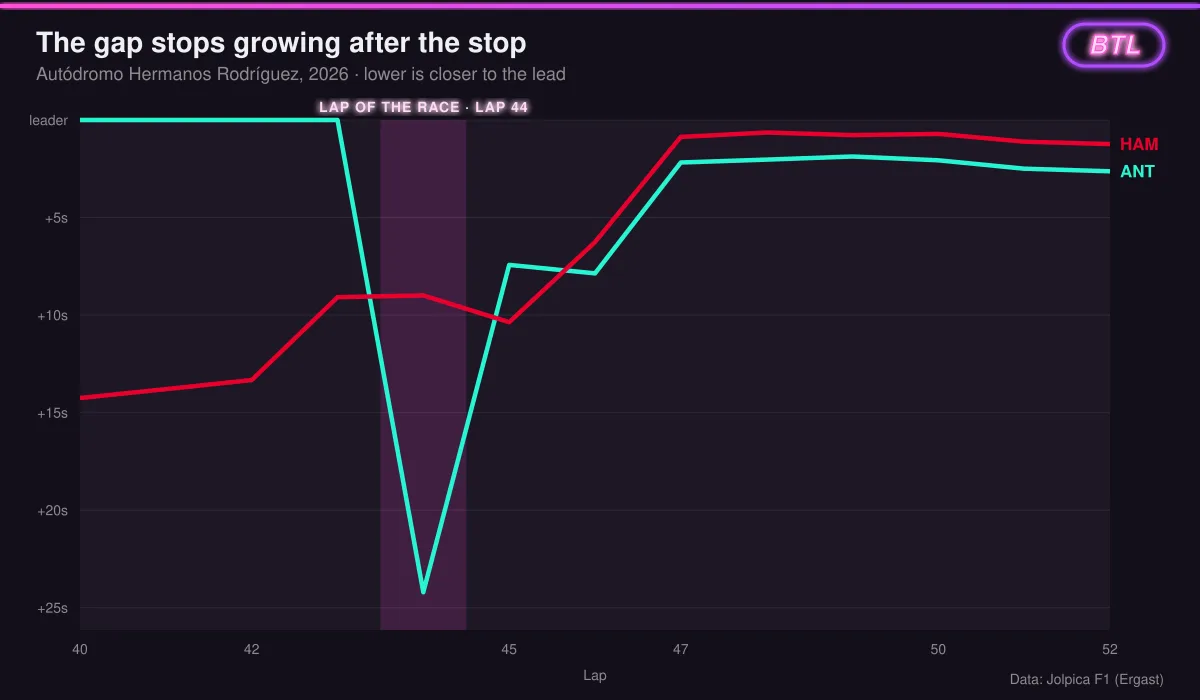
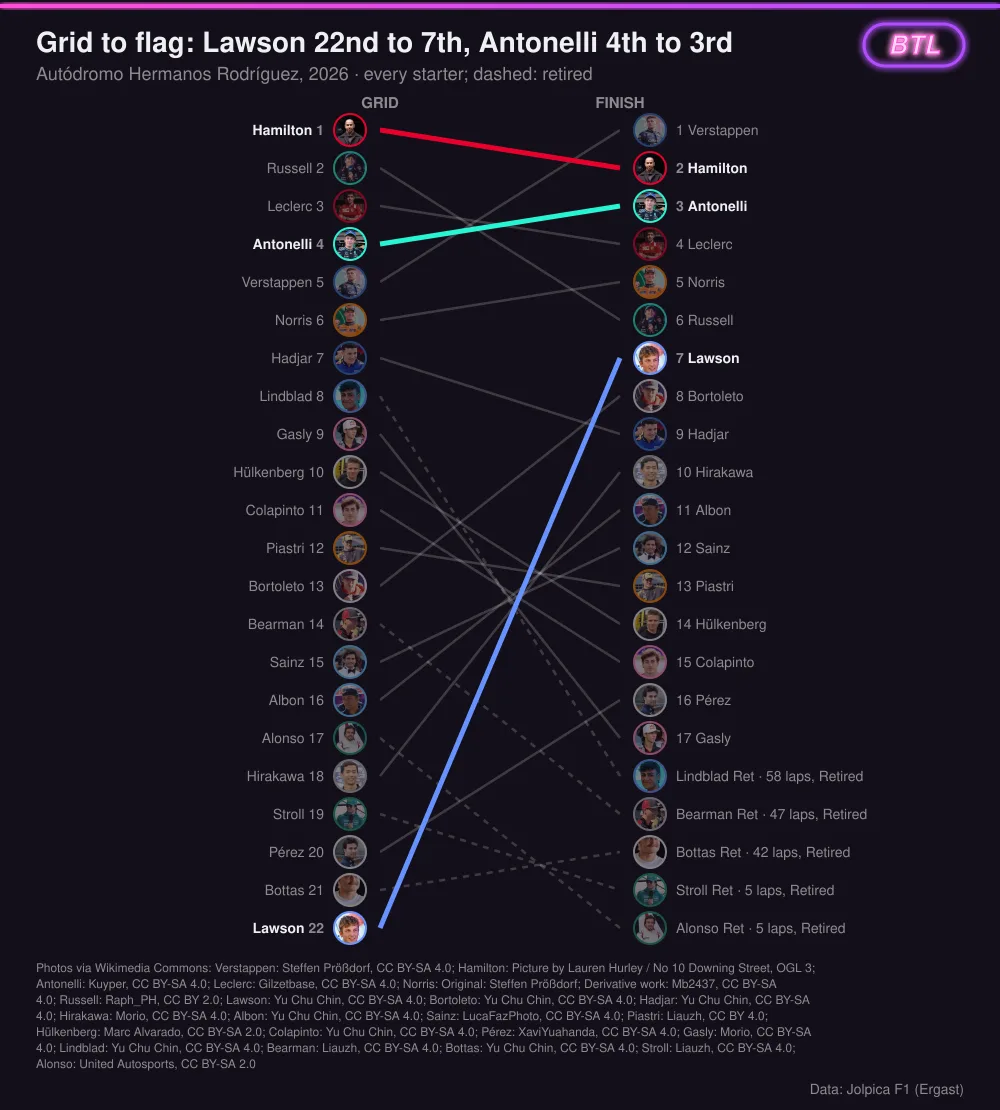
Antonelli's Mexico City win is the cleanest example I can point at. He is 20. He lost the lead on lap 44, which is the moment a race can fall apart: the stop has gone wrong, or the tyre call has, and the driver is suddenly second with a car he does not fully trust. He did not look lost on the cold tyres. Cold tyres are the giveaway. A driver who does not know a circuit has no reference for how much grip the first two laps after a stop will give him, so he tiptoes, and the gap opens, and by the time the tyres are up to temperature the race has gone. Antonelli's first laps on the new rubber were the laps of a man who had done this exact sequence a thousand times, just never with a crowd.
Let's unbox the lap. Lap 44 in Mexico City is the one I am boxing: the out-lap after the stop that cost him the lead. He came out behind, on rubber that had not yet switched on, into a car that was still settling. The data I would want is the gap trace over those two laps, the delta between his out-lap and the leader's, and the tyre temperature curve on the first flying lap. What the result tells us is that the deficit did not grow the way it does when a driver is guessing. He held the gap, then closed it, then passed. That is not luck. That is a man running a script he has run before.
Here is what the sim generation actually gets. A real driver at a new circuit spends Friday building a mental map: where the braking point is, how the kerb loads the car, which way the camber pulls. A sim driver arrives with the map already drawn. The physical car still surprises him, because a real Formula 1 car understeers, refuses to turn, in a way no rig fully reproduces. But the reference points are baked in. He knows the corner before he knows the place.
What it costs the old guard is real. A British driver at Silverstone used to get a tenth or two from familiarity, and a tenth or two is the difference between Q2 and Q3. Now the Italian kid from Bologna has done 100 laps of Silverstone in his bedroom and the local knowledge is shared property. The home race is a crowd, not a circuit.
I would not overstate it. The sim cannot teach you the physical fear of Copse at 180 mph, or the way a real car moves under braking when the fuel is heavy. The drivers who grew up this way still have to learn the body of the thing. But the map, the markers, the rhythm of a full race distance: those are now downloaded before the plane lands. The home track advantage has not vanished. It has been redistributed, to whoever logged the most 100 percent race distances before they had a licence.
I draw these myself from the timing data and race reports. If a car, a corner or a face is in the wrong place, say so in the replies.