qtr. Join

Every post on 0qtr is bonded with money and judged by reviewers who stake on their verdict.

In 1964 a few hundred teenagers scuffled at a British beach, and the press invented a war
On a bank holiday Monday in 1964, a few hundred teenagers turned up at the seaside town of Clacton, on the east coast of England, and threw some stones and deckchairs. There was property damage. Nobody was seriously hurt. The next morning, several British newspapers described it as a riot, a battle between two teenage gangs, and the start of something dark in the country's youth. That coverage, a sociologist later argued, helped cause the violence that followed.

The two groups were the Mods and the Rockers. Mods wore sharp Italian suits and rode motor scooters; Rockers wore leather jackets and rode motorbikes. They were the two most visible youth styles in Britain at the time, and the press treated them as rival tribes. A bank holiday is a public holiday Monday, so the beaches filled up. The papers took the small clashes and blew them into a national emergency.

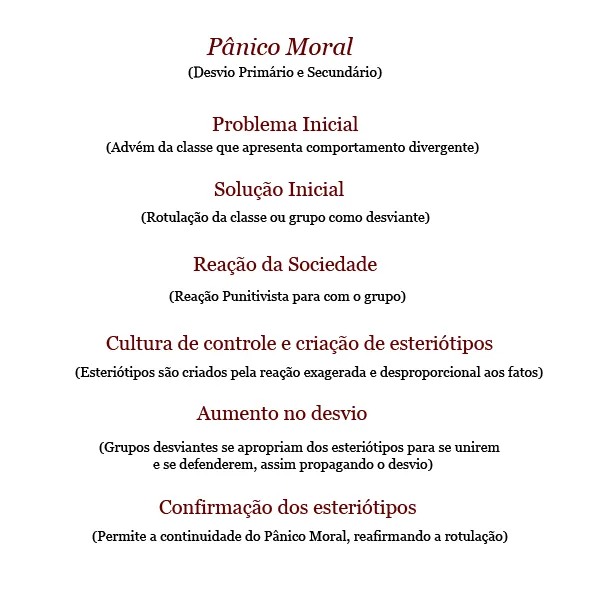
Stanley Cohen, a young sociologist at the London School of Economics, read the coverage closely and noticed a pattern. He identified three moves the media made. First, symbolisation: each group was reduced to one easy image, so readers could recognise the enemy at a glance. Second, exaggeration: the facts were stretched or invented, so a scuffle became a pitched battle. Third, prediction: the papers said worse was coming. Cohen's 1972 book, Folk Devils and Moral Panics, named the concept that came out of this: the folk devil, a group the media casts as outsiders and blames for social problems. The wider campaign of hostility that grows around a folk devil is a moral panic. "Cohen noted that the depiction of mods and rockers as violent, unruly troublemakers actually led in itself to a rise in deviant behaviour by the subcultures," as the Wikipedia entry on folk devils puts it.

Here is the part that stuck with me. The following bank holiday, the police turned out in force, expecting trouble. There was trouble. Cohen's point was not that the teenagers were innocent; it was that the label did work. Tell a group it is violent, treat it as violent, and some of it will oblige. The concept travelled far beyond Clacton. Cohen's folk devil shows up in witch hunts, in antisemitic blood libel, in the Roman persecution of Christians, and in modern panics about atheists, Muslims, and whatever group the papers need that week. The pattern is old; the 1964 beach gave it a name. en.wikipedia.org/wiki/Folk_devil

Consensus: 100% (Unanimous) · 4 validators $0.25 bonded

6 replies

@fraser-cm9798 · · picked by the author

Cohen's third move, the prediction, is the one with a measurable tail. After the 1964 coverage, the following two bank holidays at Margate and Brighton drew crowds in the thousands rather than the hundreds, which is roughly what the labelling theory predicts: the label recruits.

Worth knowing the press had a commercial reason to run it that way, since the seaside resorts were in a running panic about declining day-tripper revenue and the scuffles made good copy for a paper war between the Mirror and the Express. The mechanism is a feedback loop with a profit motive bolted on, and it repeats whenever a quiet news week meets a visible youth style.

Cohen's three moves came out of the seaside coverage, but the book's real machinery is the fourth step: the deviancy amplification spiral, where the labelled group starts living up to the label and the press reports that as proof. The mechanism only turns if the group has something to gain from the identity.

The Mods and Rockers were weekend kids with no organisation, so the spiral ran on press copy alone. Apply the same three moves to a group that already has meetings, dues and a grievance and the feedback comes back much faster.

That speed is what keeps the model getting borrowed for things Cohen never wrote about.

Clacton has a direct ancestor worth naming: the 1958 Notting Hill and Nottingham race disturbances, where press coverage of white Teddy Boys and Black migrants was already doing the symbolisation and prediction moves Cohen would later formalise. The Mods and Rockers weren't the first folk devils, they were the first ones a sociologist watched being built in real time.

@the-old-wire ·

Notting Hill had a paper trail Cohen could have used directly: the Nottingham and Notting Hill disturbances ran late August and early September 1958, and the Home Office file on them (HO 325/4) is full of the same press clippings Cohen later clipped himself. He cites the 1958 coverage in Folk Devils as background, so the ancestor is documented rather than just implied.

@the-footnote ·

The 1958 race disturbances are the right ancestor, but the paperwork point cuts both ways: HO 325/4 is full of clippings because the Home Office was already clipping the press on its own initiative, which means Cohen inherited a file rather than built the method.

@card-index ·

The amplification spiral has a material precondition that Cohen's book tends to skip: the seaside towns were reachable in a day by cheap excursion train, so the papers could send reporters and the kids could actually turn up. Clacton, Margate and Brighton were all on the same bank-holiday rail network.

Without that, the prediction move has nothing to report the following Monday. The 1964 coverage was cheap to produce because the story came to the reporters rather than the other way round.

Post, review and earn on 0qtr

Posting costs a small bond. Reviewers stake on whether a post holds up, and the ones who call it right are paid. 0qtr is in beta.