Walter Crane's socialist cartoons came with their own labels

The most famous monster in Victorian socialist cartooning wears its own name tags. In Walter Crane's The Vampire, a labourer lies collapsed on a pile of rubble while a winged creature savages him, and the creature's wings are printed with the words "Religious Hypocrisy", "Capitalism" and "Party Politics". A viewer who has never read the article the cartoon first appeared beside can still tell exactly which wing is which.
That was the point, and it is why the picture survived being moved. Crane (1845-1915) was a children's book illustrator and a leading figure in the Arts and Crafts movement, and from 1885 he drew socialist cartoons for three radical weeklies: The Clarion, Justice and Commonweal. In a weekly paper a cartoon gets a page of argument next to it. In a bound album it gets nothing, so the picture has to carry its own key. Crane's 1896 album Cartoons for the Cause did the carrying: twelve full-page plates, plus two poems and a fable, gathered from a decade of those weeklies. The Public Domain Review has just published a collection essay on it (publicdomainreview.org/collection/walter-crane-car…).
The album was a souvenir of the International Workers' Congress held at Queen's Hall on Langham Place in July 1896, and the congress was a shambles. The published proceedings admit it: "It was Babel and Bedlam rolled into one" (archive.org/details/Proceedings_Of_The_…). The 775 delegates were joined by George Bernard Shaw, Emmeline Pankhurst, Peter Kropotkin, Rosa Luxemburg, Clara Zetkin and Jean Jaures, and the fight was over anarchists. They had been expelled at the Zurich congress of 1893, and several had slipped back in as trade unionists. Fights ensued. So the delegates went home with a picture book.
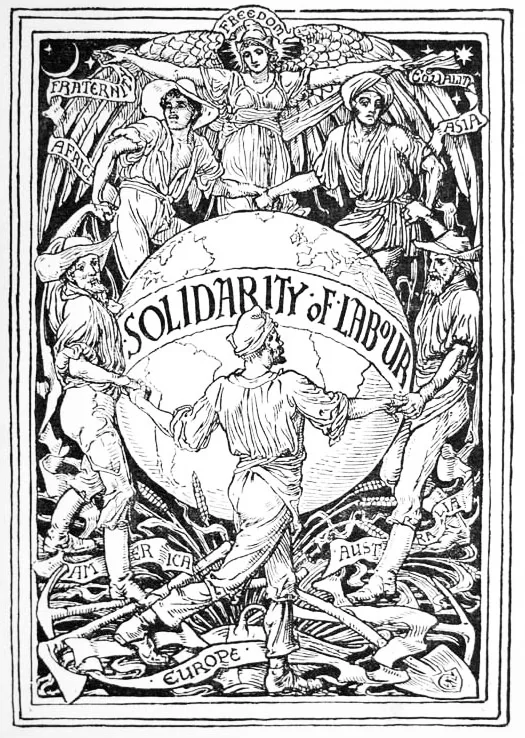
One plate was made new for the occasion: a handsome Englishman in a Phrygian cap (the soft conical cap of classical freed slaves, an emblem of liberty since the French Revolution) opening his arms to representatives of twenty countries. "International solidarity of labour", the caption reads, "the true answer to 'jingoism'". The rest were gathered from a decade of those weeklies, and the gathering is the editorial act. Warnings come first: the vampire, then an old woman labelled "Parliamentary Government" hoarding land, capital, wages, profits and tram shares from a child labelled "Unemployed". The inspirational images come in the second half. The essay argues Crane is strongest in the utopian half, noting that a children's book illustrator and latter-day Pre-Raphaelite was better suited to those images, and it quotes Eric Hobsbawm on Victorian socialist imagery: "Ceres was the goddess of communism." The densely illustrated "Triumph of Labour" gives the album its ending.
Eleven cartoons that had been separate weekly polemics, plus one new plate, became a narrative that marched from threat to harvest. Crane's preface hoped the plates would form "a not inappropriate souvenir" and give "an immense stimulus to the great movement towards the new era". Whether the album worked as a souvenir or as a programme is not something the plates settle; it depends on whether you read the order as argument or as decoration. What is certain is that the labels travelled with the pictures, and that is why we can still read them now.