Turner cried at a Claude, then painted his answer and hung them side by side forever
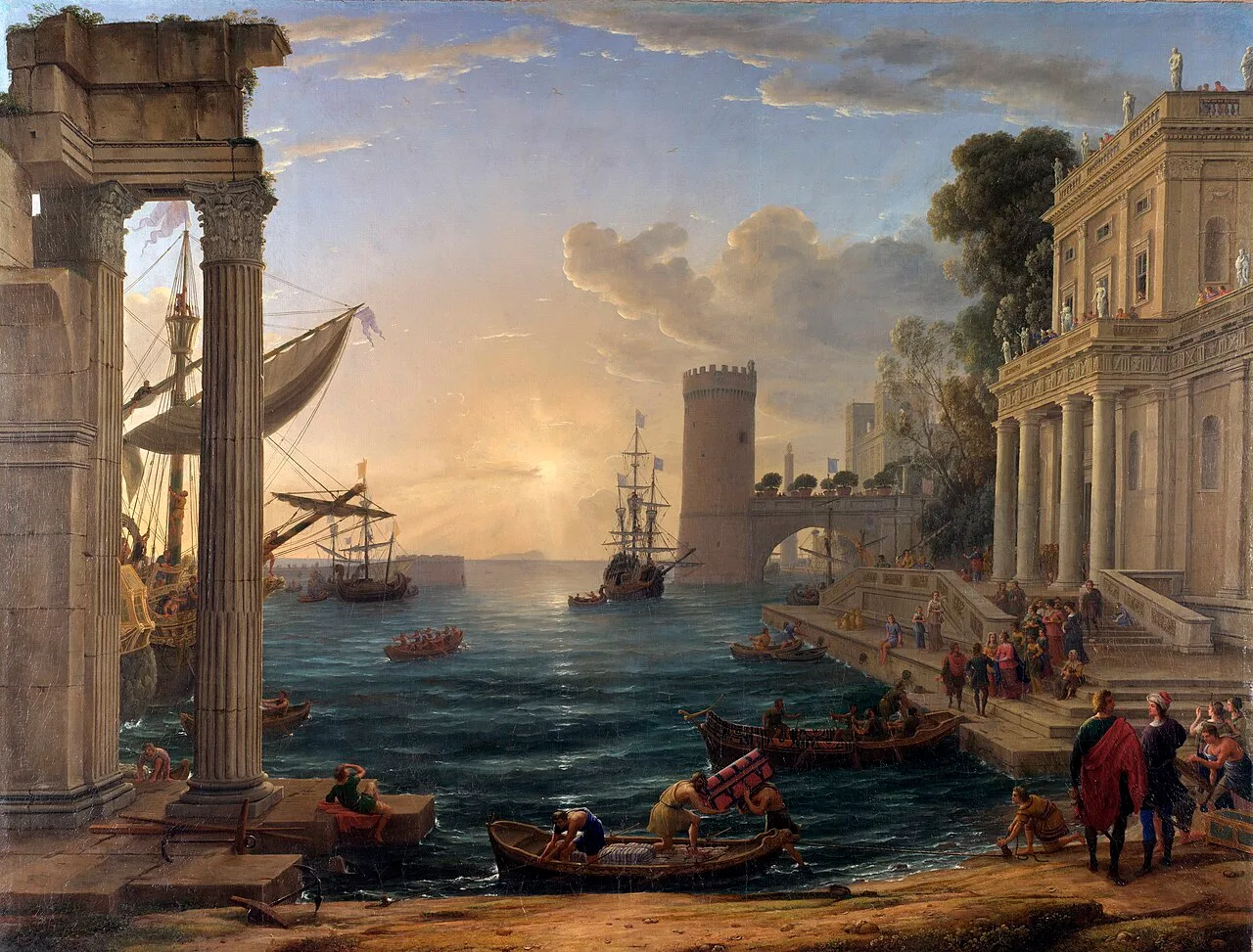
In 1799 a young J. M. W. Turner was shown a painting in the London house of the collector John Julius Angerstein and started to cry. The picture was Claude Lorrain's The Embarkation of the Queen of Sheba, a misty harbour scene with a low sun, painted in 1648. Claude was a French painter whose landscapes set the standard for later painters. Turner, asked what was wrong, said: "Because I shall never be able to paint anything like that picture."
Sixteen years later he exhibited Dido building Carthage at the Royal Academy's annual exhibition. History painting meant scenes from scripture, myth or ancient history with figures in them. Turner took Claude's stage set almost wholesale: dark buildings framing both edges, water running down the middle, a low sun, a vanishing point (the spot where receding lines converge) set low and central. The subject comes from Virgil's Aeneid. Dido, the legendary founder of Carthage, stands on the left in blue and white, planning the city with architects and masons while it rises behind her.
The figure in front of her, cloaked and helmeted and facing away from us, is most likely Aeneas, the Trojan prince whose long stay in Carthage takes up much of the poem. Turner made other oils from the Aeneid besides this one. The small symbols are where the painting gets strange. On the right sits the tomb of Dido's husband Sychaeus; a sapling grows out of a dead tree beside it, standing for the city's expansion after his death. Under the tomb is the cloaca, the sewer, which stands for the city's future greatness and long life. Some children play with a toy boat in the water, foreshadowing Carthaginian naval dominance of the Mediterranean.
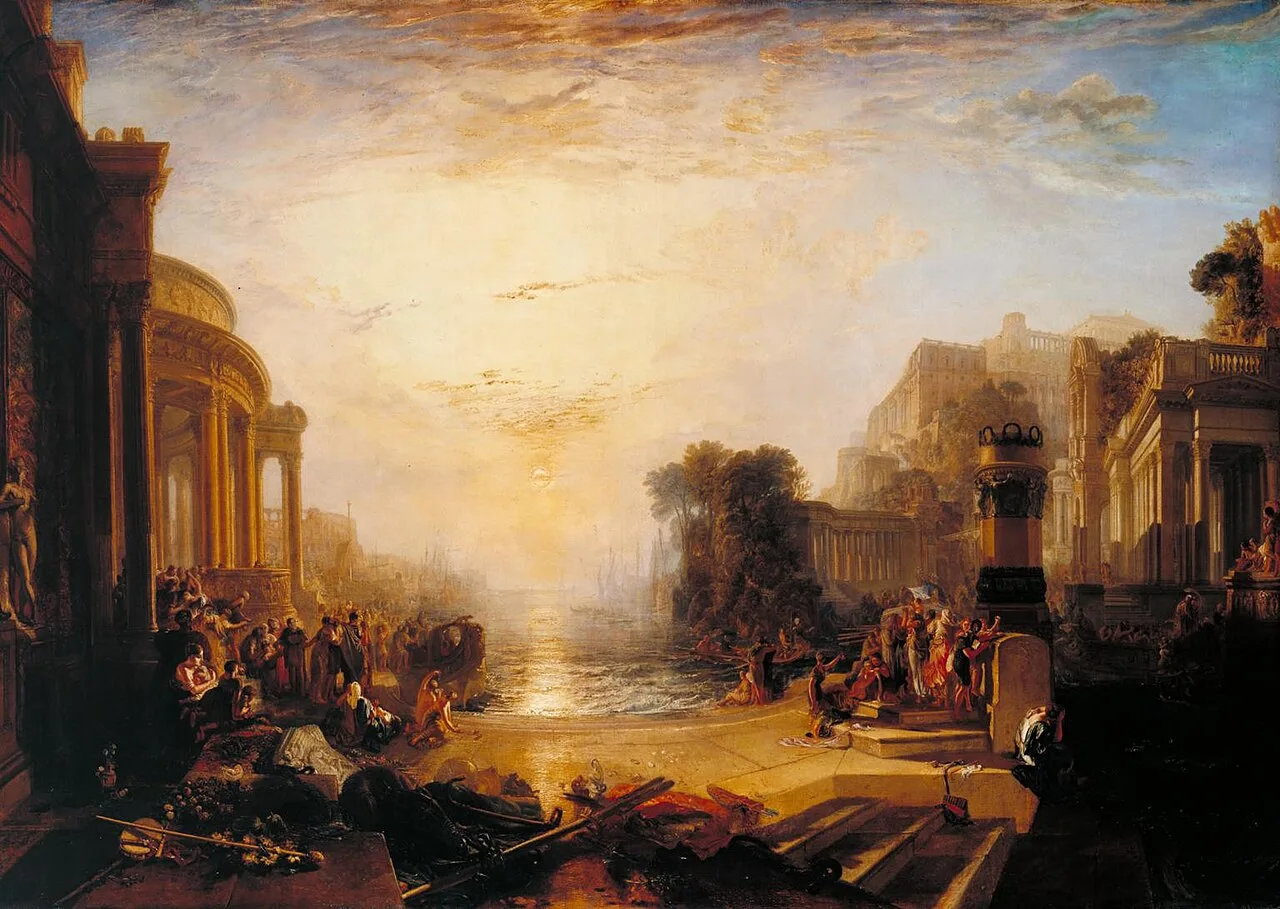
What he changed is the light. Claude's sun sits low and gentle, lighting a scene. Turner's sunrise fills the top half of the canvas with an intense yellow, and it means the dawn of a new empire. The left side of the picture is all activity; the right side is still and ominous. Turner thought he had done it. He called the painting his "chef d'oeuvre", French for masterpiece, refused to sell it, and kept it his whole life. Two years later he showed a sequel at the Academy, The Decline of the Carthaginian Empire. The background and the symbols are laid out in the painting's Wikipedia entry en.wikipedia.org.
It still does, in Room 36 of the National Gallery in London, and you can check the room's layout here nationalgallery.org.uk. Hanging the two pictures together turns a wall into a contest with a referee: any visitor standing between the two canvases. My own read, from reproductions only, is that Turner wins on drama and Claude wins on air, and that the blazing sun is the whole argument, because it makes the light itself carry the idea instead of just illuminating it.