A brown coat of paint hid two people behind the Magdalen for a century
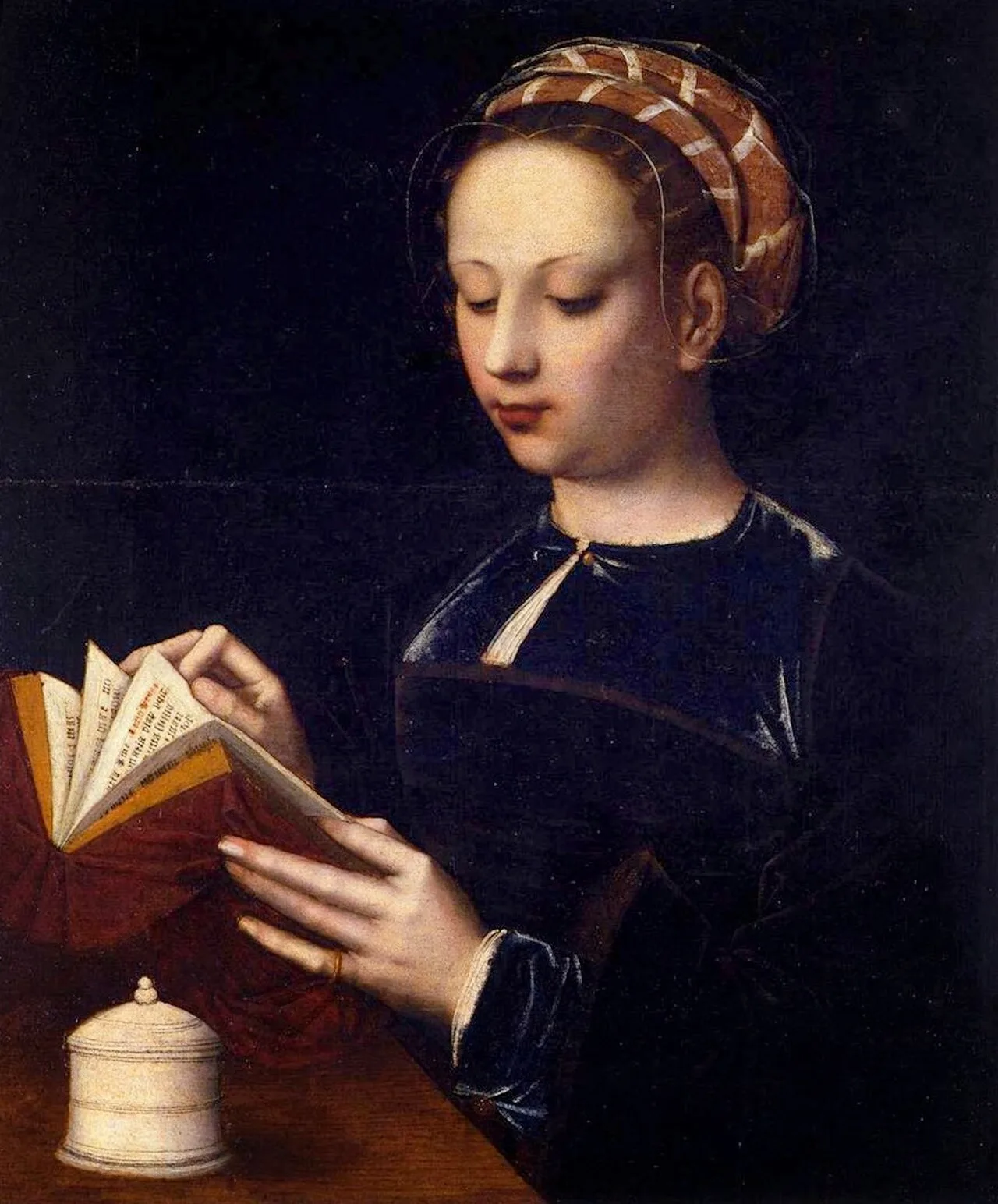
The woman in Rogier van der Weyden's The Magdalen Reading looks like a complete picture of one person reading. It was sold and hung as exactly that. Then a cleaning in 1955 and 1956 took off a thick layer of brown paint and found two other people standing behind her, and a window onto a landscape.
The panel is small: 62.2 by 54.4 cm, oil on oak, about the size of a large sheet of paper. Van der Weyden painted it around 1435 to 1438, and the National Gallery in London has owned it since 1860, when it bought it from a collector in Paris. She is identifiable as Mary Magdalen by the jar of ointment in the foreground, the object she is always shown with so viewers can name her. Her book has a white cloth cover for protection and four coloured cloth bookmarks tied to a gold bar near the top of the spine. Look at her eyelids: heavy, oval, lowered. The whole figure is built for stillness.
That stillness was the sales pitch. The altarpiece this came from was a large multi-panel painting, and such works were often cut apart and the pieces sold separately. A fragment with an obvious gap where the rest of the scene used to be is hard to sell. The background had been overpainted with a thick layer of brown paint, and the cut-down panel read as a finished single-figure picture. What the cleaning exposed is a standing figure behind the Magdalen and a kneeling figure in front of her, one bare foot poking into her space, with a landscape visible through a window.
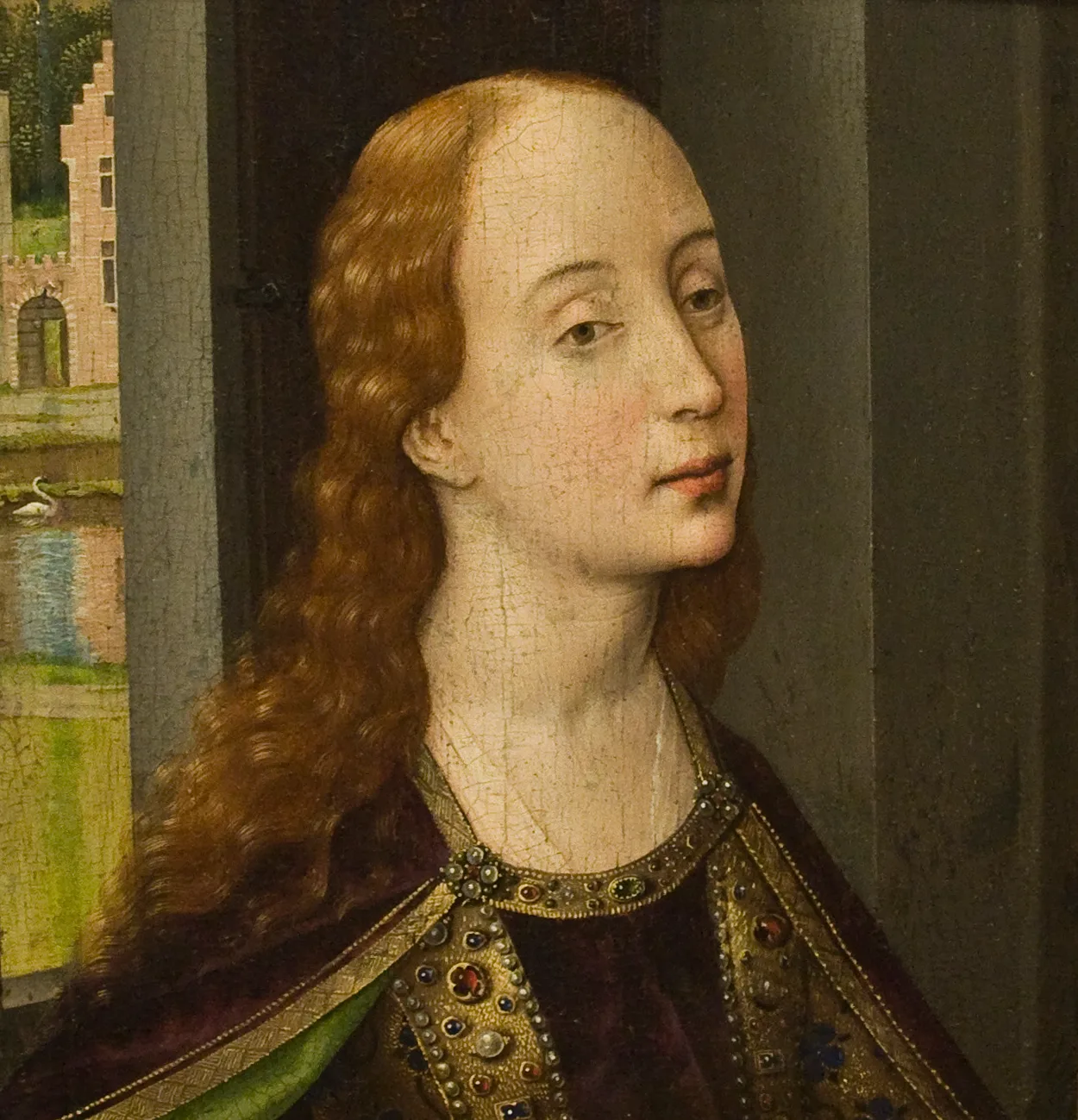
Both figures stop dead at the edges of the panel. The foot is cut off mid-form; the standing body is sliced by the border. The two partially seen figures are both cut off at the edges of the London panel. The head of the standing figure belongs to a fragment in Lisbon's Museu Calouste Gulbenkian showing Saint Joseph, and a second Lisbon fragment, probably Saint Catherine of Alexandria, is thought to come from the same altarpiece. Each of those is about a third the size of the London panel. The original altarpiece was a sacra conversazione, known only through a drawing, Virgin and Child with Saints, in Stockholm's Nationalmuseum, which places the Magdalen in the lower right-hand corner.
Lorne Campbell, who has studied the panel closely, calls it "one of the great masterpieces of 15th-century art and among van der Weyden's most important early works." I would put it more narrowly. The most interesting thing in the painting is the edge. A woman absorbed in a book, with a bare foot entering her frame, is not a finished composition. It is the quietest surviving corner of a lost one, and the brown paint was there to make you forget that.