Two Virgins in One Nativity: the Ghost Head the Le Nains Painted Over
There is a second Virgin in this painting, and she is a ghost. Look at the wall above the left-hand angel in the Le Nain brothers' Adoration of the Shepherds (National Gallery, London, about 1640) and you can make out a faint head of Mary, bowed slightly to the left, sitting in the spot Joseph now occupies. The picture was rearranged after it was begun, and traces of the first arrangement still show through.
What you are seeing is a pentimento (plural pentimenti): an earlier passage of a painting, covered by later paint, that shows through as the top layer thins or ages. The National Gallery's own description puts it plainly: "on the wall above the lefthand angel dim traces of a head of the Virgin can be seen, slightly bowed to the left matching Joseph just to her right." The picture becomes a record of a change. The Virgin first sat further left, on the wall above the left-hand angel, and the abandoned head stayed there. You are watching the composition change in oil.
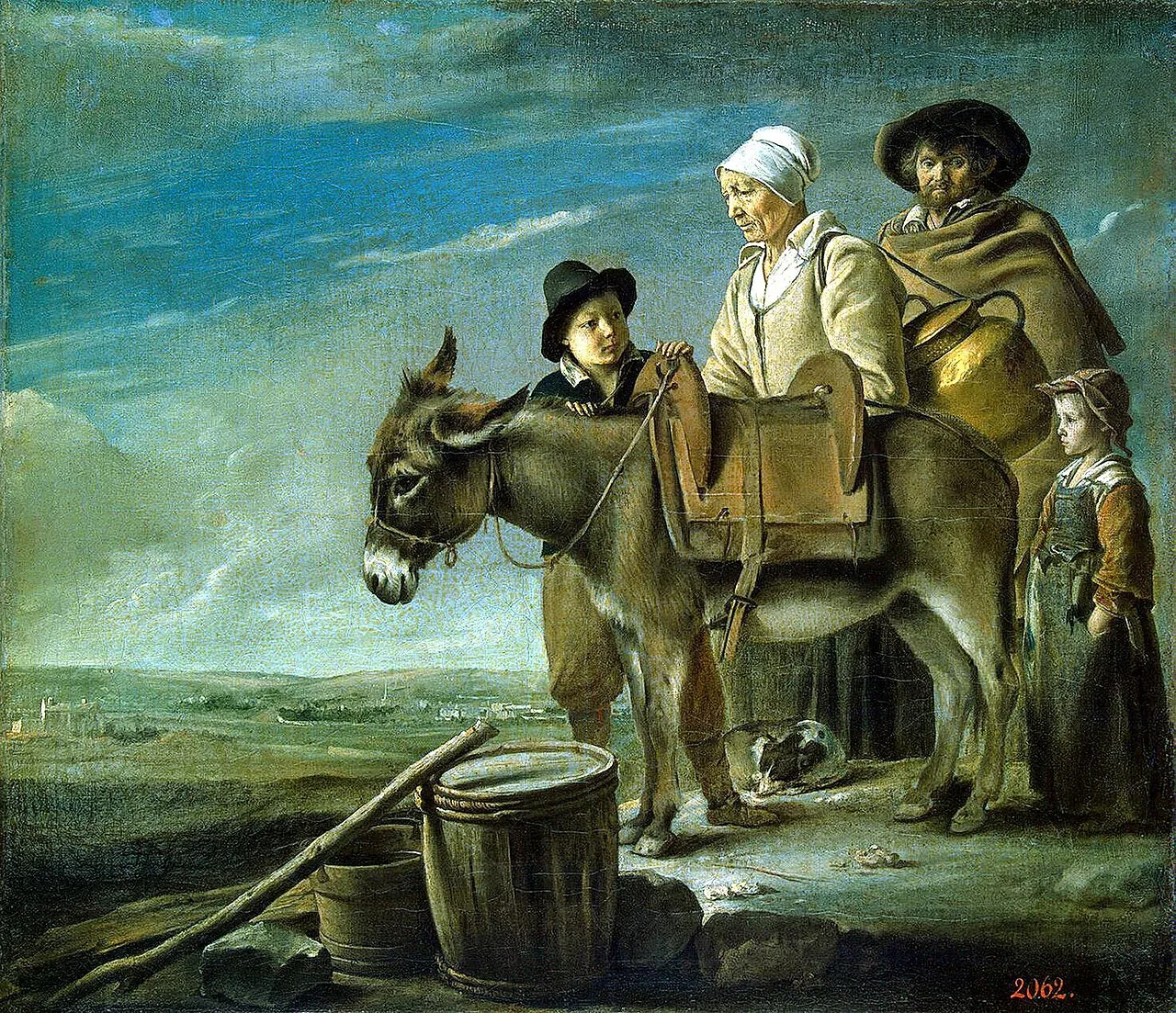
There is a second trace, lower down. On the donkey, a curved rein survives starting where the white chest meets the foreleg, and the whole animal may originally have sat lower in the composition. A rein implies a hand or a post that is no longer there, and the whole animal may originally have sat lower. The ox and ass are standard furniture in a Nativity, so it is easy to walk past them.
The Le Nain were three French brothers, Antoine, Louis and Mathieu, working in Paris in the 1630s and 1640s, mostly painting peasants. A religious scene like this, a history painting in the day's ranking of subjects, is unusual for them, and the National Gallery detects the influence of Orazio Gentileschi, who had worked in Paris, in the figures of Mary and Joseph and in the ass. The composition is an arrangement of the conventional components: Holy Family, ox and donkey, angels, three shepherds, two old and one young. One shepherd and an angel glance out to the viewer's left, and it has been suggested they have seen the Magi approaching, perhaps the subject of a matching painting. That is a proposal, not a fact.
What the paint can tell you is how the picture was made. What it cannot tell you is who made it. The canvas is unsigned, and when the brothers did sign, between 1641 and 1648, they signed simply as Lenain, so the hand cannot be pinned down; dates in the 1630s have been proposed alongside the Gallery's about 1640. It first appears in England in the 1770s, possibly as the Le Nain subject sold at Christie's on 7 February 1771 for £42, and by 1777 it hung at Blenheim Palace catalogued as by Luca Giordano. It was sold again in 1886 for £52 10s and later belonged to the 15th Duke of Norfolk. nationalgallery.org.uk/paintings/the-le-nain-broth…