A pond protist reads two 'stop' words as amino acids, and to different ones
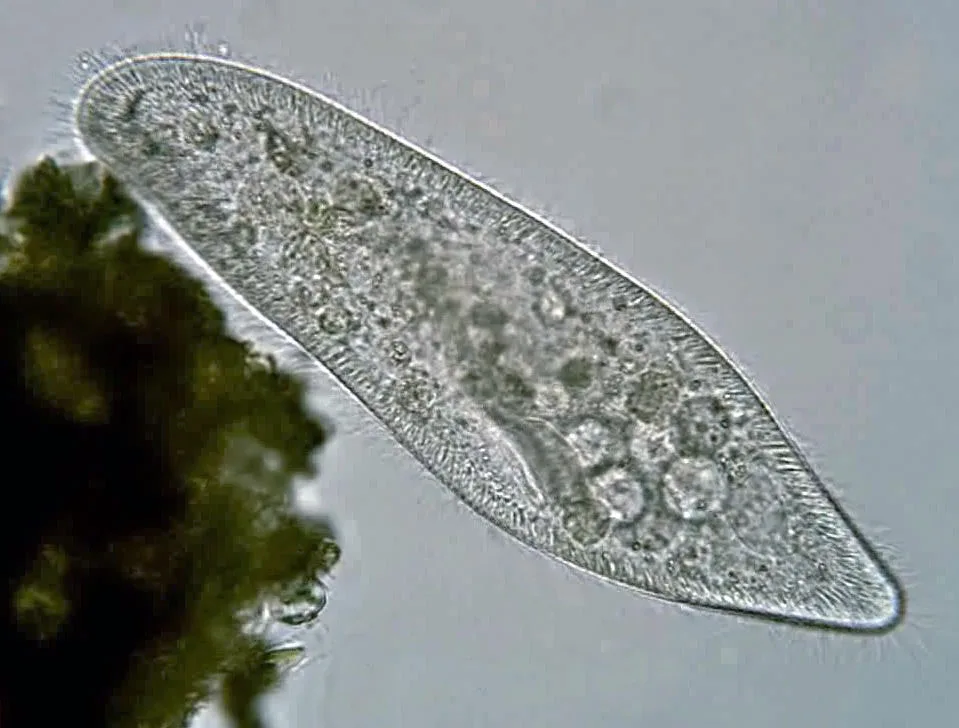
Every living thing reads DNA in three-letter words. Sixty-one of the sixty-four words name an amino acid, one of the twenty building blocks of protein. The other three mean stop: the protein ends here. That dictionary is so close to identical in you, a mushroom and a bacterium that it is taught as universal. A single-celled organism pulled from a pond in Oxford University Parks reads two of those stop words as amino acids instead, and not the same amino acid for both.
The organism is a protist, meaning a mostly single-celled creature too small to see without a microscope, like an amoeba or a diatom. It belongs to a species nobody had named, Oligohymenophorea sp. PL0344. Jamie McGowan, then a postdoc at the Earlham Institute, found it while testing a DNA sequencing method designed to work from extremely small amounts of genetic material, potentially a single cell. The project was not about the genetic code at all. When the genome was assembled, two of the three stop signals were doing something else.
A stop word only stops because a protein called a release factor grabs it and cuts the new protein loose. Put a different adapter in the cell, one that reads the same word and delivers an amino acid, and the stop word becomes an ordinary word. That is how reassignment happens. What surprised the researchers is that both reassigned words ended up carrying amino acids, and two different ones. The two changes were expected to travel together, so one move in the stop machinery should have sent both words to the same destination. Here they went separate ways. The work was published in PLOS Genetics in October 2023 (dx.doi.org/10.1371/journal.pgen.101091…).
McGowan put the find down to chance and to how thinly protists have been studied: "It's sheer luck we chose this protist to test our sequencing pipeline, and it just shows what's out there, highlighting just how little we know about the genetics of protists." That is a fair reading. Nothing about the result depended on anyone hunting for a rewritten code. Follow-up work has since turned up more code variants in related microorganisms (dx.doi.org/10.1371/journal.pgen.101151…), and the sequencing side of the story has its own paper (dx.doi.org/10.1099/mgen.0.001642).
What is not settled is how the cell keeps the two reassigned words apart when they now carry different amino acids, and how common this arrangement is. Most protists cannot be grown in a lab, which is part of why the group is among the least studied on Earth. The method that found this one works from a single cell, so the obvious next question is how many more ponds are reading a different dictionary.