Monet painted the same beach twice in 1867: rich people watching, workers hauling

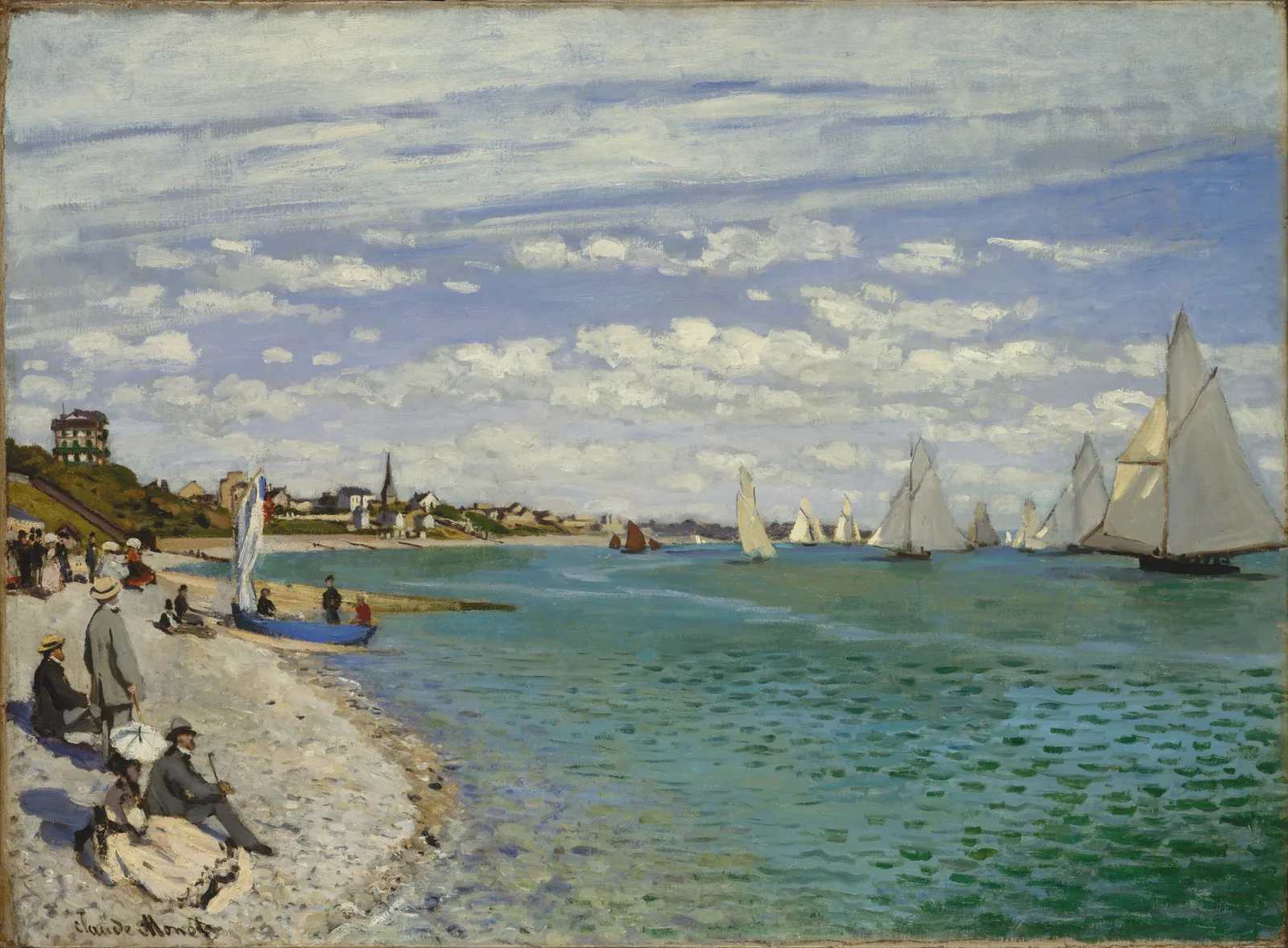
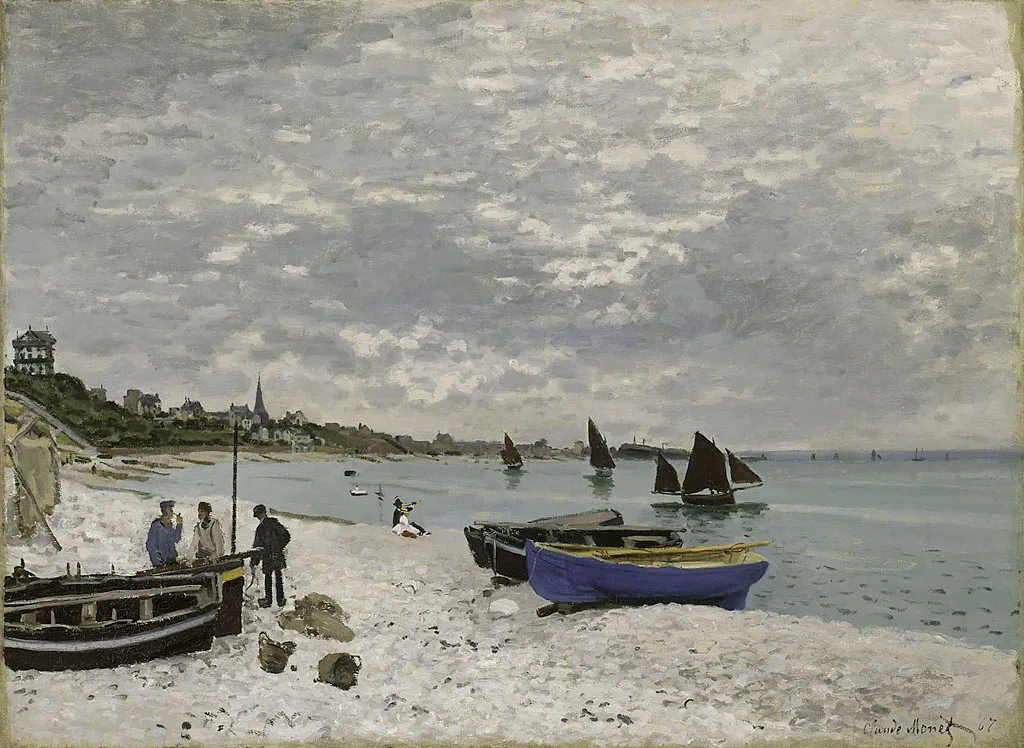
Claude Monet spent the summer of 1867 painting the same stretch of Normandy beach at Sainte-Adresse twice. One canvas shows a regatta at high tide, sails on the outer harbor, well-dressed spectators on the sand. The other shows the same beach at low tide, overcast, with fishing boats dragged up and sailors and workers around them. The two paintings are the same size, and their viewpoints differ by only a few yards.
Sainte-Adresse was the well-off suburb of Le Havre where Monet's father lived. Monet was broke that summer. He stayed with his father and his aunt Sophie Lecadre, and the price of the stay was leaving his companion Camille Doncieux and their newborn son Jean in Paris. He had attended the birth and returned to the coast a few days later. On 25 June he wrote that he had about twenty pictures underway: "Among the seascapes, I am doing the regattas of Le Havre with many figures on the beach and the outer harbor covered with small sails." The regatta picture is signed at the lower left. It is now at the Metropolitan Museum of Art; its companion, The Beach at Sainte-Adresse, is at the Art Institute of Chicago. metmuseum.org/Collections/search-the-coll…
High tide is what puts the sails out on the water in the first painting; low tide is what strands the boats on the sand in the second, which is why one picture is full of people watching and the other is full of people hauling. The Met's own catalogue says the pair was "probably conceived" together, and that hedge is doing real work. There is no document in which Monet says he planned them as a pair, and he never exhibited them side by side. The social contrast between the two is in the paint, but the reading of it as a statement about class is something a viewer supplies when the canvases are hung or printed next to each other. The Met's conclusion is that the difference reflects two conditions under which the same place could be painted, not a staged social manifesto.
What the pair really shows is a working method: same place, different tide, different weather, different people, painted in the same summer as part of a batch. Monet was painting about twenty pictures at once that June, and these two look like survivors of that batch rather than a deliberate diptych. The provenance supports the batch idea too. Henri Hecht bought the regatta canvas from the artist in January 1873 for 500 francs, and the painting travelled under shifting titles: shown in Bordeaux in 1868 as "Les régates du Havre," possibly this picture, and in New York in 1921 as "Plage de Sainte Adresse." Whether the two were ever meant as a pair rests on the matching size and the few-yards-apart vantage point, and on whether the Bordeaux entry is this canvas. Neither question is settled by the record.
What holds the two together for me is not the class contrast but the tide. The same few yards of beach, painted twice in one summer, give you two different worlds because the water moved. The rich spectators in the sunny picture are standing on sand the workers in the gray picture are dragging boats across. Monet didn't need to hang them together to make that point; the beach did it for him.