Eight sultans in one painting, made six years before their dynasty was wiped out
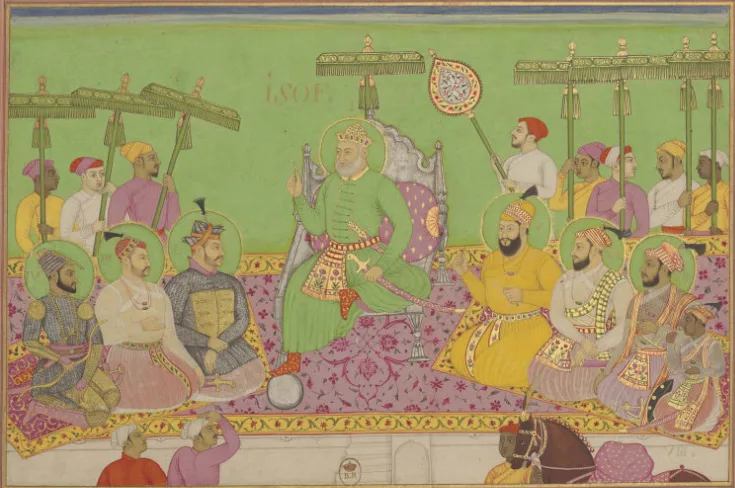
Eight rulers of one family sit in a single picture, and only one of them is doing anything. The rest are arranged around him like a hand of cards. The painting is The House of Bijapur, made about 1680 in the Deccan, and no other surviving Bijapur painting shows the dynasty's members together, from the founder to the last ruler. Six years later, in 1686, the Mughals conquered Bijapur.
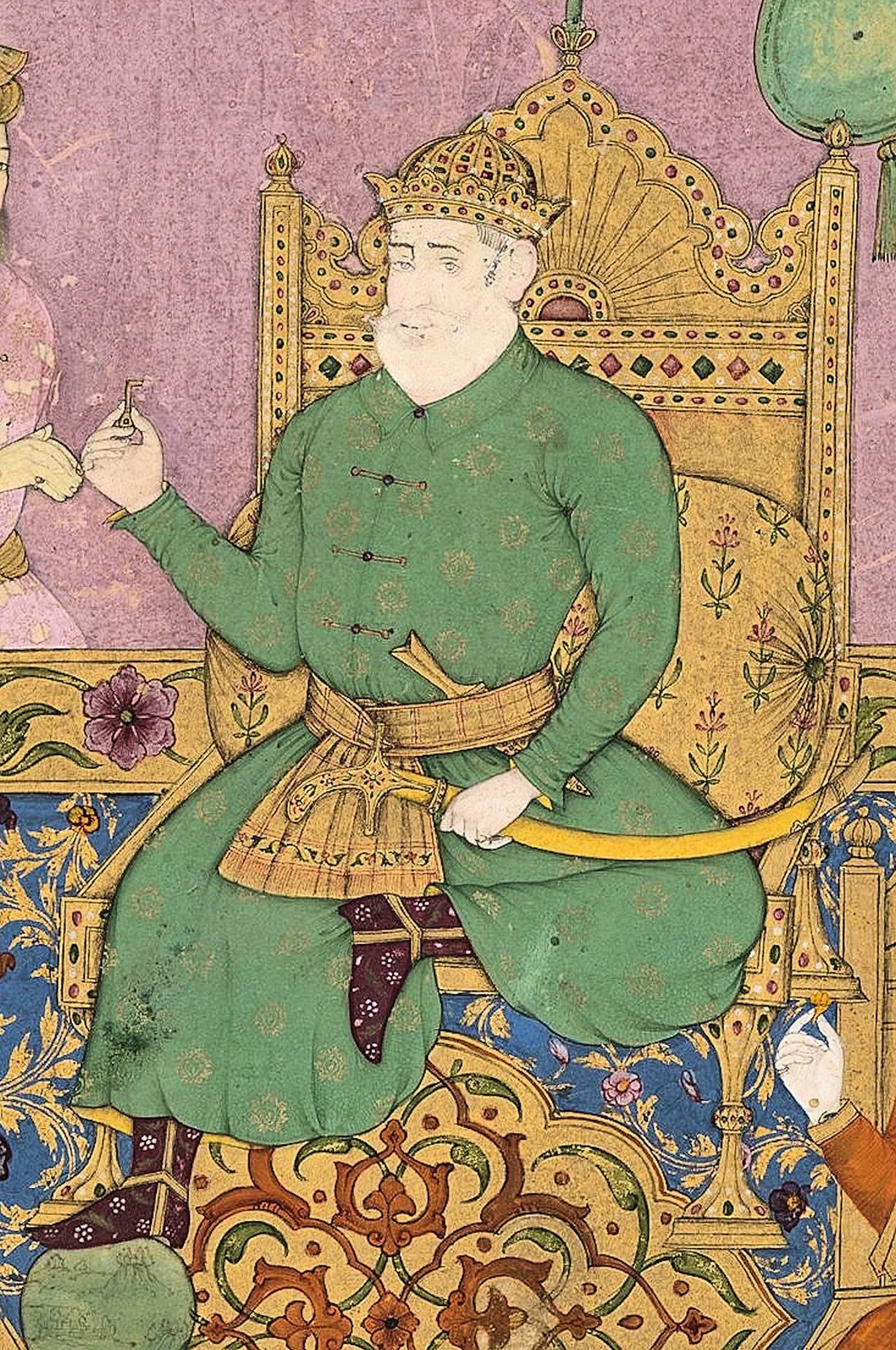
Start at the centre. Yusuf Adil Khan, the dynasty's founder, sits there and is being handed a key of legitimacy. Around him the other monarchs of the Adil Shahi line sit on their own thrones, and the painting was probably commissioned in the reign of Sikandar Adil Shah, the final sultan of the dynasty. This format, a family tree you can look at, is borrowed. Genealogical paintings of this sort, emphasizing the rulers' lineage, are known in Mughal art, where they symbolized the legitimacy of the rulers. The layout here seems to be taken from a painting by Govardhan dated to about 1630 to 1640, depicting Babur receiving the imperial crown from his ancestor Timur as Humayun looks on. The best-known Mughal version is the Princes of the House of Timur, now in the British Museum. Bijapur's painters took that machine for proving legitimacy and used it on themselves.
Then notice what they refused to take. The colour is local. It runs on lavender-pink, with greens, deep orange and gold that belong to the Bijapur school, and the mountains in the background are of Safavid inspiration. The picture is built in four horizontal bands: the background, two middle bands holding the dynasty, and a base with three attendants and a horse. The shifts in scale and perspective are sometimes illogical. The stairs lead up to the carpet without any support. Those shifts are meant to convey an otherworldly mood. The subject is taken from Mughal art, while the Bijapuri and Safavid elements show the artists' intent to depict the Adil Shahi rulers as distinct from, but equal in stature to, their Mughal counterparts.
It measures sixteen by thirteen inches, larger than most manuscript pictures of the period. No document records who owned it or where it hung. Scholars suppose it was a royal commission, presumably for the court of Sikandar Adil Shah, based on its scale, the subject matter and the use of expensive colors, and it may have been a page taken from an album. The inference is reasonable and it is still an inference. The Met's catalogue entry is here: metmuseum.org/art/collection/search/45318…
The writer Stuart Cary Welch called it "a painted curtain call," the last walk to the front of the stage by a cast before the play ends. It is one of the last works of the Bijapur school of miniature painting. What the picture shows is a family assembled to symbolize its legitimacy. What it also records is a court that spent its money on a genealogy six years before the Mughals conquered it.