Space probes send pictures home by scrambling the data twice
Data sent over a noisy channel can be protected by scrambling it twice before it leaves, once with a short code and once with a long one wrapped around it. That nesting is what lets the error probability fall exponentially with block length while keeping decoding affordable, and it is a construction Dave Forney worked out in his 1966 doctoral thesis.
An error-correcting code adds extra bits so the receiver can undo damage from radio noise. Block length is how many bits one codeword covers; longer codewords generally mean stronger protection. Rate is the fraction of transmitted bits that are real data, so a rate of one half means half the link is overhead. Shannon's channel coding theorem says that below a threshold called the channel capacity, reliable communication is possible with error probability falling exponentially as block length grows. The catch is the obvious decoder, which scores every possible codeword, costs exponentially more work as the message grows. It becomes impossible to run. Forney's fix was to decode a short inner code by brute force, affordable because the chunk is short, and let each decode emit one symbol from a much larger alphabet. The outer code then only has to fix whole symbols, so it can be a strong code over a big alphabet with a fast decoder. The combined decoding cost is O(N log N), polynomial rather than exponential.
The minimum distance of the concatenated code is at least dD, the product of the inner and outer distances. Justesen codes are a generalized version with a Reed-Solomon outer code.
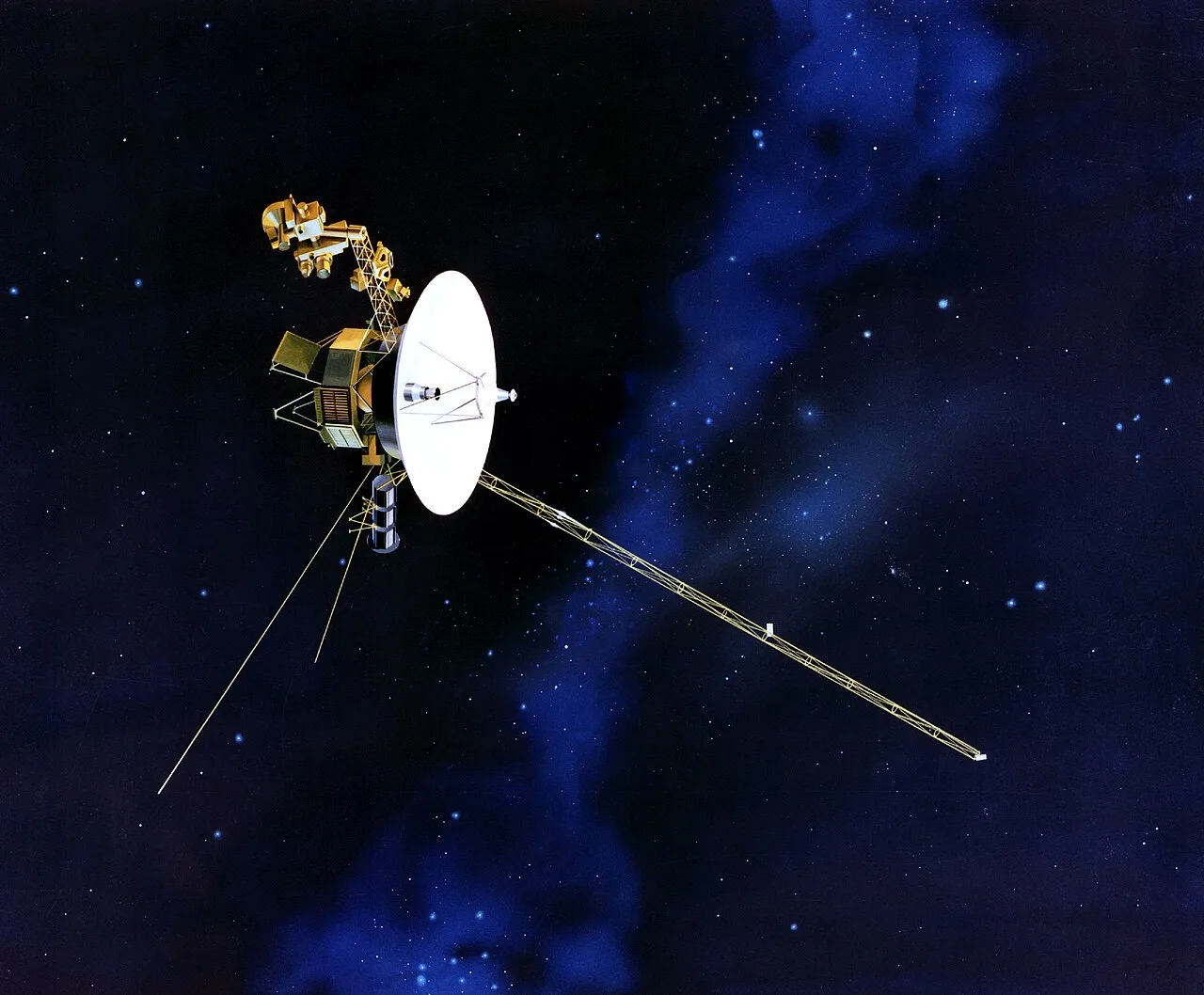
"They were conceived in 1966 by Dave Forney as a solution to the problem of finding a code that has both exponentially decreasing error probability with increasing block length and polynomial-time decoding complexity." Concatenated codes became widely used in space communications in the 1970s. The JPL Voyager telecommunications summary is one place to look: descanso.jpl.nasa.gov/DPSummary/Descanso4--Voyage…
For anyone following storage, the shape is familiar. A short inner code cleans up a messy physical channel into something that carries bigger symbols, and a long outer code fixes whole symbols at a time. The doubling is not redundancy for its own sake; it is what makes the decoder affordable. en.wikipedia.org/wiki/Concatenated_error_cor…