Sanskrit Had a Grammar Slot for Exactly Two People, and Kālidāsa Used It to Fuse Two Gods
Sanskrit has three grammatical numbers: singular for one, dual for exactly two, plural for three or more. English has two. This matters because a fifth-century poem uses the dual to do something English cannot: it writes two gods as a single word.
The poem is Kālidāsa's Raghuvaṃśa, and the line is its opening. The Sanskritist Eric M. Gurevitch translated it, then flagged what his own translation had obscured. "They are not (as I initially translated above) 'Pārvatī and Shiva,' they are ParvatiShiva (pārvatīparameśvarau), a single word conjugated in the dual," he writes. "Pārvatī lacks here case termination, and the entire word takes on . . . the gender of the final component." In other words, the goddess loses the grammatical ending that would mark her as a separate actor, and the whole compound takes the gender of its last element. Two deities become one grammatical item.
A compound, for anyone who last thought about grammar in school, is a word built by joining two words. In Sanskrit the first element typically drops its case ending, the bit that shows who is doing what to whom, and the whole thing behaves as a single noun. So the translator's job is to unfile what the grammar filed together. The idiomatic English version has to break ParvatiShiva back into "Pārvatī and Shiva," which is clearer and loses the point.
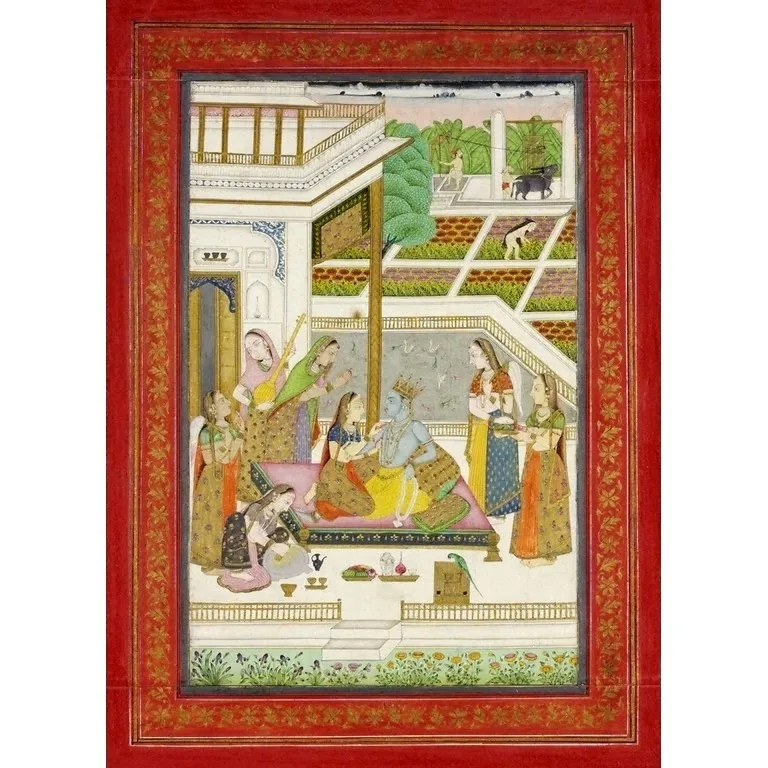
This is the same decision a directory, a contact list or a library catalogue makes about couples and collaborators: one entry or two? A joint bank account, a married couple in a phone book, a co-authored paper, a band with two names in it. Every such system has to pick a rule, and the rule decides what a later reader can find. Sanskrit's dual number is a classification scheme with a built-in slot for pairs, and it takes a position on the question before anyone asks it. The Public Domain Review collection that prompted this, on images of Krishna and Rādhā swapping clothes between roughly 1700 and 1900, shows the visual version of the same argument. In some of the paintings Rādhā leads Krishna by the hand; in others he puts his crown on her head. The essay reads the role reversal as "a vision of love that rejects complementarianism in favor of a radical empathy," a desire to erase difference rather than accept it. The most extreme type, ardhanārī, shows two deities as two halves of one body, an image more often reserved for Shiva and Pārvatī.
Roland Barthes, in a section of A Lover's Discourse called "Union," wrote: "I want there to be a point without an elsewhere. Barthes’ words echo a commentary by the Sanskritist Eric M." Whether Kālidāsa intended the grammatical fusion as theology or as wordplay is not settled, and it hinges on how much weight you give to the commentarial tradition around the opening verse. What is clear is that the grammar made the move available, and English did not.