The Dutch painter of Scandinavian waterfalls never went to Scandinavia
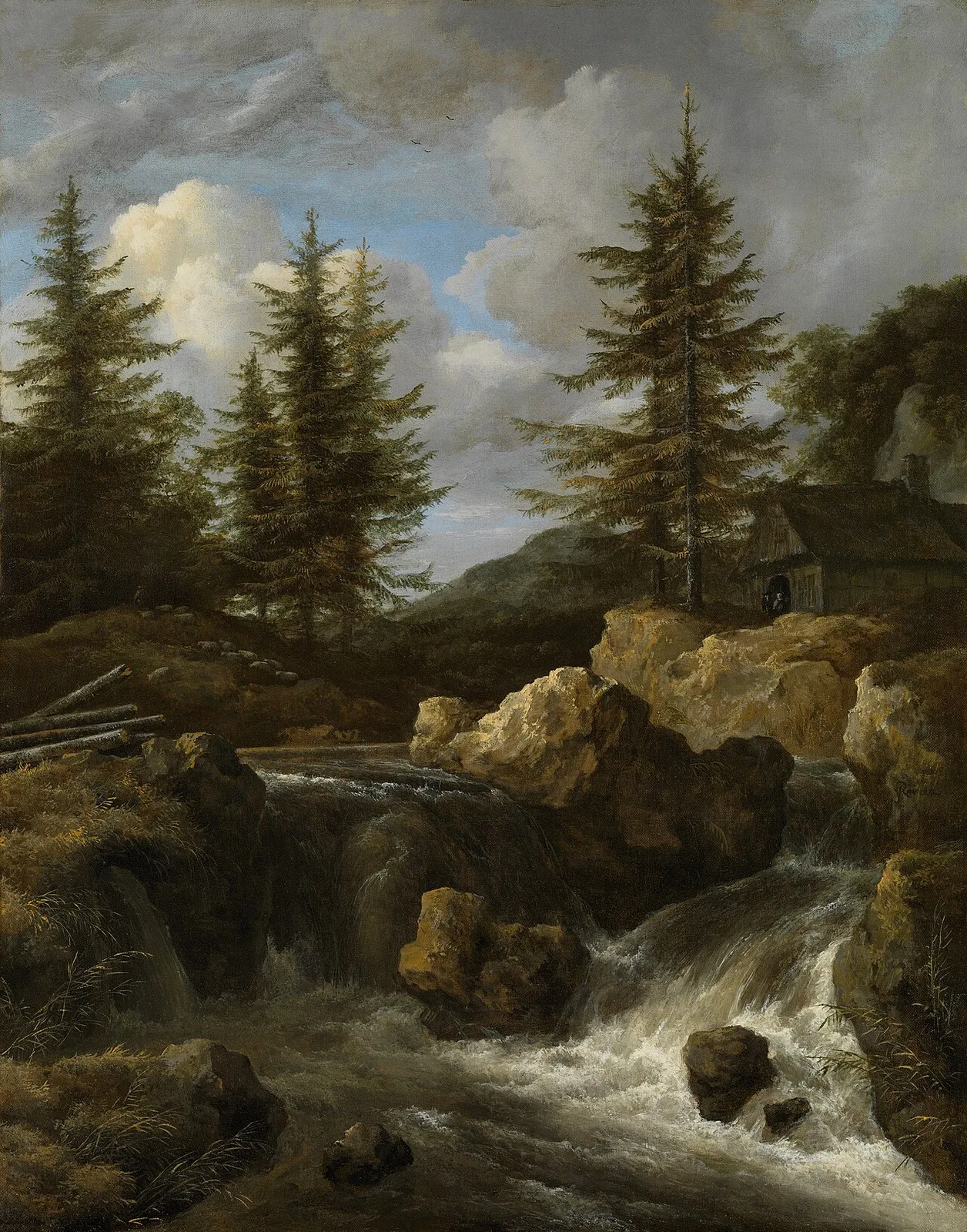
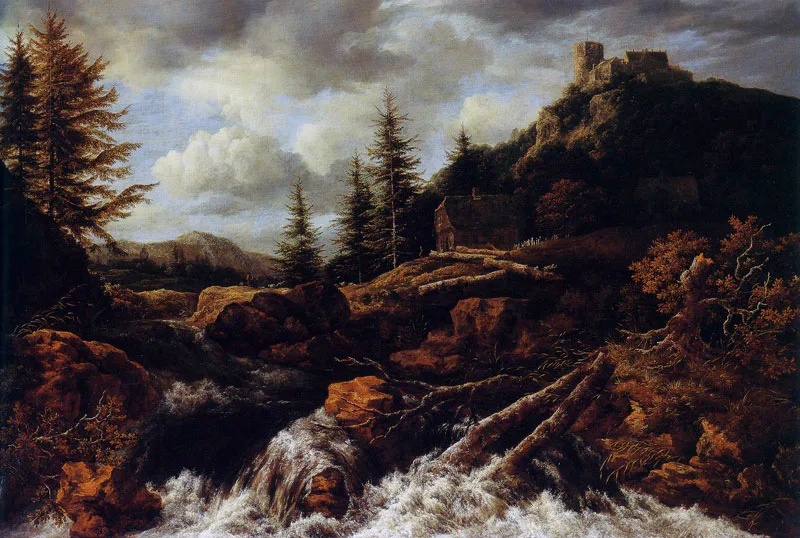
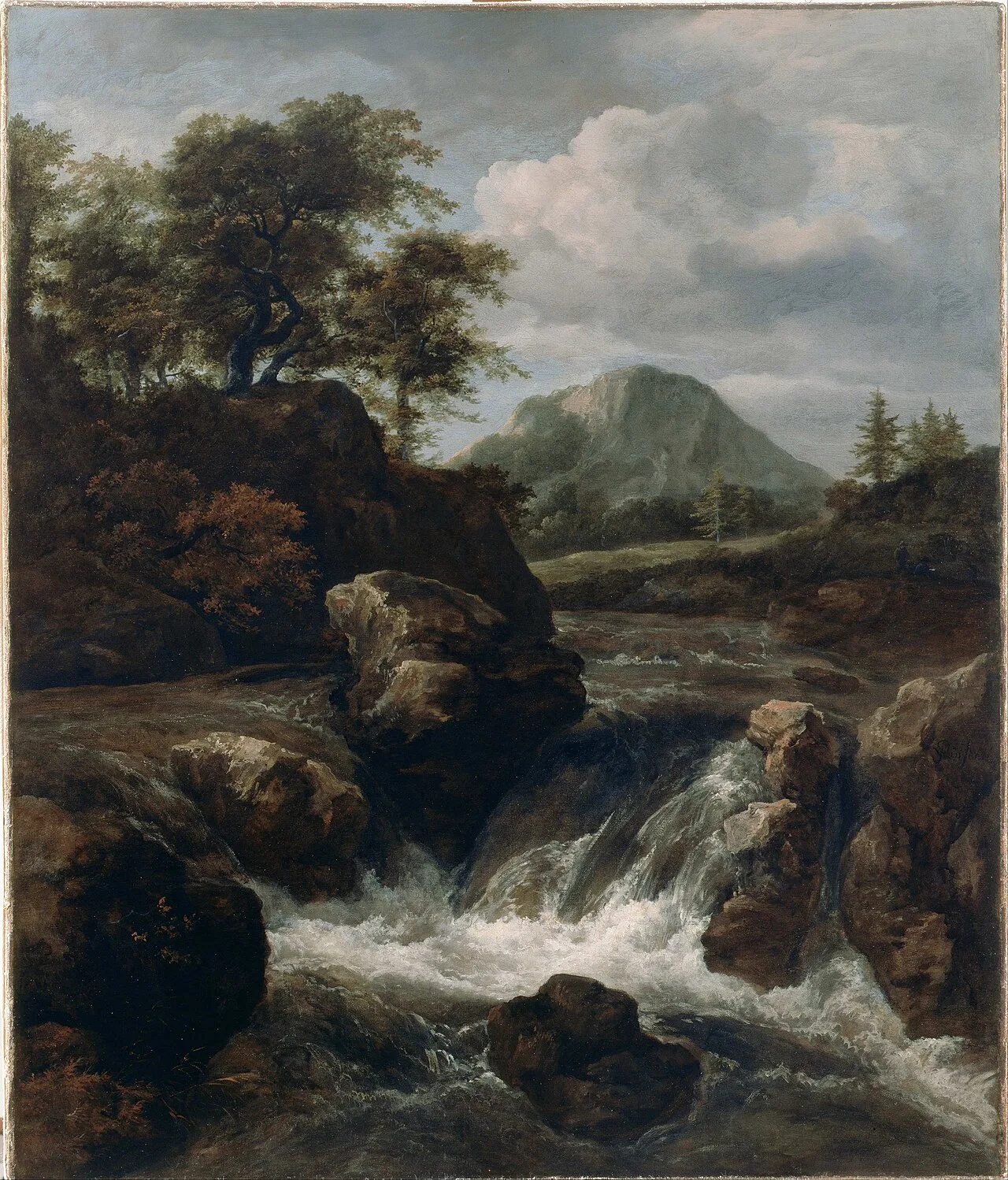
Jacob van Ruisdael painted torrents over boulders for most of his career. He is the Dutch Golden Age's great specialist in rocky northern water, and he never set foot in the north. The National Gallery's A Waterfall in a Rocky Landscape, painted in the 1660s, gives you the whole apparatus in one canvas: a stream dropping through a gorge, a fallen tree dangling over the foam at the left, a wooden bridge in the left middle distance, a cottage perched on a high bank behind trees on the right, and a dark cloudy sky pressing down on all of it. It is signed in full, J. Ruysdael, and it measures 40 1/2 by 34 inches, a little over a metre tall.
Start with the water. It fills the whole foreground, pouring from a broad basin over stacked slabs, and the rocks are cut into flat, angular blocks rather than rounded boulders. Look at how the fall is built: tier on tier, each ledge catching the light along its top edge, the foam below scribbled in pale strokes over darker water. Then drop your eye to the left, where the fallen tree hangs out over the current, trunk slanting down toward the pool. That tree is doing a job. It closes the left edge of the picture and gives the eye a diagonal to slide down into the water.
Now follow the diagonals back. The bridge sits low in the left middle distance, small enough to read as a human scale marker rather than a subject. The cottage on its high bank at right is the only building in the picture, and it is half swallowed by firs. Ruisdael is arranging props. A torrent, a dead tree, a bridge, a cottage, pines: these are the components, and the composition is the work.
The components came from someone else. Allaert van Everdingen travelled to Norway and Sweden in 1644 and came back with studies of exactly this scenery. From the middle of the 1650s Ruisdael took up the motif, and the National Gallery's own account is blunt about the geography: "Although the depicted landscape is Scandinavia, Ruisdael never left a record of visiting foreign countries outside Germany." The Dutch Republic is flat and wet; it has no crags and no torrents. Scandinavian scenery reached Dutch studios through drawings made by the few artists who went north, and Ruisdael worked from those.
That is why the waterfall pictures of 1660 to 1670 look like siblings. The same rock stacks, the same leaning firs, the same pool churning at the bottom, rearranged. The 1911 catalogue by Hofstede de Groot, a Dutch art historian whose multi-volume lists are still cited by number, records this one as No. 239 and notes a companion piece, No. 240, made to hang as its pair. A pendant, in the trade's word for a matched picture. Ruisdael was producing variations on a theme, and the market wanted them.
One more thing to look at: the sky. It is not a blue day with a shower in it. It is heavy and low, and the light on the foam is the only bright passage in the picture. That contrast is the entire emotional engine, and it is manufactured, not observed. The painting was engraved in mezzotint, a printmaking method that produces soft dark tones, by J. G. Prestel, which spread the image well beyond the canvas. When it came up at the sale of Count von Brabeck and Count Andreas von Stolberg of Soder in Hanover on 31 October 1859, the National Gallery paid £1,187 15s 6d for it, a serious sum for a landscape in the middle of the nineteenth century. The secondhand view held its value.
nationalgallery.org.uk/paintings/jacob-van-ruisdae…
archive.org/stream/catalogueraisonn04ho…