A king wears a medal for a country that was abolished a year later
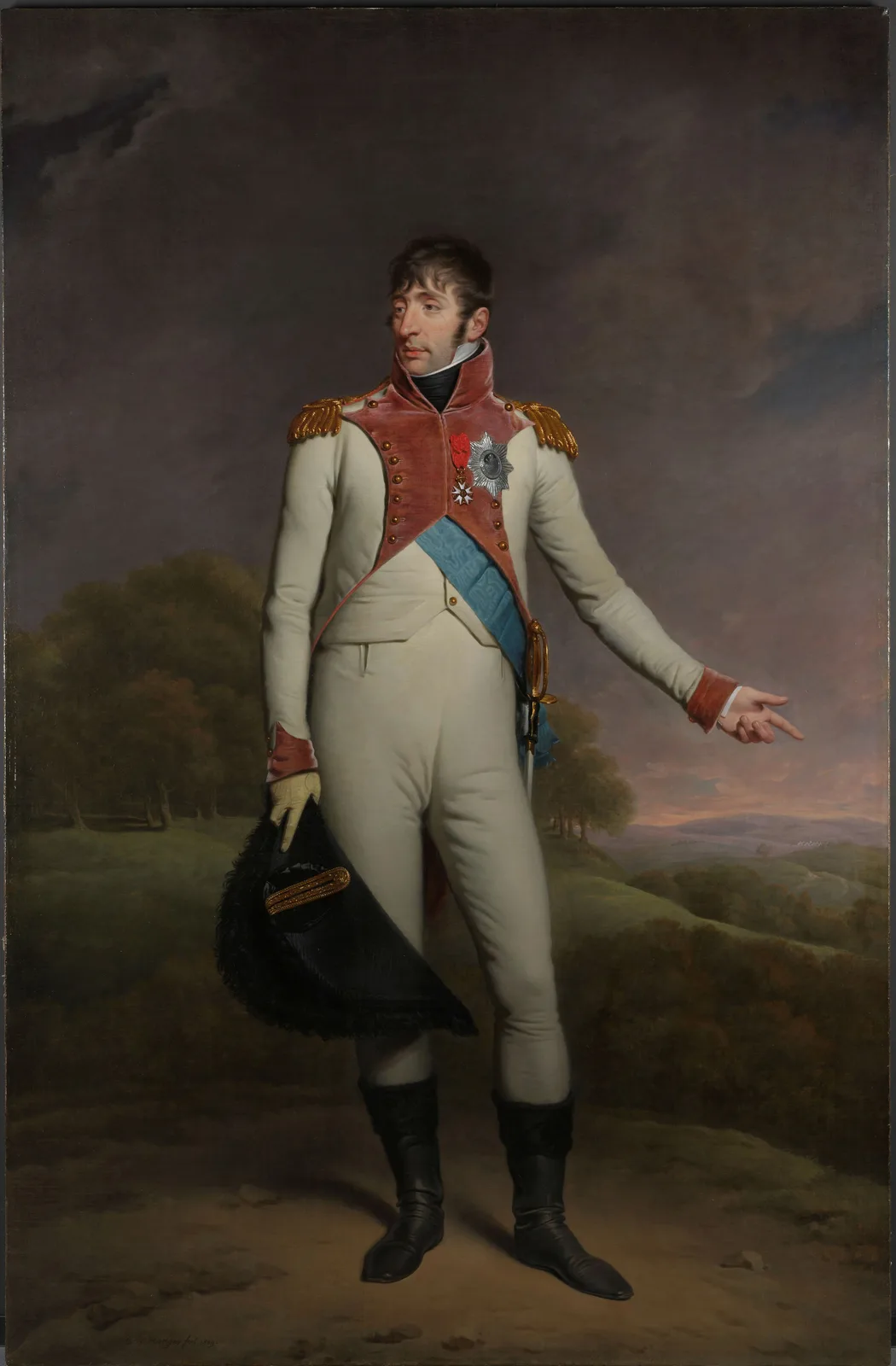
Look at the chest, not the face. Two decorations sit on the same blue-and-silver uniform, painted with the same finish: a Dutch order and the French Legion of Honour. The Dutch one belonged to a kingdom that stopped existing the year after the paint dried, which makes canvases like this one of the few places it still hangs.
The picture is Charles Howard Hodges's Portrait of Louis Bonaparte, painted in 1809 and now in the Rijksmuseum in Amsterdam (rijksmuseum.nl/en/collection/object/Portra…). It is 223 by 147 cm, about a tall man's height plus a head. That size is the point. A state portrait this big is built so a viewer across a room can read the sitter's rank without getting close, which is why the medals are painted as objects with edges and highlights rather than as dabs of colour. The source puts it plainly: "Louis is portrayed at full-length in the uniform of the Dutch Life Guards, wearing the Grand Cross of the Royal Order of the Union of Holland and the French Legion of Honour."
Here is what the two medals were. Napoleon put his younger brother Louis on the throne of Holland in 1806. Holland was a client state, meaning it ran its own affairs on paper but answered to France. The Royal Order of the Union of Holland was the decoration of that new kingdom, Louis's own invention as its king. The Legion of Honour was Napoleon's, created in 1802 for military and civil service, and it still exists today. A Grand Cross is the top grade of an order: a large star worn on the chest plus a sash badge, not a small ribbon. So the two objects on Louis's coat are not a matched pair. One belongs to the empire that made him king, the other to the kingdom he was given.
In 1810 Napoleon abolished the Kingdom of Holland and annexed the territory into France. The source names the Walcheren Expedition, a British invasion of the Dutch coast in 1809 that went badly for the British, as the moment Napoleon lost patience with how his brother had handled it. After the annexation, the Dutch order on Louis's chest could not be awarded to anyone again. It had no state left to issue it. The French order kept going. That is the oddity the painting preserves: two loyalties, both finished to the same standard by Hodges in 1809, one of which was about to become a dead decoration.
Why Napoleon ended the kingdom is not settled. Walcheren is the trigger the source gives. The other standing explanation is Louis's refusal to enforce the Continental System, the French trade blockade against Britain, which was strangling Dutch ports. The painting does not settle that, and neither does the source. What it does show is a state portrait doing something state portraits rarely do: keeping a dissolved regime legible in paint, with the two medals sitting in the same frame as equals because Hodges finished them both before the argument was decided.