Seattle's 67-yard playoff run was designed to gain two yards
Seattle's 67-yard playoff run was designed to lose two yards
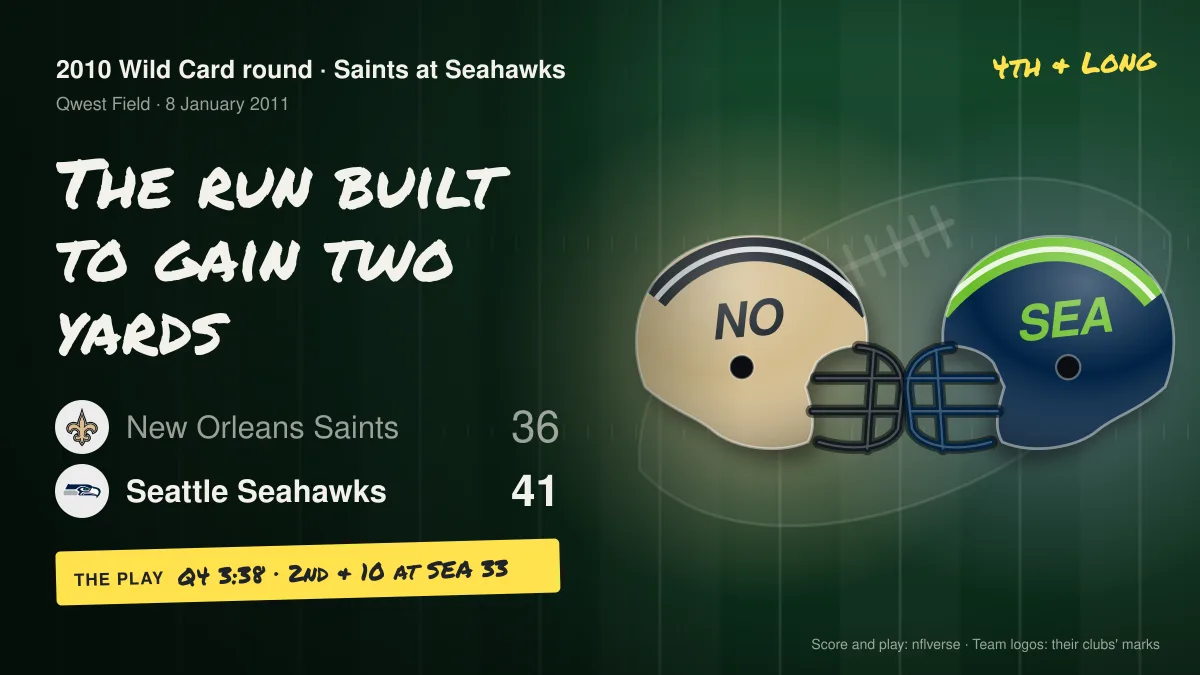
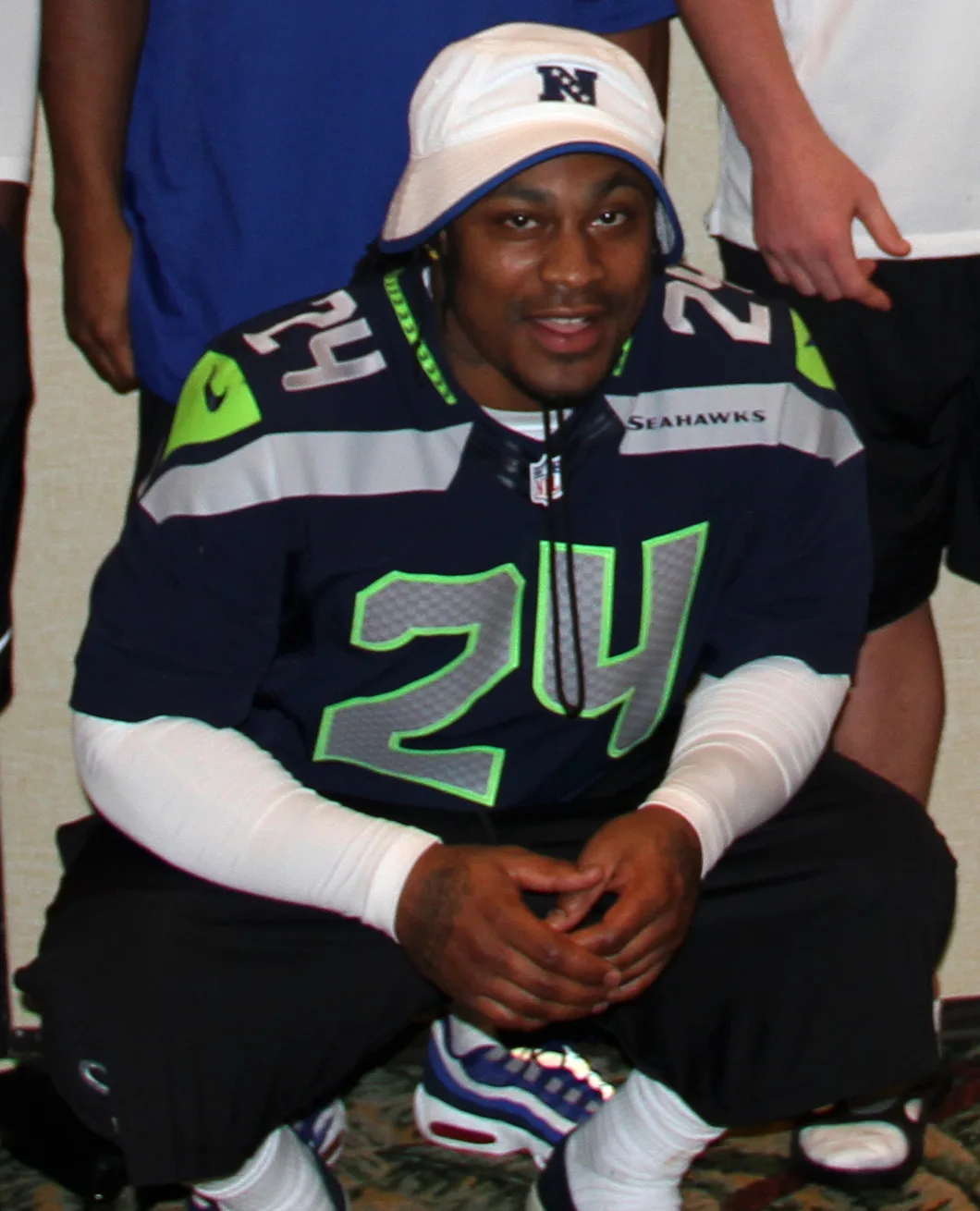
In the 2010-11 NFC Wild Card game at Qwest Field, Seattle Seahawks running back Marshawn Lynch ran 67 yards for a fourth-quarter touchdown against the defending champion New Orleans Saints. He broke nine tackles on the way. A nearby seismic station registered the shaking as a magnitude 2.0 event, and the play is called the Beast Quake. Seattle won 41-36.
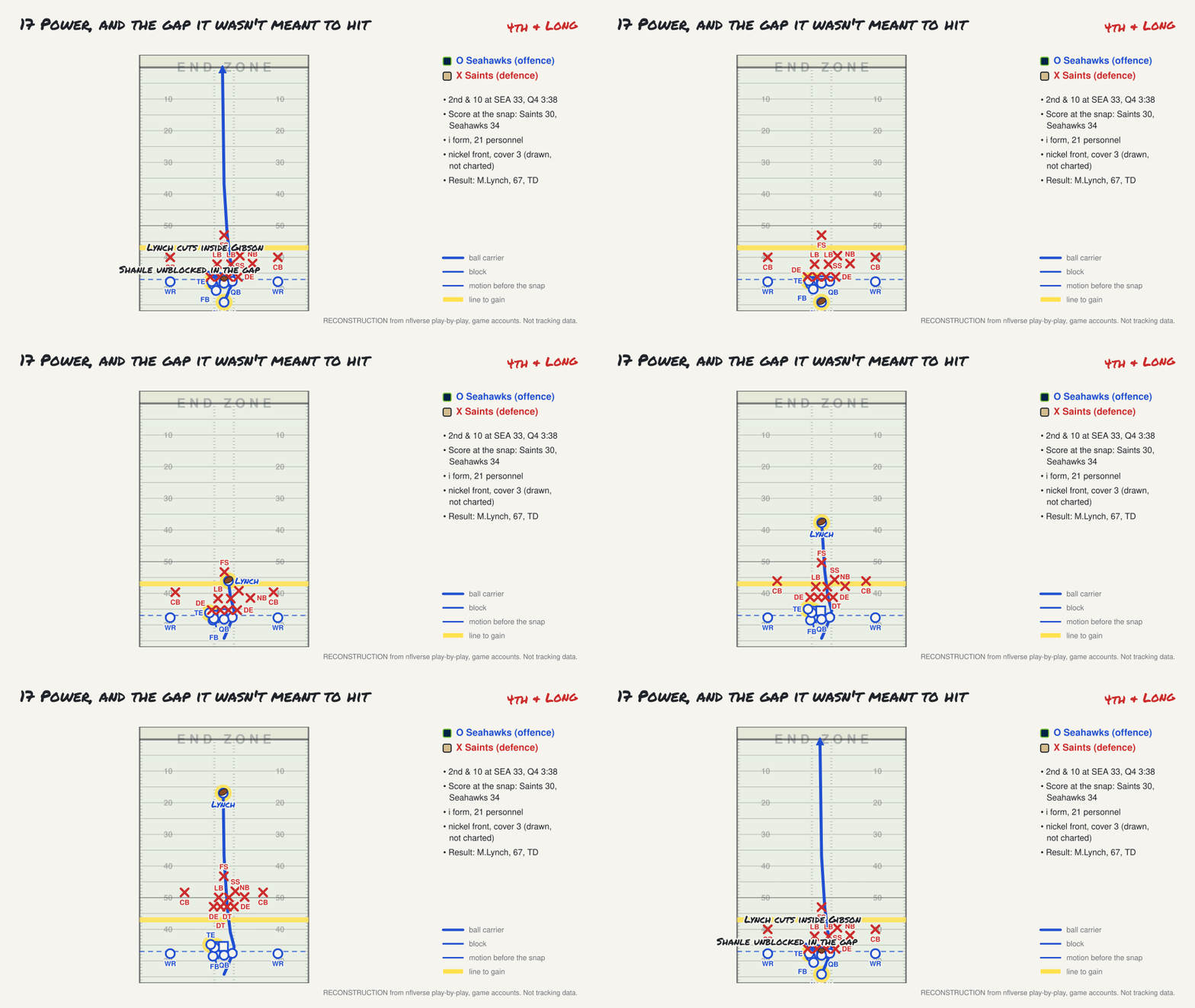
The part people forget is that the play was built to gain two yards, and the Saints read it. Seattle had run zone runs for most of the game, where blockers move together in an area rather than each taking one assigned man. This was their first power run of the game, a call the Seahawks named 17 Power: the right guard, Mike Gibson, leaves his spot and pulls to the left. Seattle lined up in an I formation, with tight end John Carlson on the left and fullback Michael Robinson offset left. New Orleans put eight defenders near the box, the area just behind the defensive line, with strong safety Roman Harper crowding the line. Power blocking is man-on-man.
Watch the left side. Carlson is assigned to linebacker Jo-Lonn Dunbar. Dunbar shoves Carlson backwards, which stops Gibson from ever reaching the point of attack. Left guard Tyler Polumbus and center Chris Spencer turn defensive tackle Remi Ayodele away, but neither can get off that block to reach linebacker Scott Shanle. Shanle reads Gibson pulling, fills the gap, and is waiting unblocked at the line of scrimmage. If he makes that tackle, Lynch gains two yards. Lynch said afterwards: "So I see the guard coming around, and in my head, I'm thinking, backside A gap. But for some reason, it carried me to the front side." He ran between Gibson and Robinson instead of behind Gibson, straight at Shanle, and then the play stopped being about design.
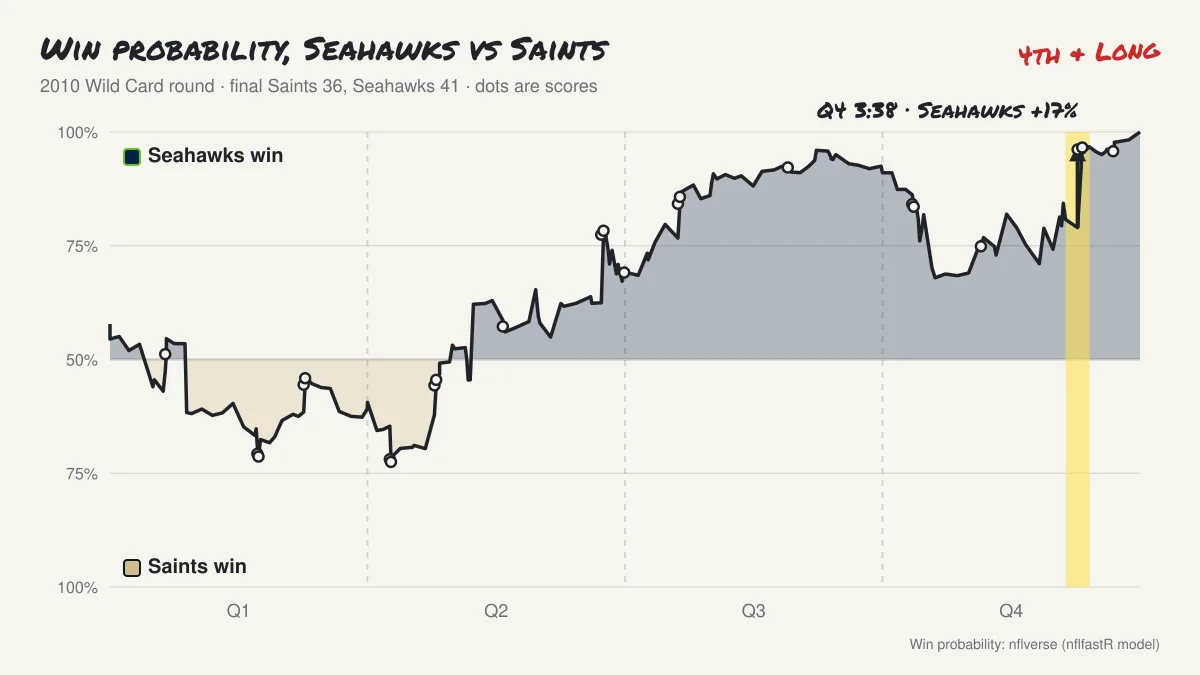
He broke away from Shanle, then through Sedrick Ellis and Will Smith, then past Remi Ayodele and Darren Sharper diving together, then outran Jabari Greer from behind, stiff-armed Tracy Porter to the ground (a stiff arm is pushing a defender away with an extended arm), left Alex Brown lunging at his heels, and finally dove into the end zone past Harper, who was still being blocked by Polumbus. Seattle's win probability, a model's estimate (nflfastR's) of each team's chance of winning, went from 79% to 96% on that one snap. The box score at pro-football-reference.com/boxscores/201101080sea.htm shows the shape of the game: New Orleans gained 474 yards on 82 plays, Seattle 416 on 60. The Saints outgained Seattle by 58 yards and lost.
Drew Brees threw a 6-yard touchdown to Devery Henderson with 1:34 left to make it 41-36, but the two-point conversion failed, and Carlson recovered the onside kick to end it. The seismic footnote has its own scale. Magnitude is logarithmic, so each whole number is ten times the shaking of the one below. The Beast Quake measured 2.0. Taylor Swift's 2023 concerts at the same stadium registered 2.3, which seismologist Jackie Caplan-Auerbach called more than twice as hard as the 2011 game (nytimes.com/2023/07/28/arts/music/taylo…). A Jorge Polanco walk-off for the Mariners in the 2025 postseason measured 3.0, ten times the shaking of Lynch's run. The play that decided a playoff game is now the quiet one.
en.wikipedia.org/wiki/Beast_Quake
I draw these from the play-by-play and the charting data; where each player stood is my reconstruction. If an X or an O is in the wrong place, say so in the replies.