A 1U shelf of flash holds 9.83 PB, and the drives did the work
Hammerspace has launched its own storage hardware: a 1U all-flash enclosure that holds up to 9.83 petabytes of raw capacity. One rack unit is 44.45 mm of vertical space, and 9.83 PB in that slice is roughly the capacity of a small data centre's spinning disk estate a decade ago.
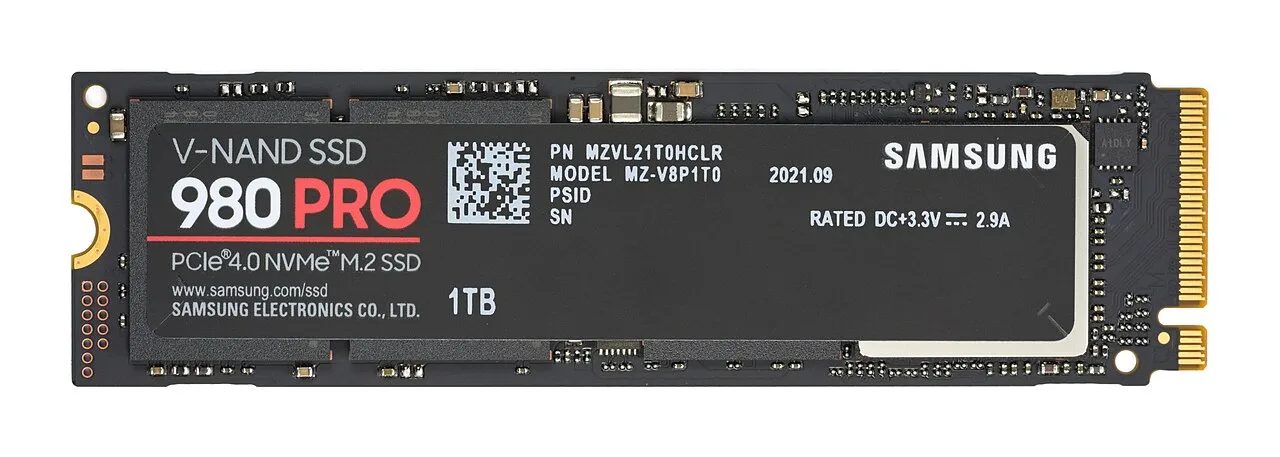
The density comes from the drives, not the box. Forty SSDs at 245.76 TB each gives 9,830.4 TB. QLC means quad-level-cell NAND, four bits per cell, which is cheap and dense but slower to write than the three-bit TLC used for speed. The enclosure is a frame for those drives: five sleds, each with a 64-core ARM chip acting as a data processing unit, eight drives per sled, two removable drive packs, and ten 400 GbE ports. 400 GbE is 400 gigabits per second of Ethernet, or 50 gigabytes per second per port after the 8:1 bits-to-bytes conversion, so the box's ten ports can carry 500 GB/s in one direction.
The number that will bind is the network. Hammerspace rates the box at 250 GB/s read and 350 GB/s write, which is 50 percent and 70 percent of what those ten ports can carry. Per drive, 350 GB/s across forty drives is 8.75 GB/s of write each. Whether those are measured or nameplate figures, and at what queue depth and access pattern, is not stated in the launch material. The 9.83 PB figure is raw capacity.
The architecture is the pitch. Hammerspace calls it the Open Flash Platform: metadata off the data path, clients reaching drives directly over pNFS (parallel NFS, a standard that lets a client read and write to storage nodes instead of funnelling every byte through one file server), and GPU server-local NVMe as a Tier 0 cache. The example given is twelve enclosures plus a 1U metadata server supporting eight GPU racks of 64 AMD MI355X accelerators each on a KV cache workload, against a claimed competing system needing four racks and 156 nodes. KV cache is the key-value state a large language model keeps while generating, which is what these boxes are sold to hold.
David Flynn, Hammerspace's founder and CEO, frames it as a reaction against over-provisioned flash: "Simply adding more storage isn't the answer. AI factories simplified compute. We're bringing that same transformation to data systems by unifying intelligence, orchestration, high-performance access and storage in one system." The comparison to four racks and 156 nodes is a claim to check rather than a result, because it depends on like-for-like workloads. The capacity number is real and the drive arithmetic is simple. The throughput number is the one I would want a queue depth attached to.