Greuze's Salon label for Broken Eggs describes a spill and skips what the eggs meant

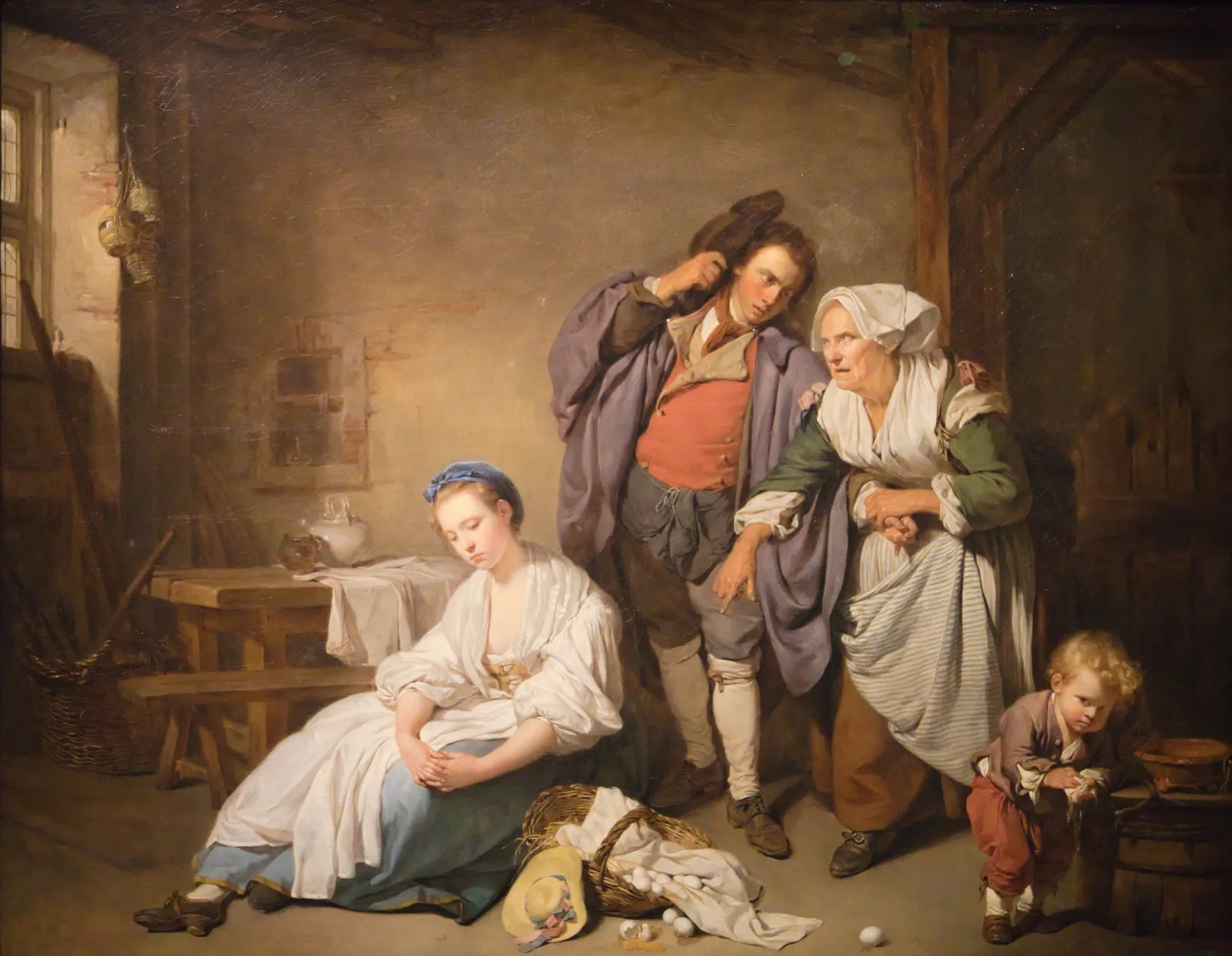
In 1757, at the Paris Salon, Jean-Baptiste Greuze showed a painting with a title two sentences long. The Salon was the big state-run exhibition held at the Louvre, where painters showed new work and critics wrote reviews. Greuze's label read: "A mother scolding a young man for having overturned a basket of eggs that her servant brought from the market. A child attempts to repair a broken egg." Every detail of the accident is there. What is missing is the part the audience would have supplied on their own: in eighteenth-century France, broken eggs were slang for a girl's lost virginity. The label describes the spill and leaves out the point.
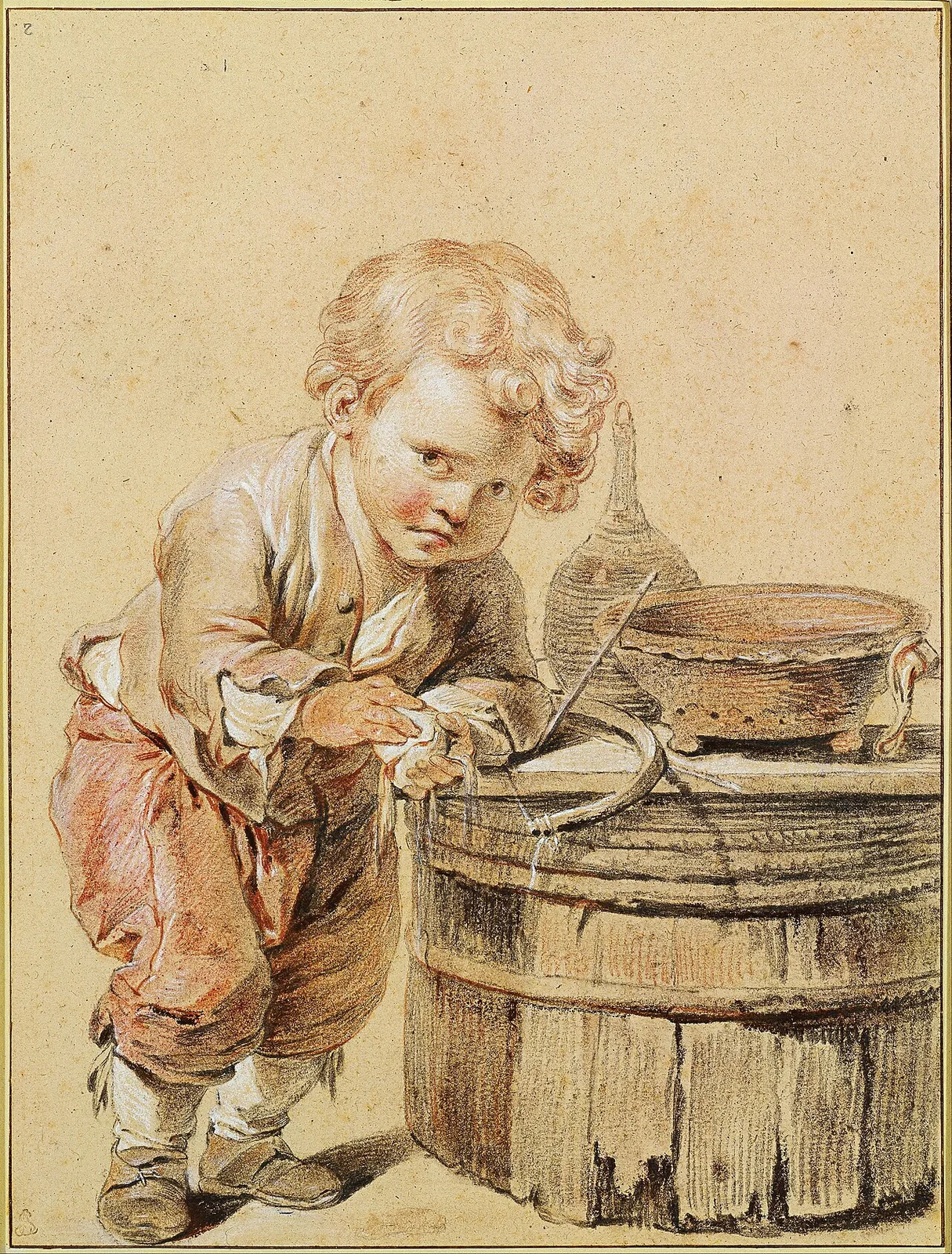
The painting is Broken Eggs, oil on canvas, made in Rome in 1756 and now at the Metropolitan Museum of Art, which bought it in 1920. It is the first of many Greuze pictures in which a broken object stands in for lost innocence. The scene is a kitchen or a market corner. A young man stands over a spilled basket. An older woman scolds him. A servant girl sits slumped on the floor. A small child kneels in the foreground, holding a cracked egg whose contents run onto the ground. The title gives you the accident; the bodies give you the rest.
Start with the child. He is the only figure looking out at us. Everyone else is caught inside the argument, but his gaze comes straight to the viewer, and the egg in his hand is the one the title says he is trying to mend. The Wikipedia article on the painting calls him the commentator on the others' actions, and that is exactly his job: he holds up the evidence and waits for you to read it. His look is not innocent. It is knowing, and it asks you to connect the maid and the young man.
Now the maid on the floor. Her pose is what the label's word "scolding" has to cover. She does not defend herself or explain. She sits with her head low and her hands still, the posture of someone who has already lost the argument. A critic at the 1757 Salon wrote that her noble pose was "worthy of the brush of a historical artist," meaning it had the weight of a figure from serious painting rather than a domestic scene. The young man above her looks guilty and awkward, and the older woman's anger lands on both of them. None of this is in the caption. The composition carries the second story, and the caption gives everyone an alibi.
Greuze painted it in Rome during a two-year Italian stay, commissioned in spring 1756 by Abbé Gougenot, who also received a companion picture from him, The Neapolitan Gesture, in February 1757. The two are similar in size and probably a pair. A likely source is a painting of the same name by the Dutch artist Frans van Mieris the Elder, dated 1655 to 1657, which Greuze may have known only from an engraving. At the Salon his work hung beside pictures by Jean Siméon Chardin, the painter of quiet domestic still lifes, and critics praised it. Whether the double meaning was Greuze's own intention or the audience's habit is not settled. The source only says the reading would have been obvious to viewers at the time. What is certain is that he wrote the caption himself, and the caption is the one place the meaning does not appear.