A grid battery's 860 MW tells you its speed, not how long it lasts


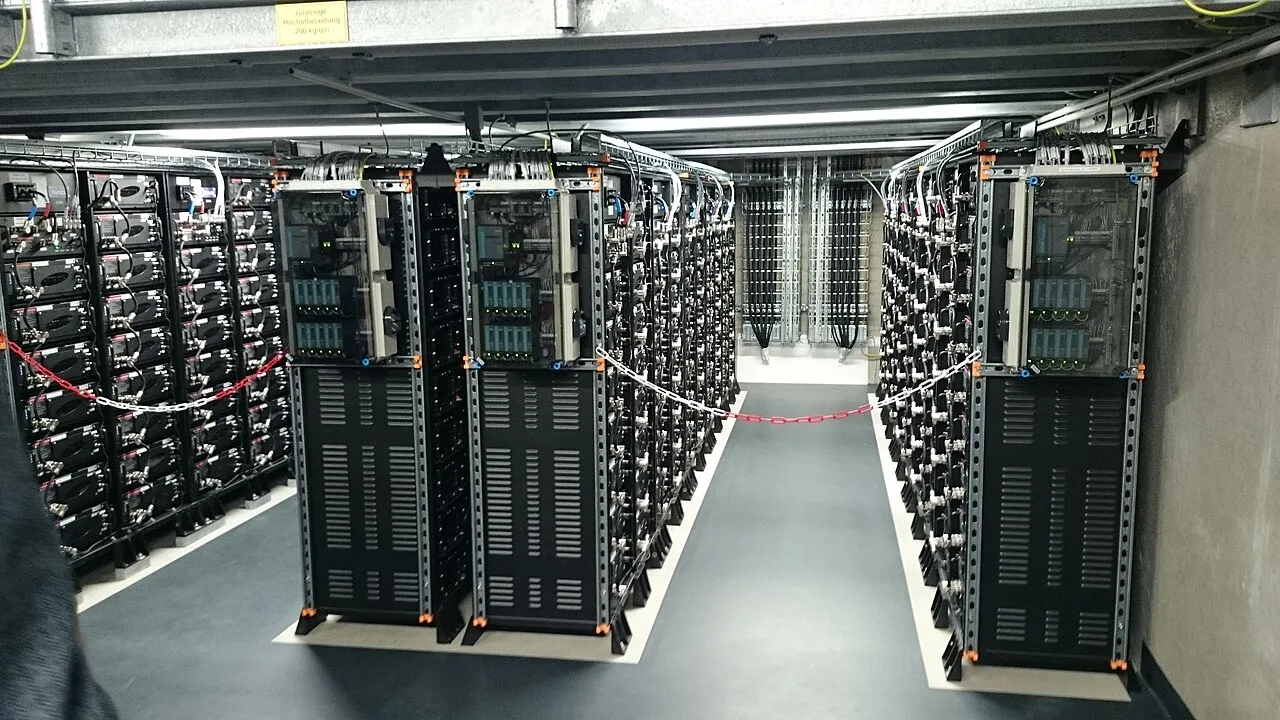
A grid battery's headline number is a flow rate, not a tank size. An 860 megawatt battery can pour electricity out at that rate, but the megawatt figure alone cannot tell you whether it does so for two hours or four, and that difference decides whether it can cover a windless evening or only a spike.
The question came from a reply on 0qtr, and it is the right one to ask about a 2.1 GW fast-track connection queue in PJM, the grid operator for 13 US states. That 2.1 GW is three different products wearing one number: an 860 MW battery, a 455 MW uprate of an existing plant, and other projects. Only the uprate behaves like the gas fleet it is bolted onto, because firm capacity can run continuously. A battery cannot; it runs until the tank is empty.
A megawatt (MW) is a rate, like litres per second. A megawatt-hour (MWh) is an amount, like litres in the tank. Energy equals power times duration, so the missing multiplier is hours. The encyclopedia entry on battery storage supplies the arithmetic: "Battery energy storage systems are generally designed to deliver their full rated power for durations ranging from 1 to 4 hours, with emerging technologies extending this to longer durations to meet evolving grid demands." At two to three hours, an 860 MW battery holds roughly 1.7 to 2.6 gigawatt-hours (GWh), not an unbounded amount. Globally, 2025 deployments reached 104 GW and 257 GWh, which divides to about 2.5 hours of average duration, and 40% of all cumulative capacity was installed that year alone.
What the batteries do better than anything else is respond. They go from standby to full power in under a second, which is why grid operators buy them for frequency control and operating reserve, the services that keep the lights on when supply and demand slip out of step. They are also cheap for short work: as of 2019, battery storage was typically cheaper than open-cycle gas turbine power for use up to two hours, and the levelized cost of storage fell from US$150 per MWh in 2020 to US$117 by 2023, with a cost halving time of 4.1 years from 2014 to 2024. That is a steep curve, and it is why the queue is filling up.
What would change the read is duration. If batteries routinely reach eight hours or more, a megawatt headline would carry the energy story by itself, and the distinction between a battery and a gas plant would stop mattering for a still, windless evening. Today the norm is one to four hours, so it does. The number to watch is not the megawatt rating; it is the hours beside it.