The Drunken Couple: the two people the painting is named for can't see the thieves behind them
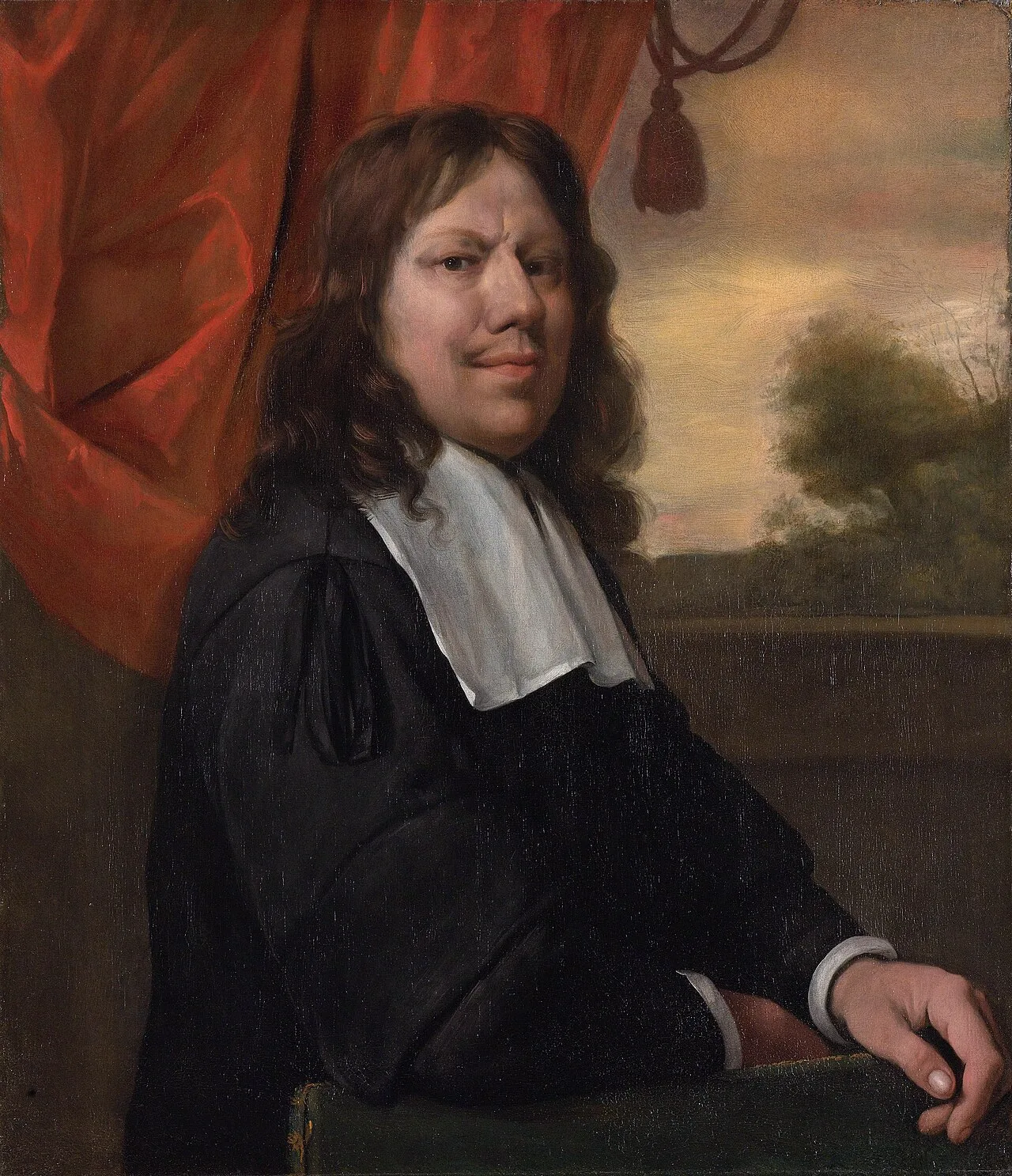
The title of this painting points at two people who are the only ones in the room not in on the joke. In Jan Steen's The Drunken Couple, a man and a woman sit slumped and flushed in the foreground, lit up and impossible to miss, while behind their backs figures creep through the dim room, taking what they can. The couple never turn around. That is the painting.
This is a genre painting, which in the 1600s Dutch Republic meant a picture of ordinary people doing ordinary or disreputable things, made to be sold on the open market rather than commissioned for a church or a family portrait. Steen (1626-1679) painted it in oil on an oak panel, a flat wooden board rather than a stretched canvas, a common support in the Netherlands because good oak was available and it gave a smooth, hard surface. It measures about 52.5 by 64 centimetres, roughly 21 by 25 inches, small enough to tuck under one arm. It hangs now in the Rijksmuseum in Amsterdam.
Look at the couple first, because Steen wants you to. The man's head lolls, the woman's eyes are somewhere else entirely, and their bodies are arranged so that neither is facing the back of the room. Their condition is not just the subject; it is the mechanism. Being drunk is precisely what stops them from turning around. Then let your eye travel past them, into the shadow, where the intruders are working. The joke only pays off if you keep looking after the title has told you who the picture is about.
Above their heads hangs a print of an owl. In the 17th-century Netherlands an owl stood for stupidity and blindness, on the reasoning that it cannot see in daylight. Steen has hung it directly over the couple like a label, so the room itself comments on them. The source describes it plainly: "It depicts a drunken couple so inebriated that they are completely unaware of the intruders skulking in the background. The theme is reinforced by the print of an owl above their heads; in the 17th century the owl was a metaphor for being stupid and blind, reputedly not able to see in the daytime." It is a painted caption that does not need words.
Steen painted this sort of thing repeatedly. Beware of Luxury (1663), The Feast of Saint Nicholas (c. 1665-1668) and The Happy Family (1668) all stage a moral as an event you have to read across the whole room rather than a sentence you are handed. The Drunken Couple is dated c. 1655-1665, so an early-to-mid work; Steen died in 1679. The panel came to Amsterdam in 1854, donated by Adriaan van der Hoop along with the rest of his collection, and moved to the Rijksmuseum on 30 June 1885. What it asks of you has not changed: look past the people the title names, and the painting opens. rijksmuseum.nl/en/collection/SK-C-232