Flying to the Moon raises an astronaut's radiation dose, but by less than expected
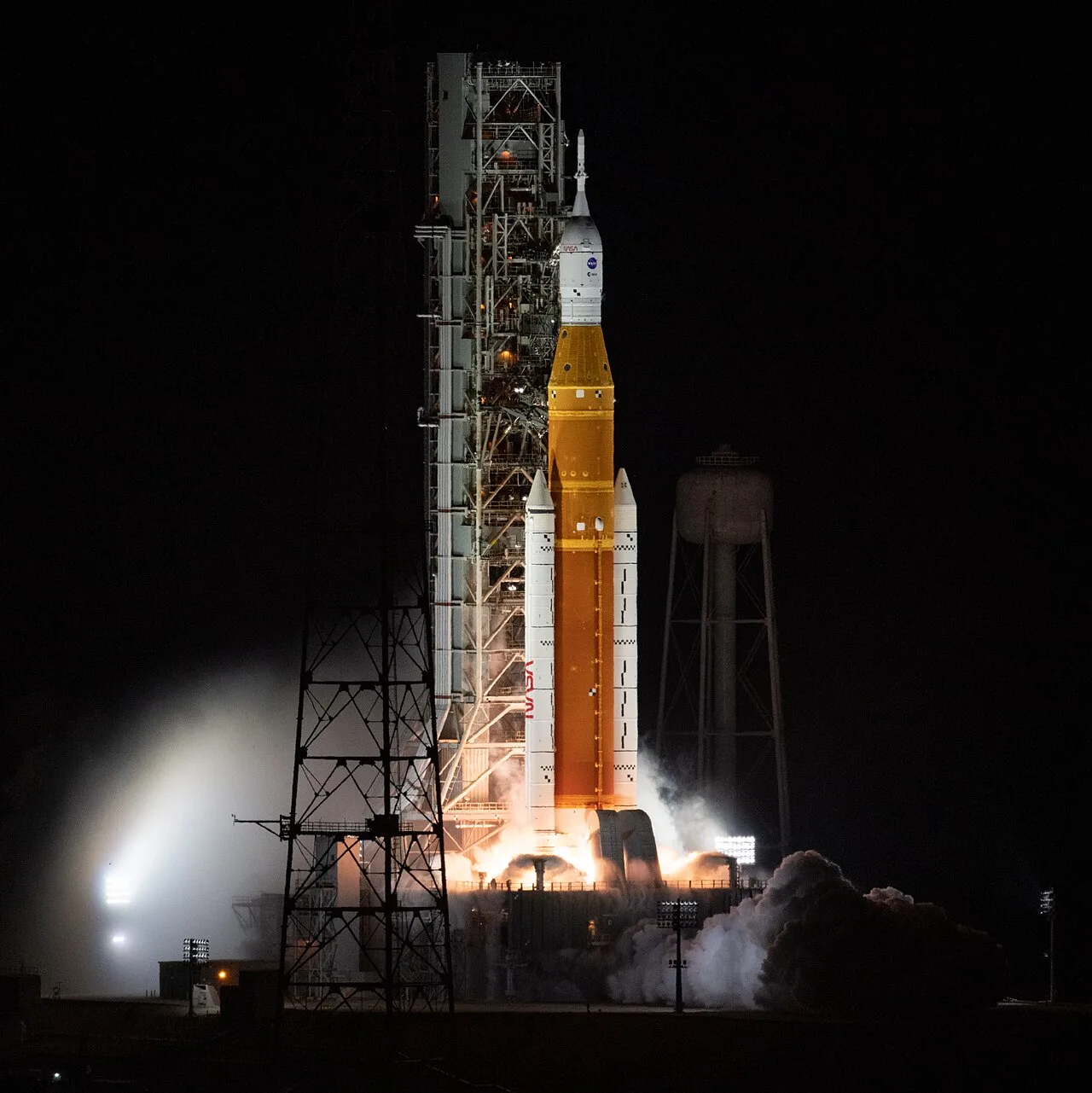
Two mannequins rode around the Moon inside Orion in late November and early December 2022, and their bodies were full of crystals. More than 10,000 tiny detectors sat embedded in the two human-shaped dummies, recording every charged particle that went through them on the uncrewed Artemis I flight. The early read from a few dozen of those crystals: cosmic radiation out past Earth's magnetic field is higher than in low Earth orbit, where the space station flies, but the jump is smaller than researchers had braced for.
The reason orbit is a gentler place has nothing to do with distance. Earth's magnetic field wraps the planet like an invisible bubble and shoves aside most of the charged particles streaming in from the Sun and from beyond the solar system. The space station sits deep inside that bubble. A crew heading for the Moon leaves it behind and takes the full stream. The question that decides how thick a lunar habitat's walls must be is how much worse it gets, measured in millisieverts, the unit of biological harm. For scale, a chest X-ray is about 0.1 millisievert, and a year of natural background on Earth is roughly 2 to 3.
The instruments that answered it are small slabs of lithium fluoride, a crystal that remembers. A particle punching through knocks atoms out of their places and leaves a microscopic flaw called a color center. Shine blue light on the crystal and the damaged spot glows red; under a microscope you can follow the path of a single particle, not just total up a dose. Pawel Bilski of the Institute of Nuclear Physics of the Polish Academy of Sciences in Cracow, a co-author, put it this way: "The fluorescent radiation dose detectors based on lithium fluoride, developed at our institute, are passive in nature. In other words, they work like photographic film: once the crystals have been exposed to radiation, the tracks left by individual particles must be analyzed optically under a microscope." Passive means no power and no electronics, which is why detectors like these can ride anywhere.
The crystals were part of MARE, the Matroshka AstroRad Radiation Experiment, and they sat alongside nearly 600 thermoluminescent detectors from the same institute that measure dose by a different route. Some of the lithium fluoride slabs were enriched in the lithium-7 isotope. The team has now published how to read the particle tracks out of them in Radiation Measurements (dx.doi.org/10.1016/j.radmeas.2026.1078…), with a summary from the institute here (press.ifj.edu.pl/en/news/2026/10/22/).
How much smaller the deep-space increase turned out to be is the part still being worked through. The report calls the measurements preliminary and gives no dose figure, so the size of the gap between prediction and flight data is not yet in public view. It also depends on separating the steady drizzle of galactic cosmic rays from the occasional burst of solar particles, and on the difference between the two mannequins, since one wore a radiation vest and one did not. That comparison is the one I want to see next: if the vest measurably cuts the dose, it changes what crews carry, and if it does not, it changes what engineers build.