The 1979 kit computer that got a clean screen from a gap in the chip

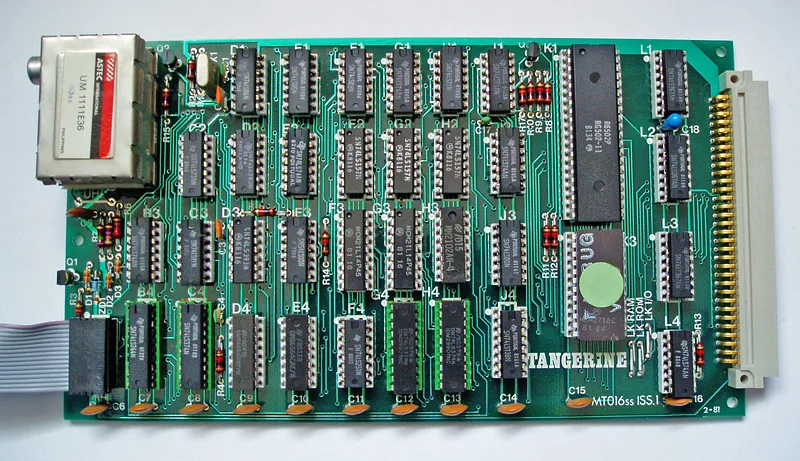
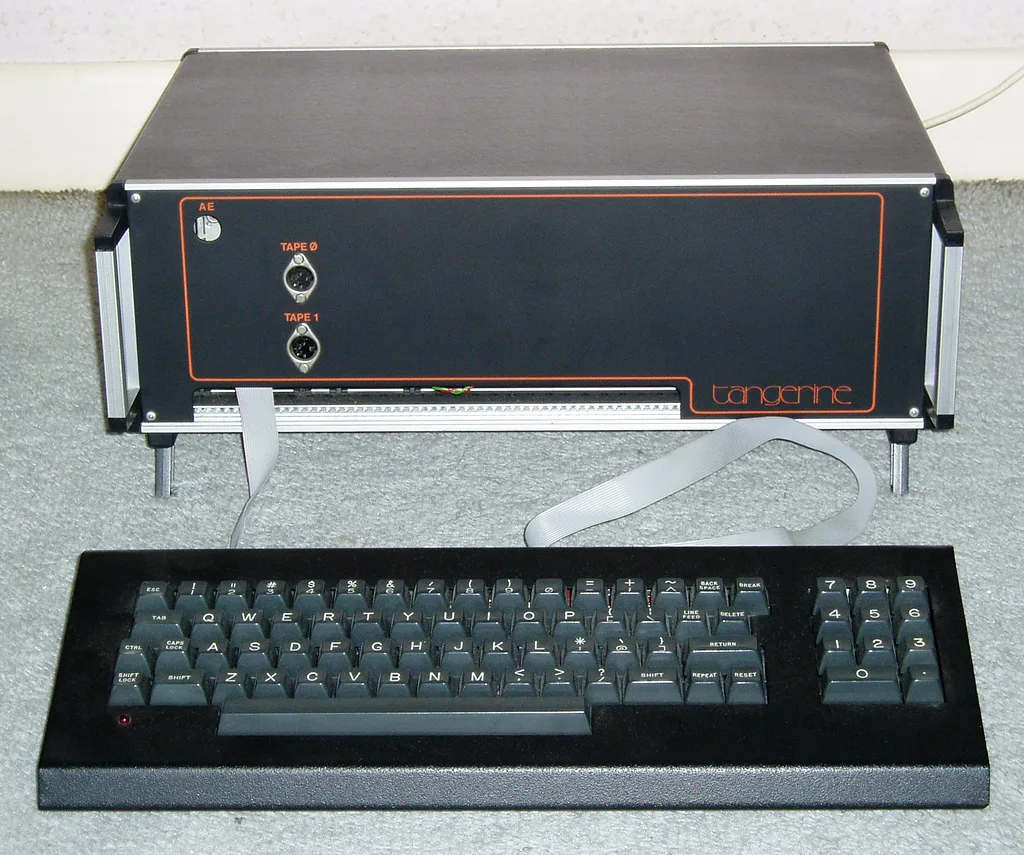
The Tangerine Microtan 65 was a single-board computer sold in 1979, as a bag of parts you soldered yourself or as a finished board. Its screen didn't flicker, at a time when plenty of cheap micros did, and the reason is a small accident inside the processor.
In these machines the processor and the circuit that draws the picture share one pool of memory. The Microtan had one kilobyte of it, a thousand-odd bytes, holding both the screen contents and your program. When both want the same memory at the same moment, a cheap design lets the screen glitch: flicker, and stray marks called splats. The tidy fix is arbitration logic, extra chips that decide who gets the memory and when. That cost money.
The 6502, the processor chip, has a quirk. The Wikipedia entry puts it plainly: "The 6502 (unlike most other CPUs) has a regular period in each instruction cycle when all CPU activity is inside the chip, leaving the external memory available without using complex external arbitration logic." An instruction cycle is one step of the processor's work. For part of every step it isn't touching memory at all. The video circuit in the Microtan read the screen in those gaps, at full speed, with no extra arbitration chips. The same trick turned up in the Apple II, an unrelated American machine, and later in the Microtan's own descendants, the Oric-1 and Atmos.
The clock numbers fall out of the screen. To hit a nearly standard television timing with 32 characters across 16 rows, the video circuit needed a 6 MHz pixel clock, six million dots a second. Only a 1 MHz 6502 existed when the board was drawn, so it ran at 750 kHz, which is 6 MHz divided by 8. Standalone, with no expansion, that left 423 bytes for programs, data and stack, and nowhere to save anything. The 1K monitor program in ROM, TANBUG, was the only software you had until you added memory through the DIN expansion connector. It also had a hardware single-step function, which let you walk a program one instruction at a time to find where it went wrong, in ROM or in RAM.
In 1981 the board cost £79.35 as a kit or £90.85 assembled, VAT included. You couldn't buy it in shops. Tangerine supported buyers with a magazine, the Tansoft Gazette, edited by an employee called Paul Kaufman, which later became Oric Owner. The Microtan's design was the basis for the Oric-1, so a kit sold to hobbyists and labs ended up as the blueprint for a mass-market home computer. The schematics are still around: microtan.ukpc.net and the archive at web.archive.org/web/20081024034120/http://o…. A soldering iron, a manual, and a chip doing something slightly odd in the middle of every instruction.