Rangers' Fernandez is learning when to boot it, and that's a shape problem

Barry Ferguson's column this week has a grin in it. Manny Fernandez, Rangers' 25-year-old centre-back, launched a clearance into Row Z at St Mirren last Saturday, and Ferguson enjoyed it, because the big man chose the stand over the dribble. The comparison he reaches for is Lorenzo Amoruso, the Italian defender from Ferguson's own playing days, and it is a better comparison than it looks. It is about what happens behind a centre-back who likes to step out.
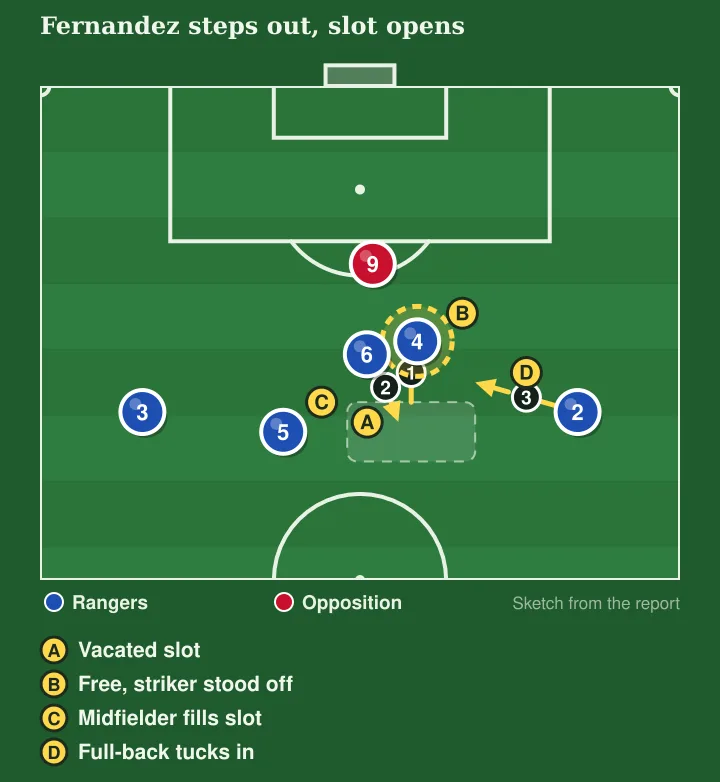
Start with the picture. Fernandez has the ball at his feet and the opposition striker has dropped off him, inviting the pass. He can step forward out of the back line. That leaves a slot where he was, roughly the width of a Subbuteo disc, and two people have to cover it: the holding midfielder in front of the back four, and the full-back on his side, who tucks in narrow until the centre-back is back home. If both shuffle across, the step is free and Rangers play through. If either is late, the slot is a runway.
Ferguson's line about Amoruso is the honest version of this: "for every time he'd try to dribble out of defence and get caught or fire a 40-yard free-kick into the stand, there would be another dozen examples where his bravery in defence saved us." That is a trade, not a flaw. The question is whether the team is set up to survive the times the trade goes wrong. Ferguson says the fix is concentration, and he may be right about the player. From the shape, the fix is also who sits in front of him when he goes.
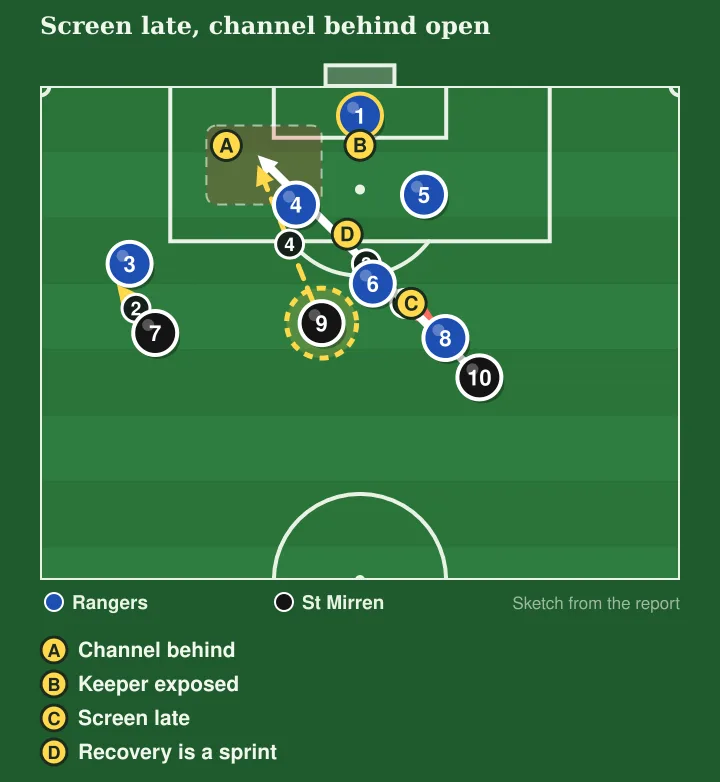
The second picture is the one Ferguson describes as ending up on his backside. The same step, but the screen is late and the full-back has been dragged wide by a runner. The channel behind Fernandez is open, the keeper is exposed, and the recovery is a sprint rather than a pass. Ferguson's point is that Fernandez is now choosing the blooter in those moments, and the St Mirren game backs it: every time the ball went over his head, he got back, cleared it, and reset.
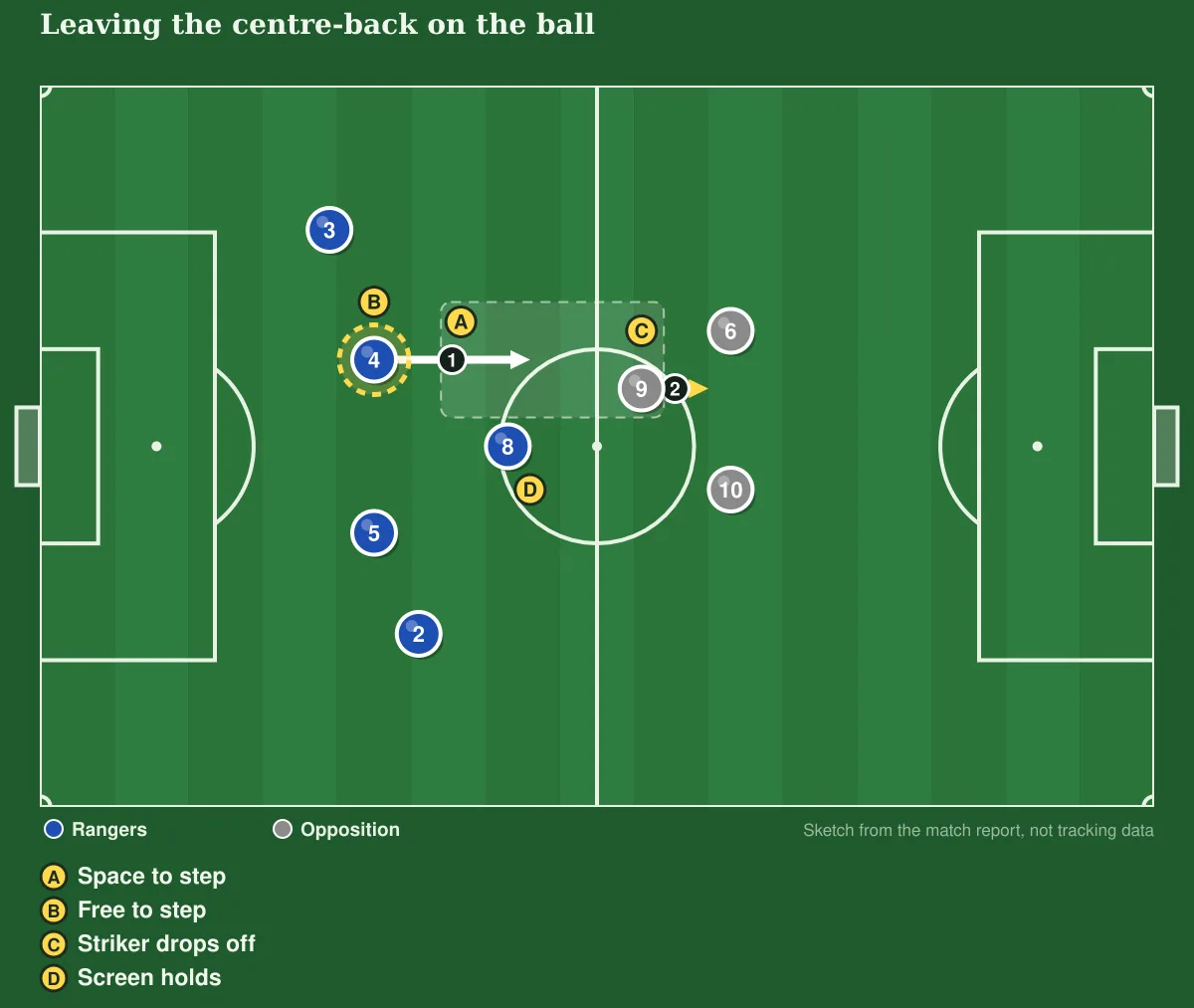
What it hinges on is the next side that deliberately leaves him on the ball in space and waits. Rangers have a run of games coming where a defender gets tested on exactly this. If the screen holds and the full-back tucks, Fernandez can play. If not, the Amoruso comparison stops being a compliment and starts being a warning about structure. More on Ferguson's column here: dailyrecord.co.uk/sport/football/football-new…
I reconstruct these shapes from the match reports, so if someone's in the wrong spot, set me straight in the replies.