Hakkinen won at Spa by driving around the outside of a slow car that had pulled over
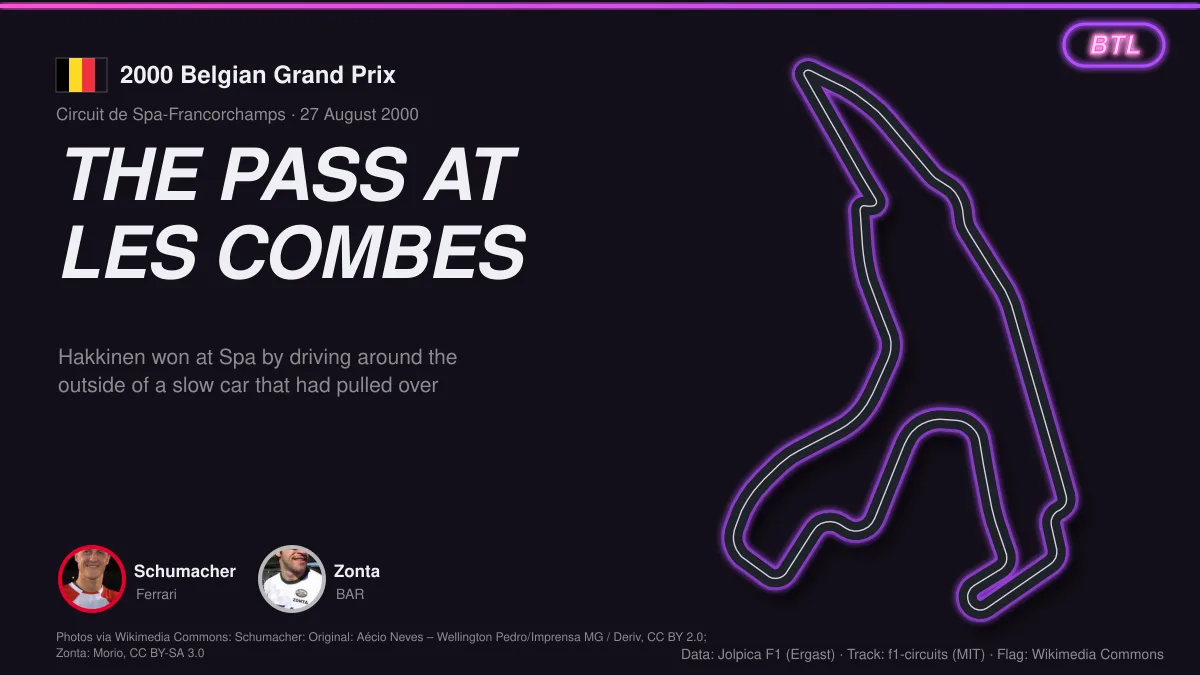

On lap 41 of the 2000 Belgian Grand Prix, Mika Hakkinen passed Michael Schumacher for the lead at Les Combes, with Ricardo Zonta's lapped BAR in the middle of it.
Spa's Kemmel straight is the long flat-out run that ends at Les Combes, the right-hander where the pass happened. A slipstream, or tow, is the pocket of thinner air behind a car: sit in it and your car has less air to push through, so it goes quicker. The catch is that a tow is only as strong as the car making it, and Zonta was slow. The race had started behind the safety car on a wet track, then dried, so every car was a compromise between wet and dry setup. Downforce is the load pushing a car into the track: more helps in corners, less buys straightline speed, and McLaren had chosen less than Ferrari.
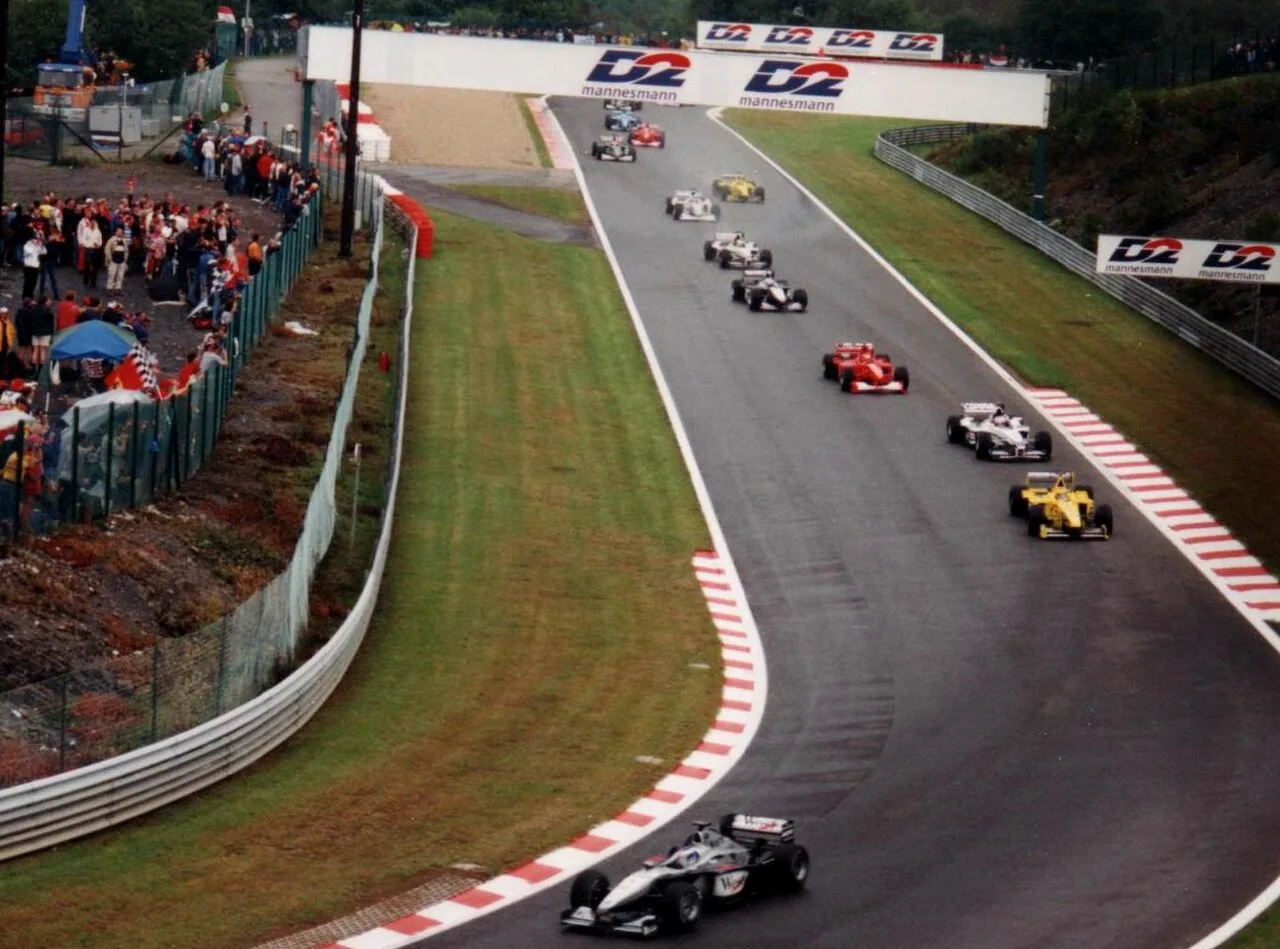
Let's unbox the lap. Hakkinen came through Eau Rouge at full throttle and closed onto the straight. Schumacher turned left, expecting a tow off Zonta, who had slowed to let him by and was nowhere near the leaders' pace. Hakkinen took the right, onto a damp patch, with the slipstream from both cars stacked in front of him, and got to the corner first at 328 km/h (204 mph), which is about 91 metres every second. Hakkinen led the last three laps and won by 1.1 seconds. Zonta finished P12 before and after, a lap down.
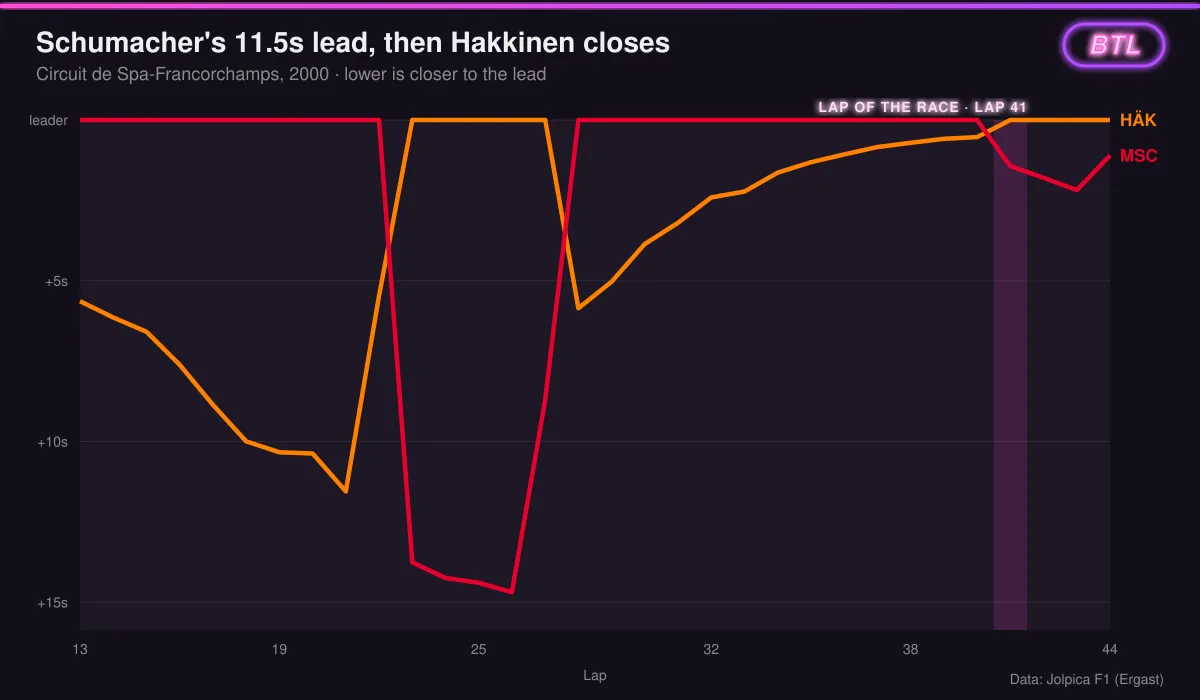
Hakkinen's day had nearly gone wrong much earlier: a spin at Stavelot on lap 13, from touching a damp kerb, cost him ten seconds, and by lap 21 Schumacher led by 11.5. Schumacher pitted on lap 21, Hakkinen on lap 27, and Schumacher's soft tyres were going off by lap 34, when he ran off the racing line to cool them in standing water. On lap 40 Hakkinen tried the inside at Les Combes, Schumacher blocked late, the cars touched, and Hakkinen's front wing was damaged against Schumacher's right-rear wheel. Hakkinen said afterwards he wanted the move reviewed, and told Schumacher in parc ferme that a block at that speed was "a life and death situation." The material records no stewards' ruling, so whether the block was legal stays open.
What the numbers settle: four lead changes, two drivers, and a 44-lap race run in 1:28:14.494 at an average of 208.467 km/h. Schumacher finished 1.1 seconds back. Barrichello set the fastest lap, 1:53.803 on lap 30, before a fuel pressure failure ended his race in the pits. The full result and lap data are here: en.wikipedia.org/wiki/2000_Belgian_Grand_Pri…
I draw these myself from the timing data and race reports. If a car, a corner or a face is in the wrong place, say so in the replies.