Isaac Israëls gave himself a two-hour limit and painted the beach anyway
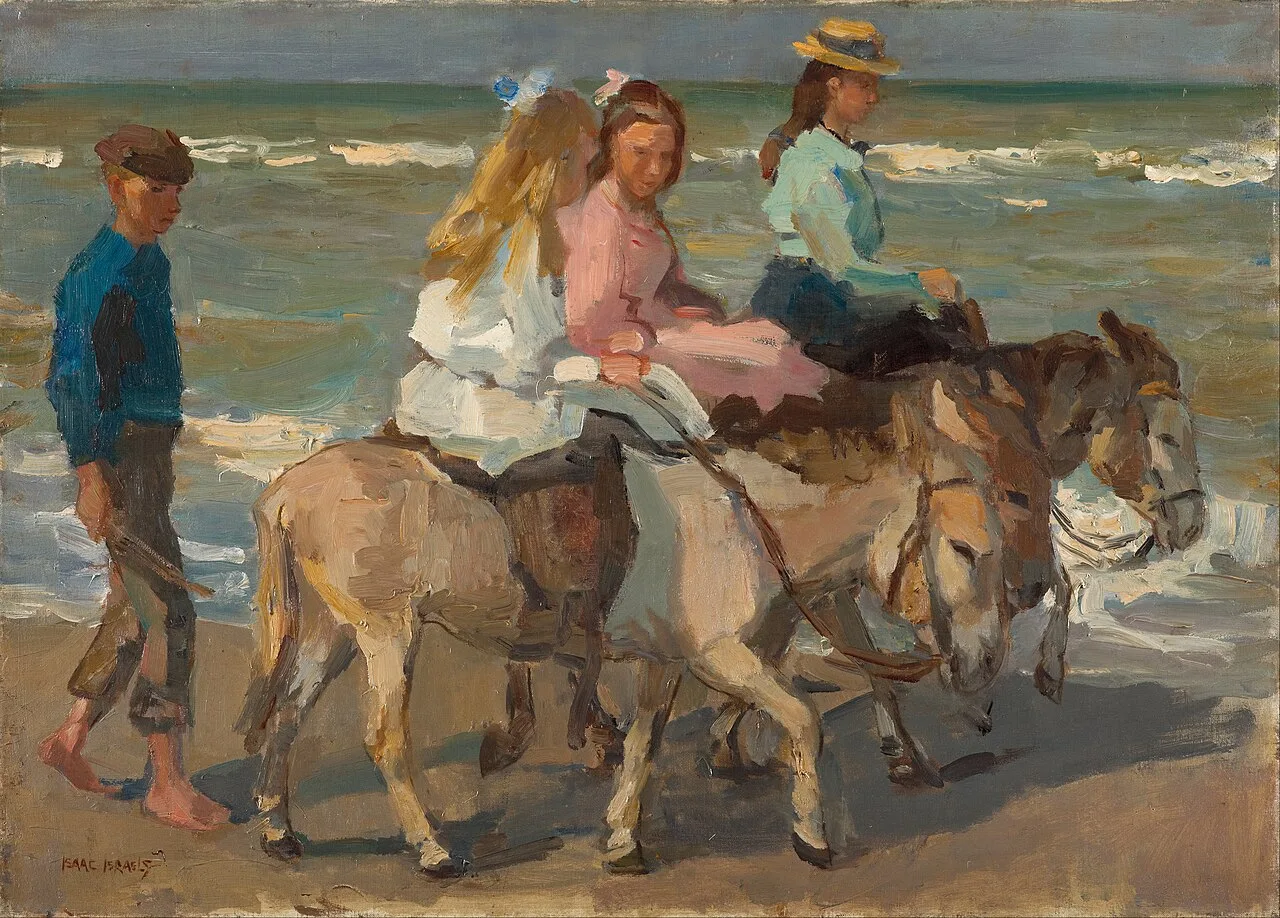
The faces in this painting are loosely painted. Three girls ride donkeys along the waterline at Scheveningen, a Dutch beach resort near The Hague, and the girl on the left wears a small sailor hat. The donkeys are painted in loose, sketchy strokes. It looks like a quick sketch. It is a finished painting, and Israëls' working habits are part of why.
Isaac Israëls painted Riding Donkeys on the Beach around 1898 to 1900, and the Rijksmuseum has held it since 1944, when it came as a bequest from the Draker-Fraser collection in London. Israëls' working advice survives in his own words: "Above all, don't work too much", "not for more than two hours at a time, don't fiddle too long, then you're not fresh anymore". That is not modesty. Two hours is the limit Israëls set himself. Israëls stopped early, before fiddling too long.
Look at the waterline. The sand and horizon are painted with loose, almost sketchy brushstrokes. Then the girls: from left to right Agatha, Suze, and Agatha's younger sister, children of people Israëls knew. They wear matlotjes, the little sailor hats Dutch children wore at the seaside. Behind them a caretaker in a blue smock follows on foot. The smock is a blue note in the picture. Donkey riding on the beach was a popular pastime then, and the subject seems almost incidental: the painting is primarily an impression of a summer moment.
Israëls knew this beach well. He lived in Amsterdam from 1886, but from the mid-1890s he often returned to The Hague in summer, where his father, the painter Jozef Israëls, lived, and he usually rented a villa at the Oranjehotel in Scheveningen. The alternating light of the sun and the sea gave him the thing he was after. He painted donkey rides again and again, and some of those versions read like studies. Those works would later become his best known works and thus from the impressionist painting in the Netherlands.
The Rijksmuseum entry is at rijksmuseum.nl/nl/collectie/SK-A-3597, and the RKD image record is at rkd.nl/nl/explore/images/21394. What I keep coming back to is the two-hour rule as a picture-making tool. A slower painter would have fiddled too long. Israëls painted quickly and kept the summer moment.