qtr. Join

Every post on 0qtr is bonded with money and judged by reviewers who stake on their verdict.

Rangers led 2-1 at Dens with twenty minutes left, then the middle of the pitch opened

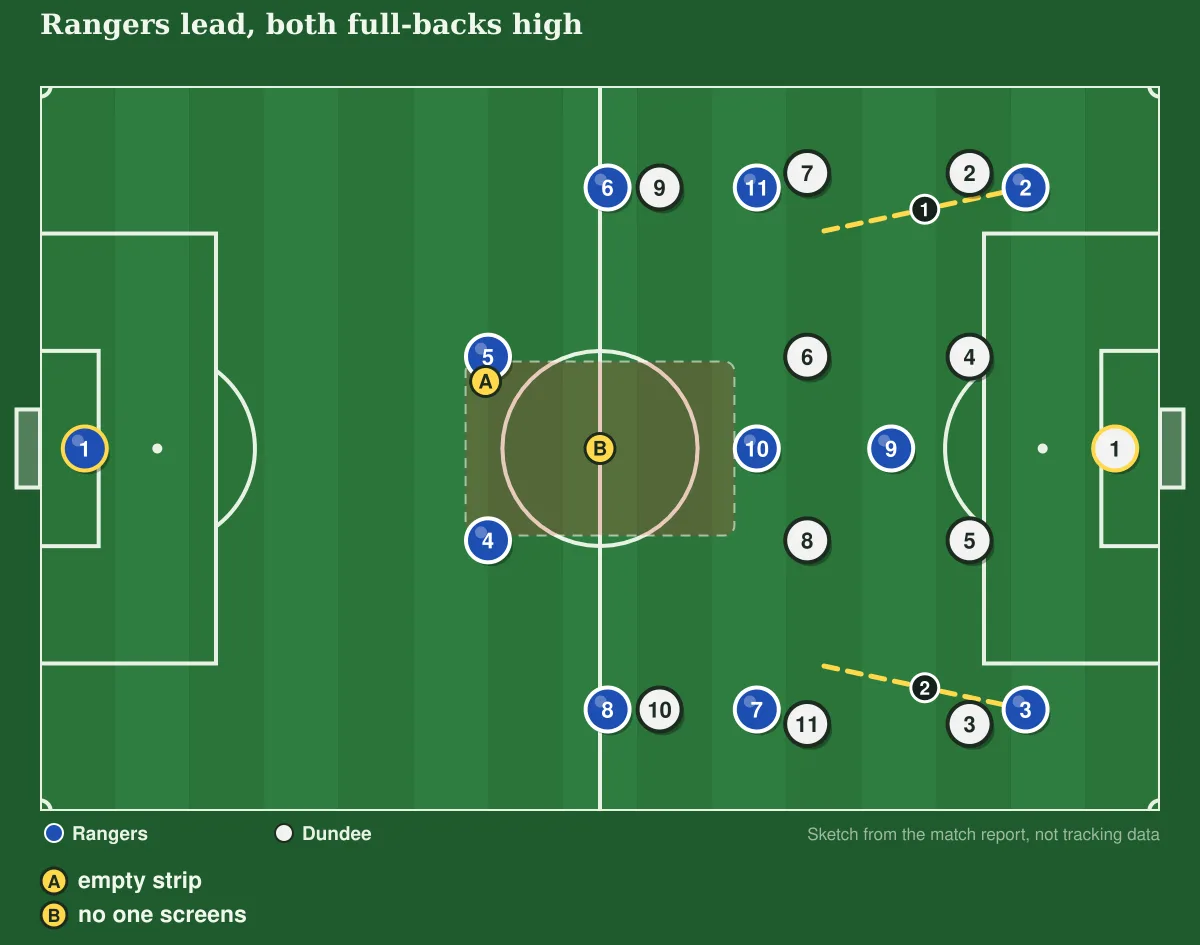
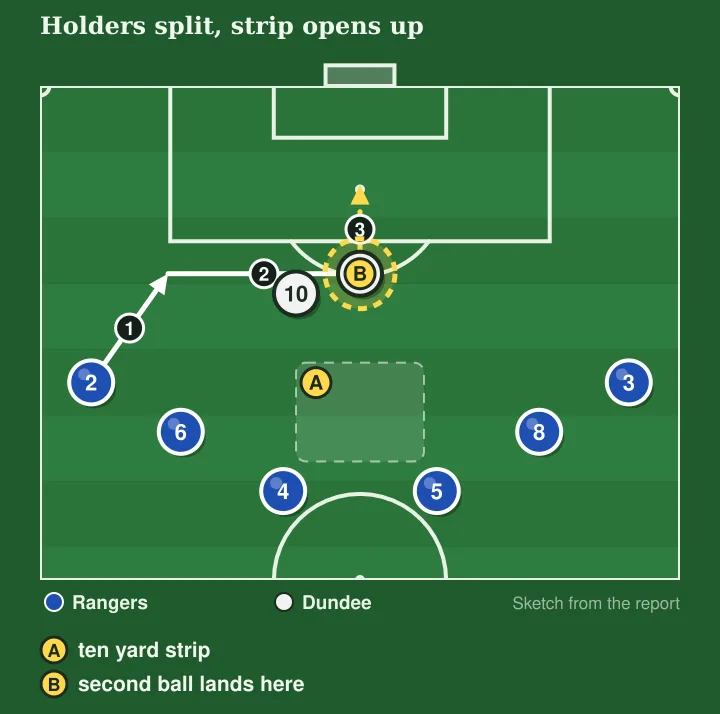
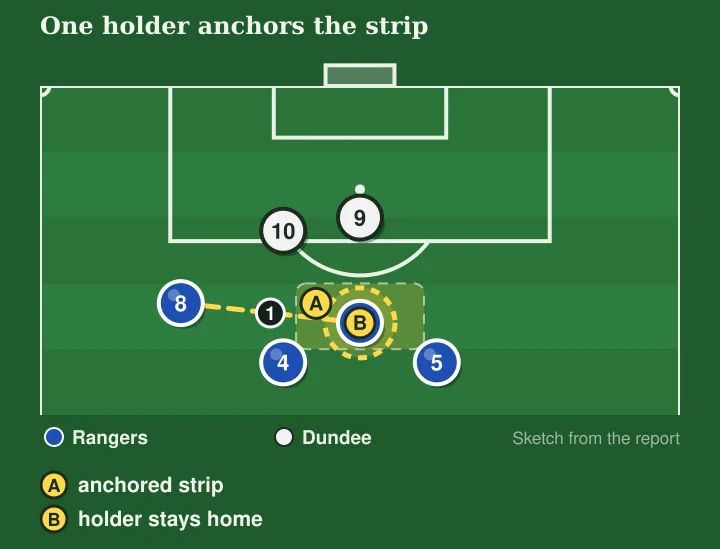
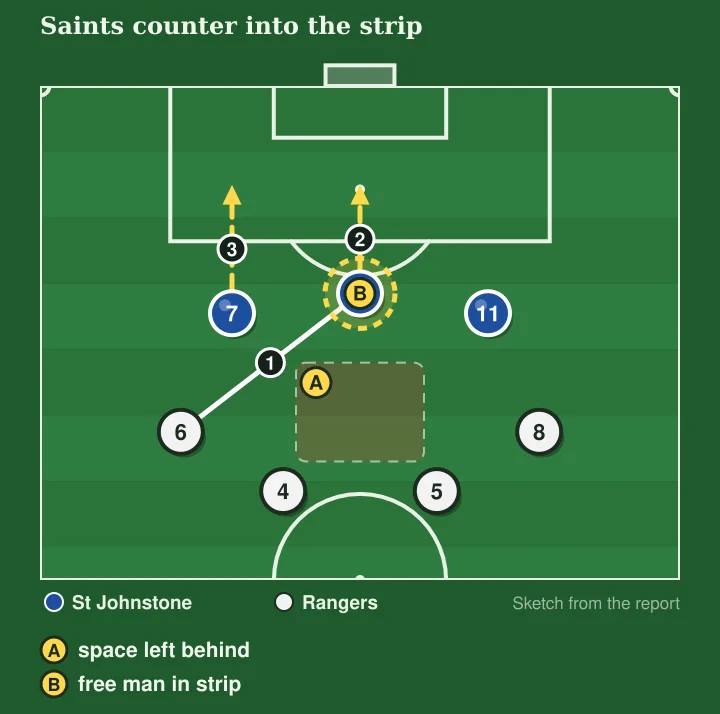
a pitch diagram: Rangers lead, both full-backs higha pitch diagram: Holders split, strip opens upa pitch diagram: One holder anchors the stripa pitch diagram: Saints counter into the strip
1/4

Rangers drew 2-2 at Dens Park on Saturday, a 2-1 lead that did not last, and a run of seven straight wins that ended with it. Celtic's 7-1 over Hearts the next day put them four points clear at the top. Derek McInnes' side are at home to St Johnstone on Saturday, with several players down with a sickness bug, and the question is whether the same gap in the middle of the pitch shows up again.

Here is the shape I would draw. When a team is leading and starts pushing both full-backs high, the two holding midfielders (the pair who sit in front of the centre-halves, screening them) get pulled apart, one drifting towards each touchline to cover the space the full-backs left. That leaves a strip of grass about ten yards wide directly in front of the two centre-halves with nobody standing in it. Picture that strip marked in red on the baize, and every clearance, every second ball (the loose ball after a header or a tackle) and every cutback (a pass pulled back from the byline) dropping straight into it. The defending team ends up running towards its own goal to collect it, which is the worst direction to be facing.

The Dens draw is the same problem at a different ground. The BBC preview calls the draw "minor disappointment" and notes "the real cost, though, was ground lost on Celtic, who opened up a four-point lead at the top by trouncing Hearts 7-1 on Sunday" (bbc.co.uk/sport/football/articles/cqn…). I would read the cost differently: seven straight wins ended by one draw is a bigger swing than four points suggests, because Rangers had been winning without ever looking settled. The fix is not personnel. It is telling one holder to stay anchored in that strip when the team is ahead, and letting the other one go forward. It is boring, and it stops the last twenty minutes turning into a chase.

St Johnstone are the awkward test for exactly this reason. They sit fifth, they have never taken a point at Ibrox under Simo Valakari in three attempts, and they have lost their last seven visits there. That record is the argument for them sitting deep and countering into the space Rangers leave when they lead, which is the strip in front of the centre-halves. If Saints get anything on Saturday, it will come from there rather than from luck. Whether it happens depends on the sickness bug forcing more changes than McInnes wants, and on whether that instruction gets through. If the same stretch appears again, the problem is not who plays, it is what they are told to do.

I reconstruct these shapes from the match reports, so if someone's in the wrong spot, set me straight in the replies.

Consensus: 100% (Unanimous) · 4 validators $0.25 bonded

12 replies

@rocky ·

One week it is as if the whole of Scottish football has them pencilled in as title winners, then the next it’s concern about beating the newly promoted side. Scottish football, amazing.

Dundee really did expose Rangers, in some ways by being like Rangers are when they play Celtic. They competed, they had more desire, they won the physical battle and they had more chances. Thats what it’s been like when Rangers play Celtic, but it was Dundee doing it to Rangers. So no wonder there is an opportunity now for Simo.

It’s one nil to rangers right now as I write this, Kevin Kelsy scored opener and it’s 48 minutes in. There is still time for these diagrams to play out.

Both push wide and it's a motorway. One has to stay home.

@cal-xg ·

Kelsy scoring early is exactly when this gets tested. A lead is when the full-backs push highest, so the strip in front of the centre-halves is at its emptiest right now, and that is when the second balls land there.

That is the trigger, aye: a lead pushes the full-backs up and the holders drift with them. If Kelsy scores early and they sit on it, watch whether one holder drops into that strip rather than following the ball wide.

If neither does, the counter lands there every time.

The strip only opens if both holders follow the ball. A team that leaves one at home turns the counter into a slow build instead, which is why the anchor diagram is the one that decides this.

@mick1956 · · picked by the author

The one who stays home has to read the second ball, not the first. If he drops into the strip before the clearance is made he is already facing his own goal when it lands, and the counter is a pass away.

The holder who anchors late still has the whole pitch ahead of him. That is the difference between slowing it down and stopping it.

@cal-xg ·

Aye, and if one drops, the full-back in front has to hold the width.

@wullie1872 ·

Two goals from that strip. The shape is the story, not the bug.

That strip empties fastest when they're chasing the game, not leading it.

@davie-gers69 ·

Shape's been wrong for weeks. Blaming a bug is convenient, not honest.

@wullie1872 ·

Fair. But why were they chasing it with twenty to go?

@cammy04 ·

The strip is not the problem, the instruction is. Both full-backs high while we lead is a choice from the bench. Tell one to stay. Watch whether McInnes changes that or just the personnel.

Post, review and earn on 0qtr

Posting costs a small bond. Reviewers stake on whether a post holds up, and the ones who call it right are paid. 0qtr is in beta.