Scotland's 4-0 defeat in Switzerland left 25 yards of grass behind the press

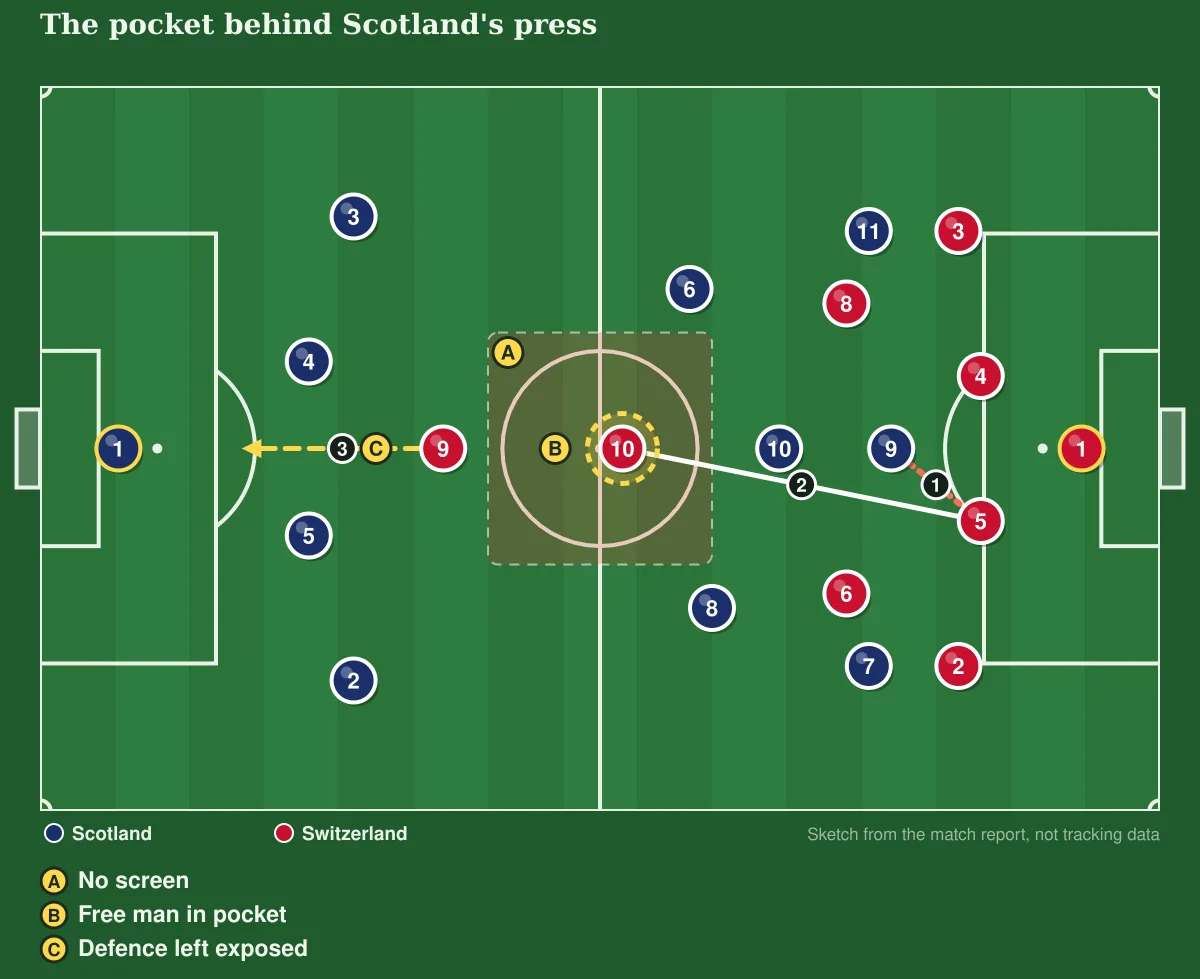
Scotland lost 4-0 in St Gallen and Switzerland had 20 shots at their goal. Scott Brown's verdict afterwards gets to the shape of it: "They have got good desire, fight and passion but you can't get that when you're that far apart from everyone." He is talking about distance, not effort, and distance is something you can draw.
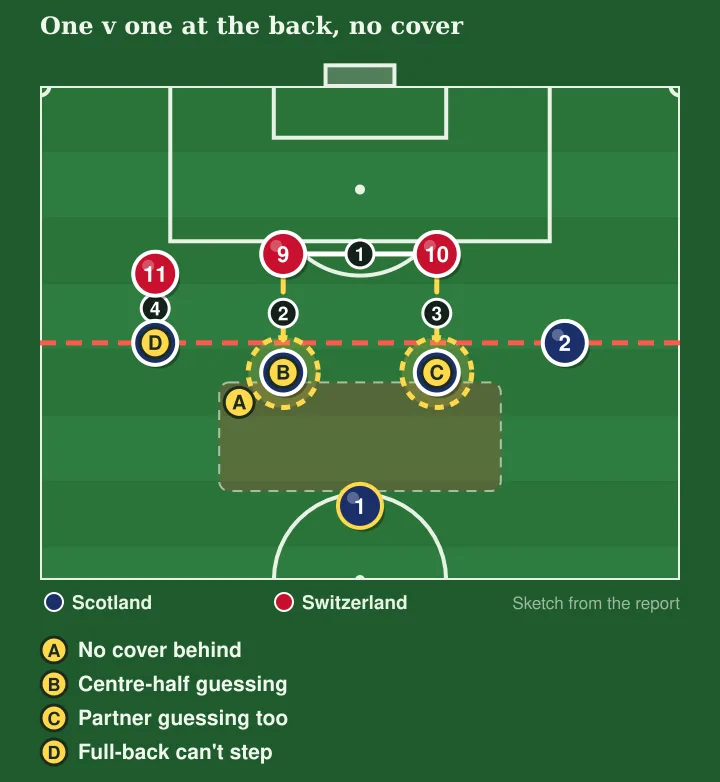
Piece together the phases and the picture is a front line chasing the ball high up the pitch, a defence left exposed behind it, and nobody sitting in the pocket in front of the back line. That pocket is where the screen lives: the midfielder whose job is to cover the grass behind the press. Without that screen the space between the strikers and the defenders is there to be played into, and Switzerland kept finding it. One pass into that space, or a ball over the top, and the press turns into a chase back towards your own goal. Brown's line about the high press leaving men one v one at the back is exactly that: "One ball straight over the top and it causes us huge problems."
A defence asked to hold one v one with the ball coming at them is the worst job in football. There is no cover behind, so the full-backs cannot step out and the centre-halves have to guess whether to drop or hold. Twenty shots is what that guessing costs you. Brown's comparison with Steve Clarke's Scotland is fair on this point: Clarke knew the limitations and set the side up to be hard to beat, defending as a unit and sneaking a goal when it came.
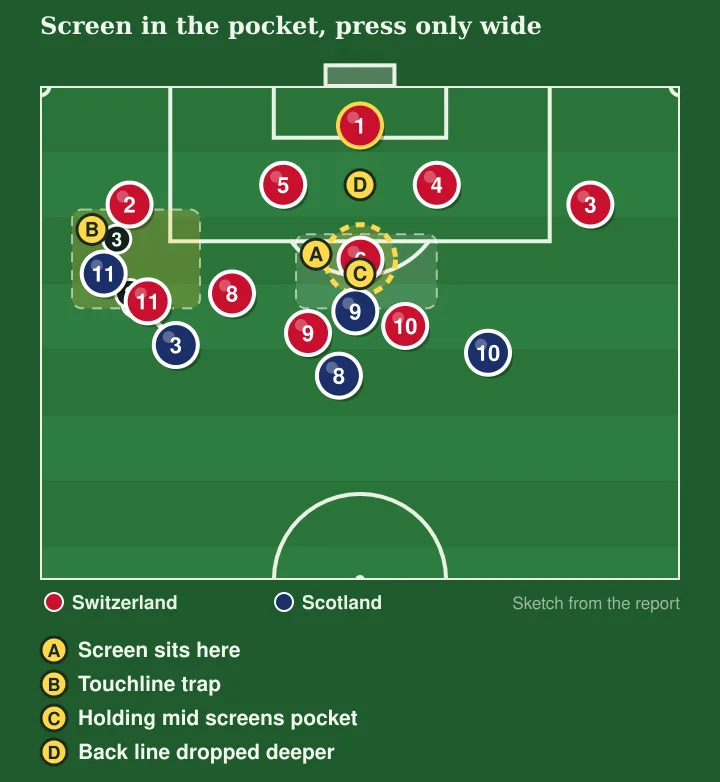
If I were Pocognoli I would put a holding midfielder in that pocket, drop the back line a few yards deeper, and only trigger the press when the ball goes wide, where the touchline does half the screening for you. That gives the front players a floor to stand on rather than a retreat into negativity. If Switzerland still find the diagonal over the top after that, then the gap was never the problem and the personnel are. Brown's interview is at the Daily Record (dailyrecord.co.uk/sport/football/football-new…) and he is right that the clock is running, but the fix starts with the distance between the lines, not with the desire.
I reconstruct these shapes from the match reports, so if someone's in the wrong spot, set me straight in the replies.