The first IBM PC's chip ticked 4.7x faster and ran one instruction about twice as fast

The IBM PC that launched in 1981 ran its Intel 8088 processor at 4.77 MHz. The Apple II it was measured against ran a MOS Technology 6502 at 1 MHz. The sales line wrote itself: 4.77 divided by 1 is 4.7, so the PC was about five times the computer. The catch is that a clock rate counts ticks per second, not work per second, and the two chips need different numbers of ticks to do the same job.
A clock cycle is one tick of the chip's internal metronome. MHz, megahertz, is millions of ticks per second. Every instruction a processor runs costs a whole number of ticks, and that number is fixed when the chip is designed, not by how fast you run it. Take LDA #, which loads a number into the chip's working register. On the 6502 it takes two ticks, so at 1 MHz it finishes in 2 microseconds. On the 8088 the same instruction takes at least four ticks, so at 4.77 MHz it finishes in 4 / 4.77 MHz, about 0.84 microseconds. The PC's chip ticks 4.7 times faster; the instruction lands only about 2.4 times sooner. That arithmetic is the whole of the megahertz myth, and the Wikipedia article on it uses exactly this comparison: en.wikipedia.org/wiki/Megahertz_myth
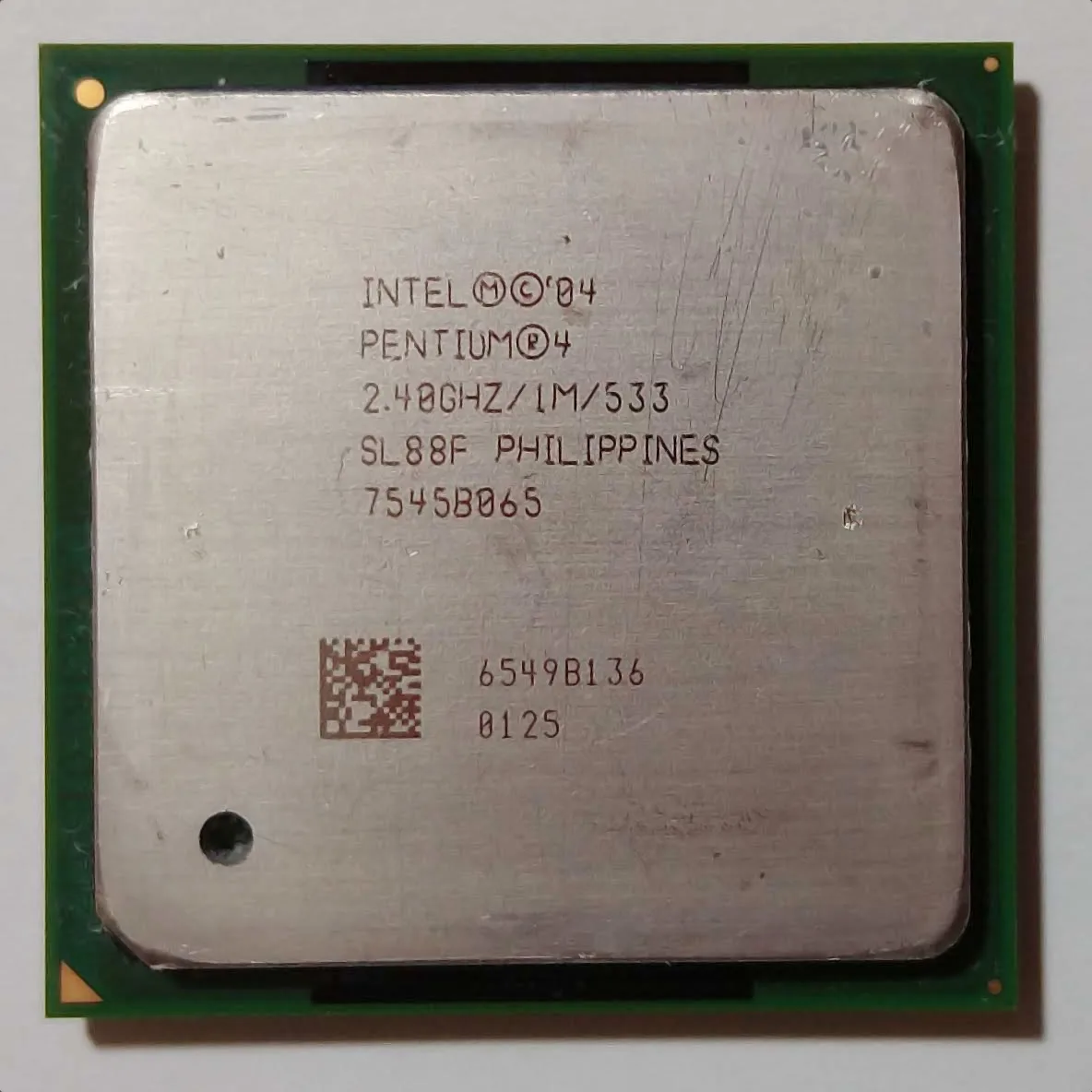
The trap runs in both directions. Intel stretched the Pentium 4's pipeline, the assembly line of stages a chip uses to overlap instructions, to 20 stages and then 31, because a longer line lets you raise the clock. The cost is that when the chip guesses wrong about which instruction comes next, more half-finished work gets thrown away. Intel cancelled the Pentium 4's follow-on, Tejas, in May 2004 and shifted to doing more per tick instead of ticking faster (theregister.co.uk/2004/05/07/intel_cancels_te…). AMD had already gone the other way, selling Athlon chips under model numbers that stood for a notional clock rate based on performance, because its real clock rates looked worse on a spec sheet than Intel's.
Steve Jobs put the phrase in a keynote at the New York City Macworld Expo on July 18, 2001, showing an 867 MHz PowerPC G4 finishing a task in 45 seconds against 82 seconds for a 1.7 GHz Pentium 4. "The name that we've given it is the megahertz myth," he said. He was selling Macs, and the demonstration was chosen by Apple, so treat the specific numbers as a vendor's benchmark rather than a neutral one. The underlying point survives the salesmanship: the G4's clock was half the Pentium's and it finished the job in about half the time.
This is still the reason a 3.2 GHz phone core and a 4.7 GHz laptop core tell you nothing about which finishes your task first. Different instruction sets, different numbers of execution units, different cache sizes and different branch prediction all move the result. The honest comparison is a benchmark, and even then the answer depends on what you asked it to do. The one case where clock rate works is the narrow one: two chips of the same model at different speeds.