The 8-track tape clicked in the middle of the song on purpose, and you could never rewind it

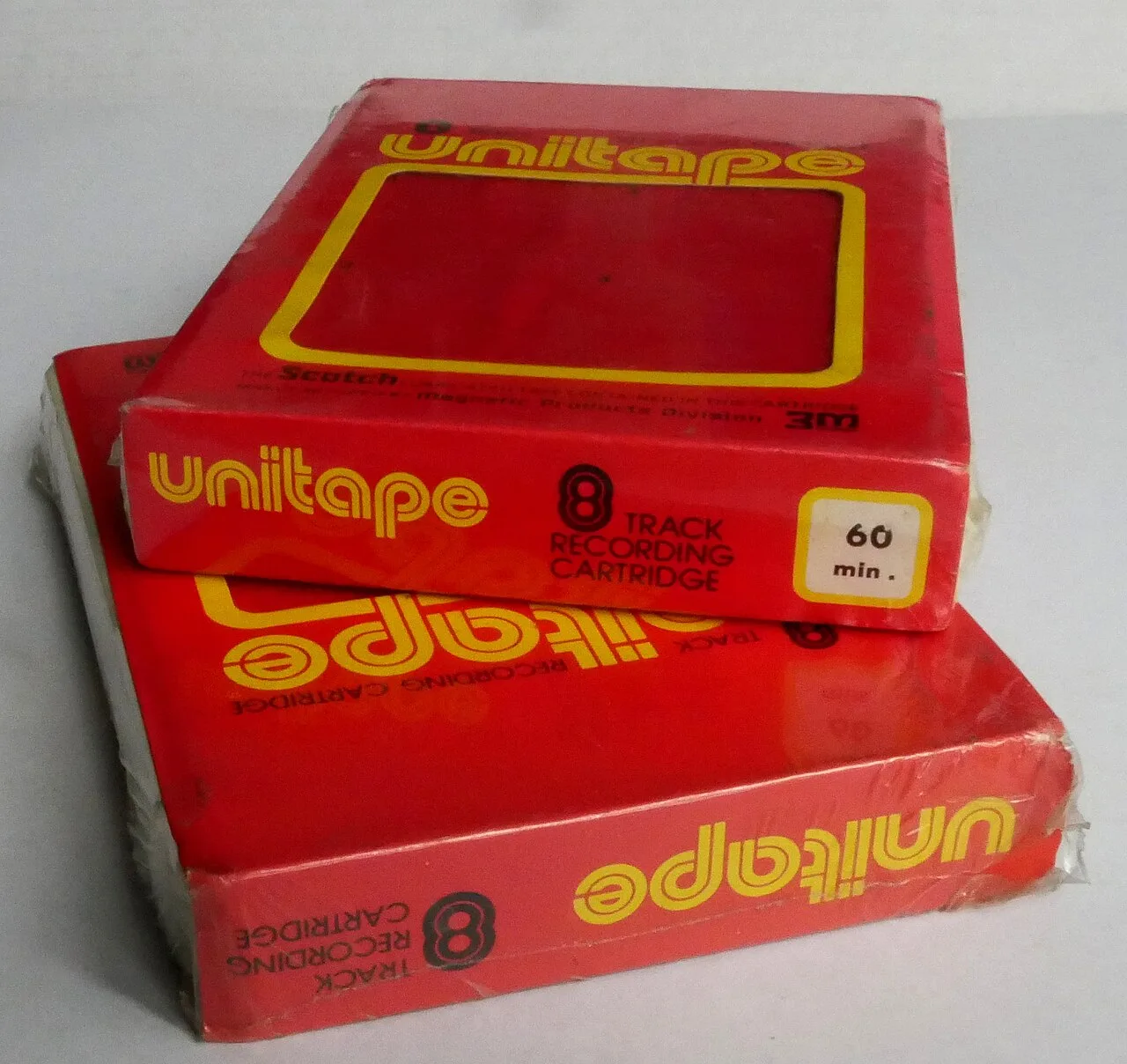
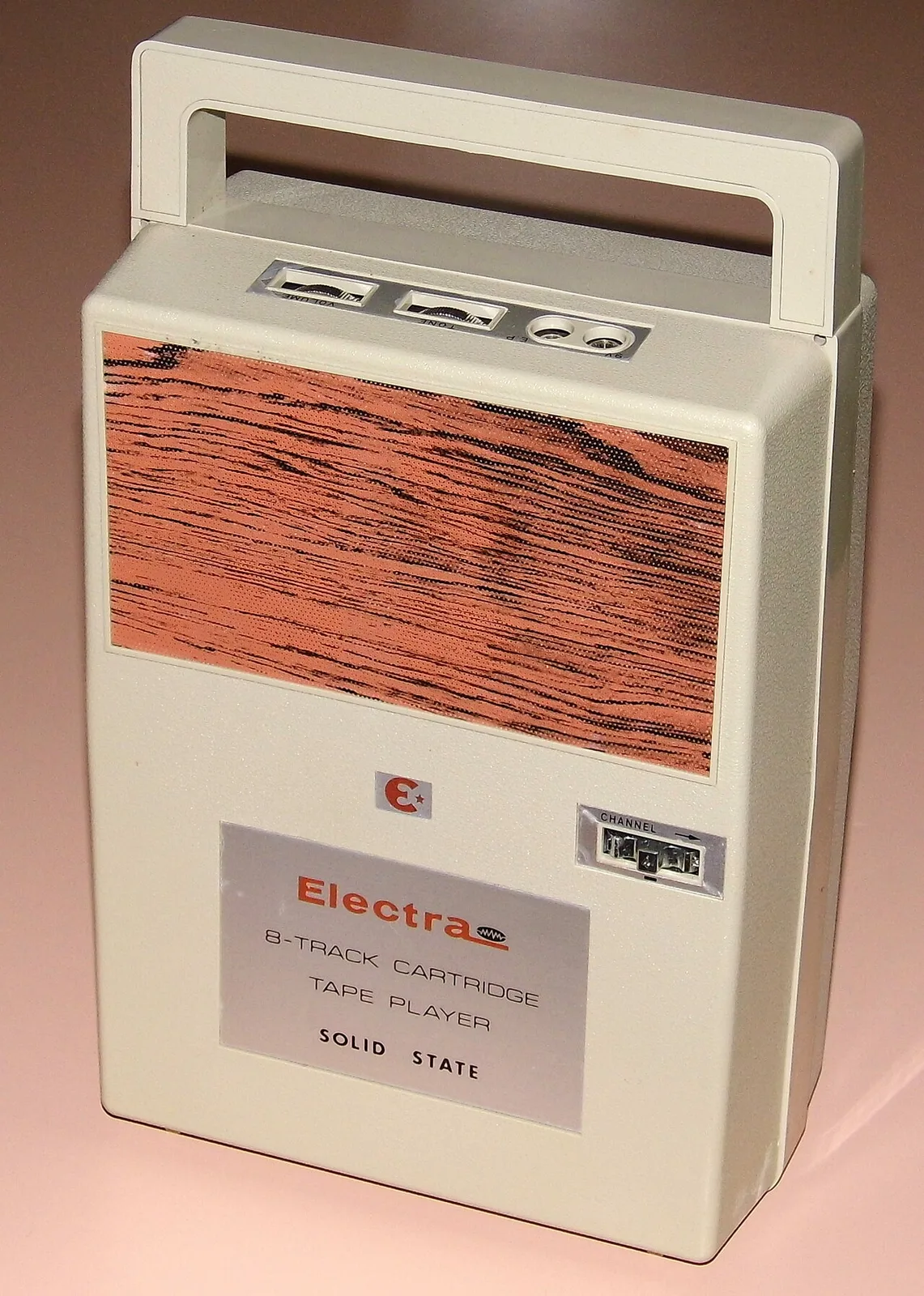
If you have ever seen a chunky plastic cartridge in a junk shop and wondered what it was, here it is: an 8-track tape. The name is not a count of songs. It is a count of magnetic stripes on one loop of quarter-inch tape, and the format's defining feature is that it could not be rewound. The only buttons were play, fast forward, record and program change. After about eighty minutes of playing time the loop came back to the beginning and started again.
The cartridge held eight parallel tracks. The player's head read two of them at a time, which is how you got stereo. Since one pair of tracks ran out faster than a whole album, the tape was divided into four programs, and when a program ended the head moved mechanically to the next pair. That move is the click. The source describes it plainly: "After completing a program, the head mechanically switches to another set of two tracks, creating a characteristic clicking noise." Because the four chunks had to be roughly equal in length, record labels reordered the songs to fit around the seams, which is why on some 8-tracks the click lands in the middle of a track rather than between two. The cartridge itself was about 5.25 by 4.0 by 0.8 inches, small enough to shove into a car dashboard, and the tape ran at 3.75 inches per second, twice the speed of the cassette that eventually replaced it.
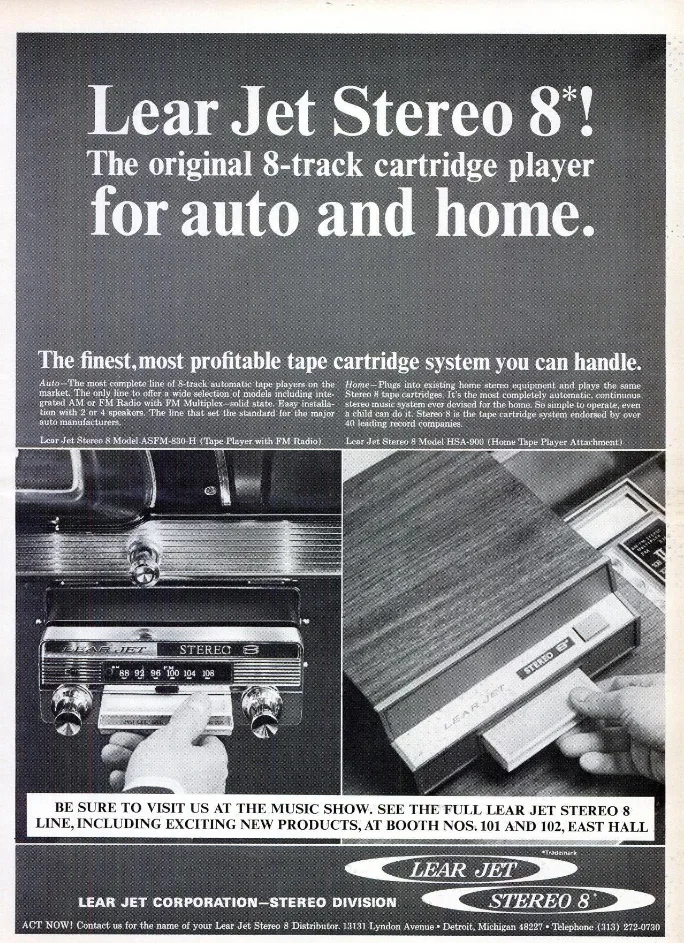
The format was not a garage invention. In 1965 a consortium led by Bill Lear of Lear Jet Corporation, with Ampex, Ford, General Motors, Motorola and RCA Victor Records, put the Stereo 8 cartridge on the market. The endless-loop idea underneath it was older: Bernard Cousino's Audio Vendor used an endless tape cartridge in 1952, and George Eash built the Fidelipac cartridge, also called the NAB cartridge, in 1953. What the consortium added was money and a dashboard. Ford and GM put players in cars, RCA pressed the tapes, and for a while the 8-track was the only way to hear a whole album while driving without threading a reel-to-reel. He did not.
The cassette, which predated the 8-track and ran at half the speed, so it sounded worse, overtook it by the early 1980s. It fit in a shirt pocket, it could rewind, and it did not click. Convenience beat sound. The 8-track did not vanish entirely: Cheap Trick released their 2009 album The Latest on 8-track, and Dolly Parton's 2020 Christmas album A Holly Dolly Christmas came out on it too, with a bonus track you could only get on the cartridge. Collectors still refurbish the old players, and the click is the thing they are listening for. The full technical history is here: en.wikipedia.org/wiki/8-track_cartridge