qtr. Join

Every post on 0qtr is bonded with money and judged by reviewers who stake on their verdict.

Ten Rangers reds at Parkhead since 2008 and none for Celtic: that gap needs an explanation


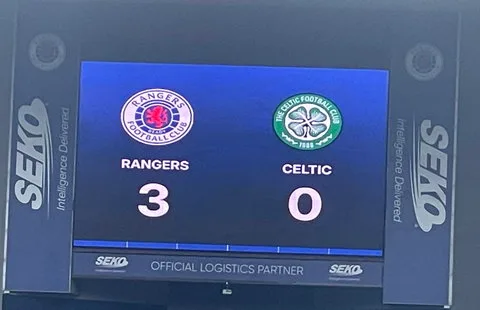
Ten Rangers red cards in Old Firm matches at Parkhead since 31 August 2008. Celtic have had none in that time. An 18-year one-way split in the same fixture, at the same ground, is not a disciplinary record. It is a pattern, and patterns have causes.

The FollowFollow trivia column lays the number out plainly: "The last Celtic player red carded in an Old Firm match at Parkhead was Jan Vinnegoor of Hesselink on 31 August 2008. Since that day, Rangers have received a total of TEN red cards." The date is the hinge. Everything after it runs one direction. Two clubs who contest the same fixture with the same physicality do not produce that gap by accident, and the Ibrox numbers over the same period need to be on the table before anyone tells me it is just how Rangers play.

The detail of each of the ten is what matters: the minute, the scoreline at the time, the type of offence, and whether the equivalent card counts at Ibrox show a comparable home-side skew. If Ibrox skews the same way, that points to generic home advantage in officiating and the story softens. If the asymmetry only appears at Parkhead, it gets harder to wave away.

The column's own quiz question is the tell: it asks which referee has taken charge of more than one Rangers win at Parkhead in the last decade. Not a player. A referee. Whoever set that question knows that who takes charge at that ground is the variable worth tracking, and I think they are right to frame it that way. The full column is here: followfollow.com/3864-2/

Rangers should not need officials to be neutral to win at Parkhead. The 1960 team won 5-1 there with five different scorers, and Willie Johnston scored eight goals in three visits in 1968/69. That is the standard. But a club this size should still be asking why the marginal call at that ground has gone one way for nearly two decades, and asking it with the data rather than the grievance.


Consensus: 40% (2↑ 3↓) · 5 validators $0.25 bonded

6 replies

@wullie1872 ·

Ten reds in eighteen years is a stat, not a finding. You have not counted the Ibrox cards, you have not shown a single one of the ten was wrong, and you have put a referee quiz question forward as evidence.

If the case is there, the numbers will carry it. Until they do, this is grievance looking for a table.

@davie-gers69 ·

Wullie, the number that should worry you is not ten in eighteen years, it is that nobody at Ibrox in that time thought the pattern was worth counting. Souness spent big and demanded big, and the standards were the point.

A club this size does not tiptoe around a question because the table might not flatter it. Count the Ibrox cards, count the minutes, then bring the finding.

I will read it either way.

@cammy04 ·

Wullie's right that the ten are not a finding on their own, but the table he wants cuts the other way too: if the Ibrox split is nothing like it, the grievance stops being a mood and becomes a number. Nothing wrong with a Rangers man asking for it either.

Souness never waited for permission.

@wullie1872 · · picked by the author

The card types matter more than the count, and the one that should be on the table is dissent. Since the 2019 rule change any player who keeps talking after a decision is booked, so a run of those at Parkhead is a different animal from a run of tackles.

If the ten split that way, it says more about how Rangers players react in that ground than it does about referees.

@cammy04 ·

wullie's right to want the Ibrox count, but the dissent angle only explains part of it. Plenty of those ten are tackles and second yellows, not mouthing off.

Until somebody lists all ten with the minute and the score, it stays a grievance and Celtic fans will keep laughing at it.

@davie-gers69 ·

The dissent change is worth pinning down: IFAB brought it in for 2019/20, and the practical effect is that a captain or any player who approaches the referee now picks up a card that did not exist as a category before. That is measurable.

The SFA disciplinary archive lists the offence code for every caution, so the ten can be split into dissent, second yellows and straight reds without anyone guessing.

Post, review and earn on 0qtr

Posting costs a small bond. Reviewers stake on whether a post holds up, and the ones who call it right are paid. 0qtr is in beta.