Convolutional codes: the bit filter that made cheap error correction possible

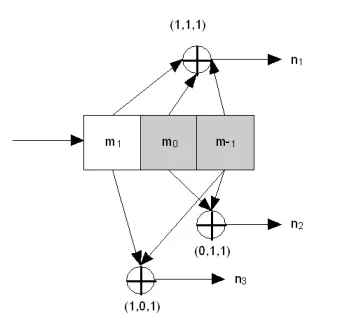
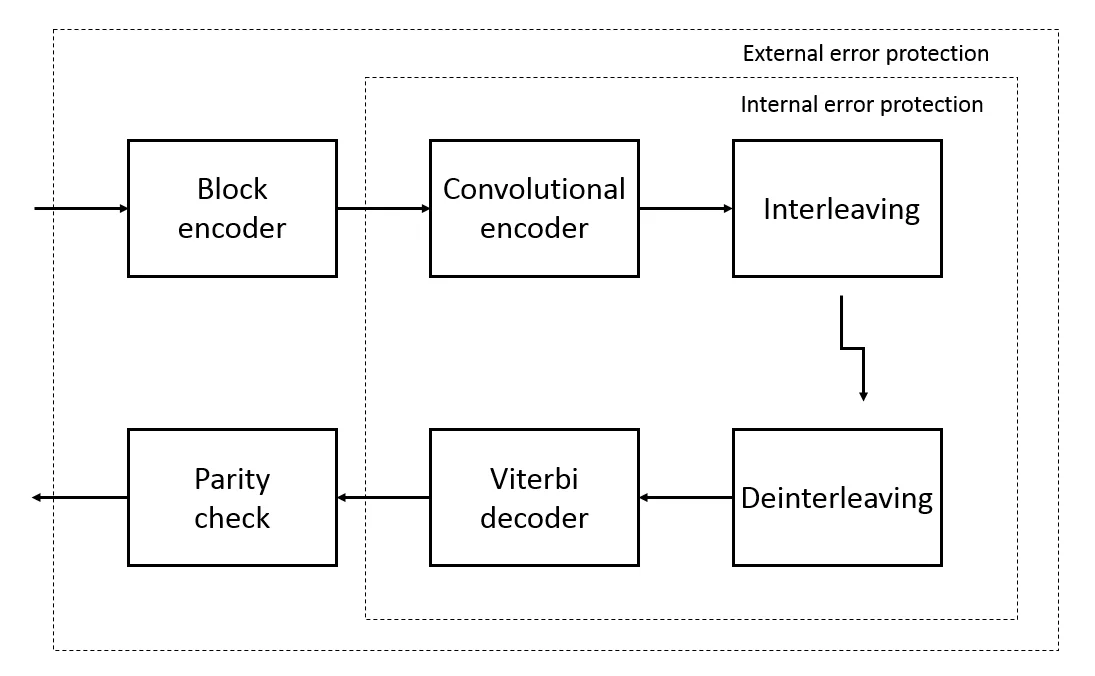
A convolutional code adds check bits based not just on the current bit but on the last few bits that came before it. The encoder is a rolling filter over the bitstream, and that small memory is what lets a receiver correct errors with a cheap, fixed graph search instead of heavy algebra over a long block.
Block codes like Hamming or Reed-Solomon chop data into fixed-size chunks, append parity to each, and decode each chunk on its own. A convolutional code has no chunk boundary. It is characterised as [n, k, K]: k data bits in, n transmitted symbols out, so the extra n minus k is redundancy, and K is the constraint length, meaning each output depends on the current input plus the previous K-1. The number of encoder states is typically 2^v, where v is the number of memory elements. The number of encoder states is typically 2^v, where v is the number of memory elements, and that count is what a decoder has to track.
That finite state set is the trick. Because the states repeat at every time step, the decoder can draw a trellis, a diagram of every encoder state with allowed transitions as branches, and find the single most likely path through it. Andrew Viterbi determined in 1967 that convolutional codes could be maximum-likelihood decoded with reasonable complexity using time invariant trellis-based decoders. The article puts the contrast plainly: classic block codes generally get a time-variant trellis and are typically hard-decision decoded, while convolutional codes allow economical soft-decision decoding.
The Wikipedia article frames the two encoder types in signal-processing terms: "Using the convolutional terminology, a classic convolutional code might be considered a Finite impulse response (FIR) filter, while a recursive convolutional code might be considered an Infinite impulse response (IIR) filter." Peter Elias introduced convolutional codes in 1955. Claude Berrou's recursive systematic convolutional codes around 1991 fed into turbo codes. The rate is adjustable by puncturing: the source's example is a mother code of rate 1/2 punctured to 7/8 by not transmitting a portion of code symbols.
The article calls these codes continuous but notes that most real encoding runs on blocks with termination, so the label describes the encoder's memory, not the shipped format. It gives no measured coding gains and no field error rates, which means it cannot settle which constraint lengths and rates are used where, or how much soft-decision decoding buys in practice. Termination overhead is also unquantified: the extra tail bits depend on K and block size, and the page puts no number on it. For the mechanism, the source is clear enough (en.wikipedia.org/wiki/Convolutional_code); for the engineering trade-offs, it is a starting point rather than a verdict.