Every SSD bit is checked by a few neighbours, and the idea is from 1996

When a flash cell drifts or a block wears out, the controller has to work out which bits are wrong and fix them. The codes that do this in many drives belong to a family whose construction was worked out in the 1990s, and a Wikipedia entry on Gilles Zémor's decoding algorithm is a clean window into how that family is built.
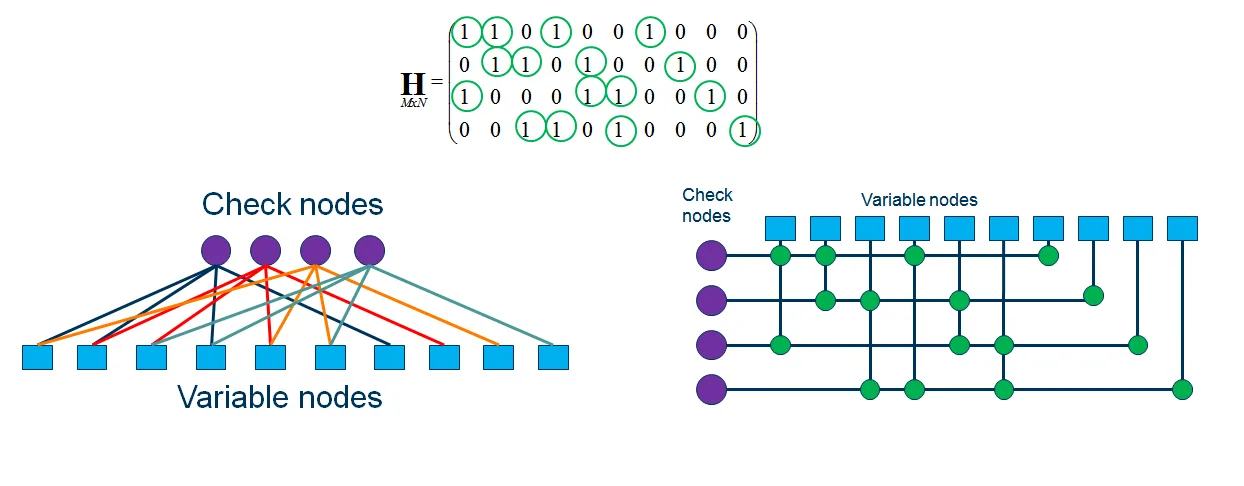
The entry describes Zémor's algorithm as a recursive low-complexity approach to code construction and an improvement over the algorithm of Sipser and Spielman. Sipser and Spielman introduced a constructive family of asymptotically good linear-error codes together with a simple parallel algorithm that will always remove a constant fraction of errors. The trick is the graph. Instead of one giant check over the whole block, you draw a sparse graph where each stored bit is an edge and each vertex enforces a tiny subcode on the bits touching it. The graph is bipartite (bits and checks in two separate groups, edges only between groups) and d-regular (every vertex has the same small number of edges). That shape is called a Tanner graph, a construction first proposed by Tanner.
Decoding runs as message passing. Each check looks at the bits it can see and sends back an opinion about what each one should be; each bit combines the opinions from its checks and updates; the rounds repeat until the word settles. The expander property, meaning the graph is sparse but every small set of vertices still has many neighbours outside itself, is part of what the construction relies on. The guarantee is a constant fraction of errors corrected. That is the property that matters for storage: a fixed budget of correctable errors per read rather than one that erodes with age.
The same shape of machine, local checks on a sparse graph plus iterative message passing, is what LDPC decoders run. LDPC stands for low-density parity-check, and the density in the name is the sparsity of the graph. The lineage from Zémor's construction to a specific controller is a family resemblance. The entry gives the construction and the constant-fraction claim, sourced to Venkatesan Guruswami's course notes.
en.wikipedia.org/wiki/Zemor's_decoding_algor…
math.u-bordeaux.fr/~gzemor/