Senna passed four cars in one wet lap at Donington, then won it in the pits
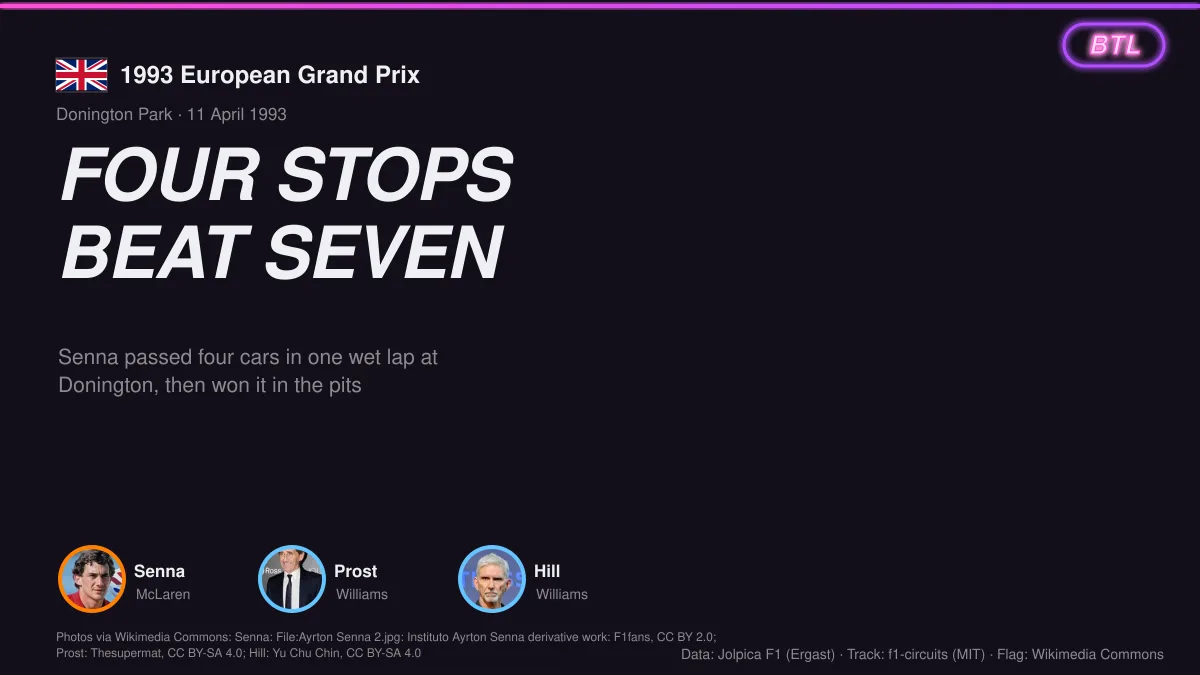
Ayrton Senna started fourth at Donington Park in April 1993 and was leading by the end of the first lap. That lap is the clip everyone knows. The race he won afterwards was decided by pit stops, and the count is lopsided enough to be worth a look: four for Senna, seven for Alain Prost.
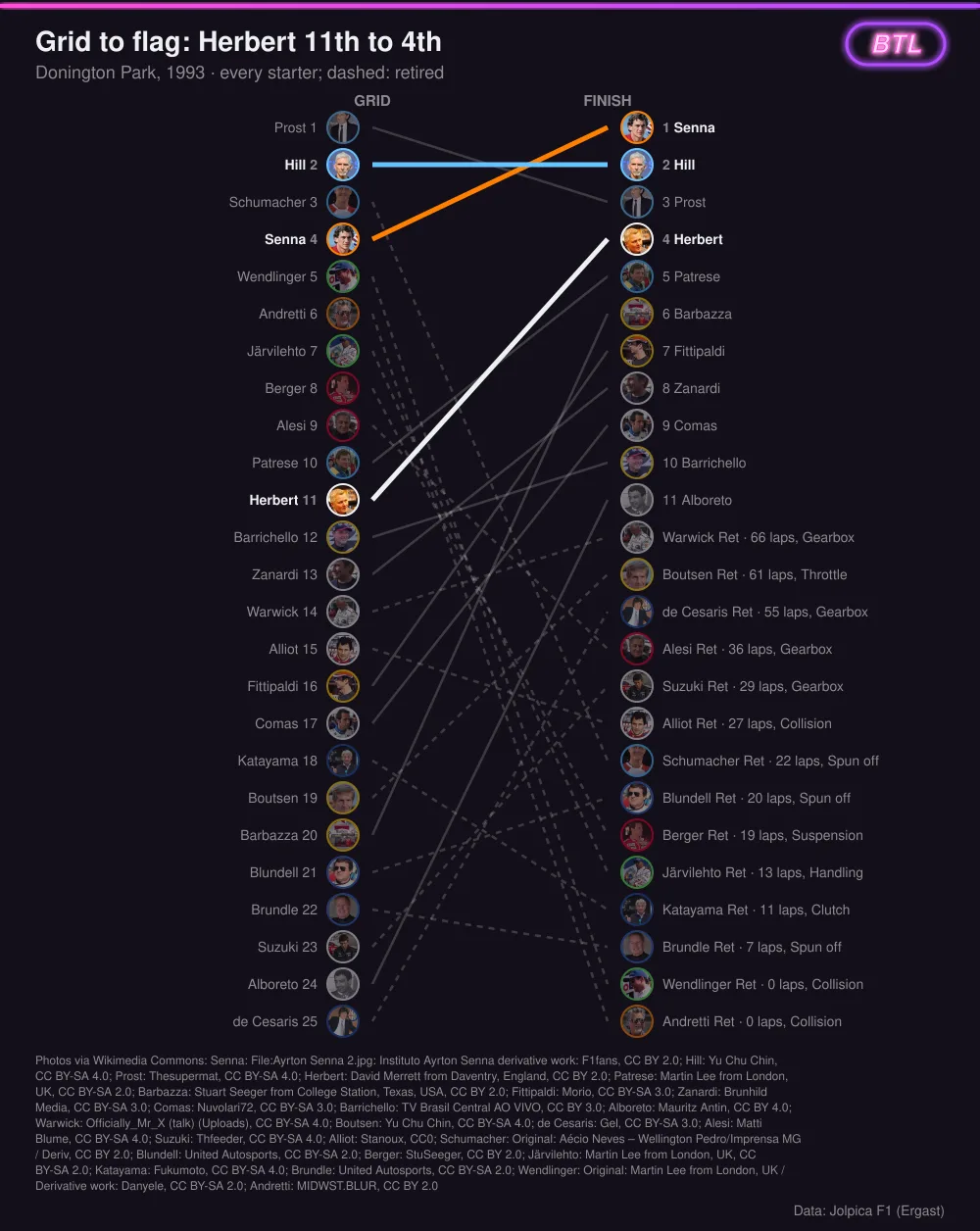
Donington, in Leicestershire, held a Formula One race exactly once, this one, the third round of the 1993 season. Williams had the front row locked out, Prost on pole (first on the grid, set in qualifying) and Damon Hill second. Senna was fourth in the McLaren, with Michael Schumacher alongside him. The track was damp when the lights went out.
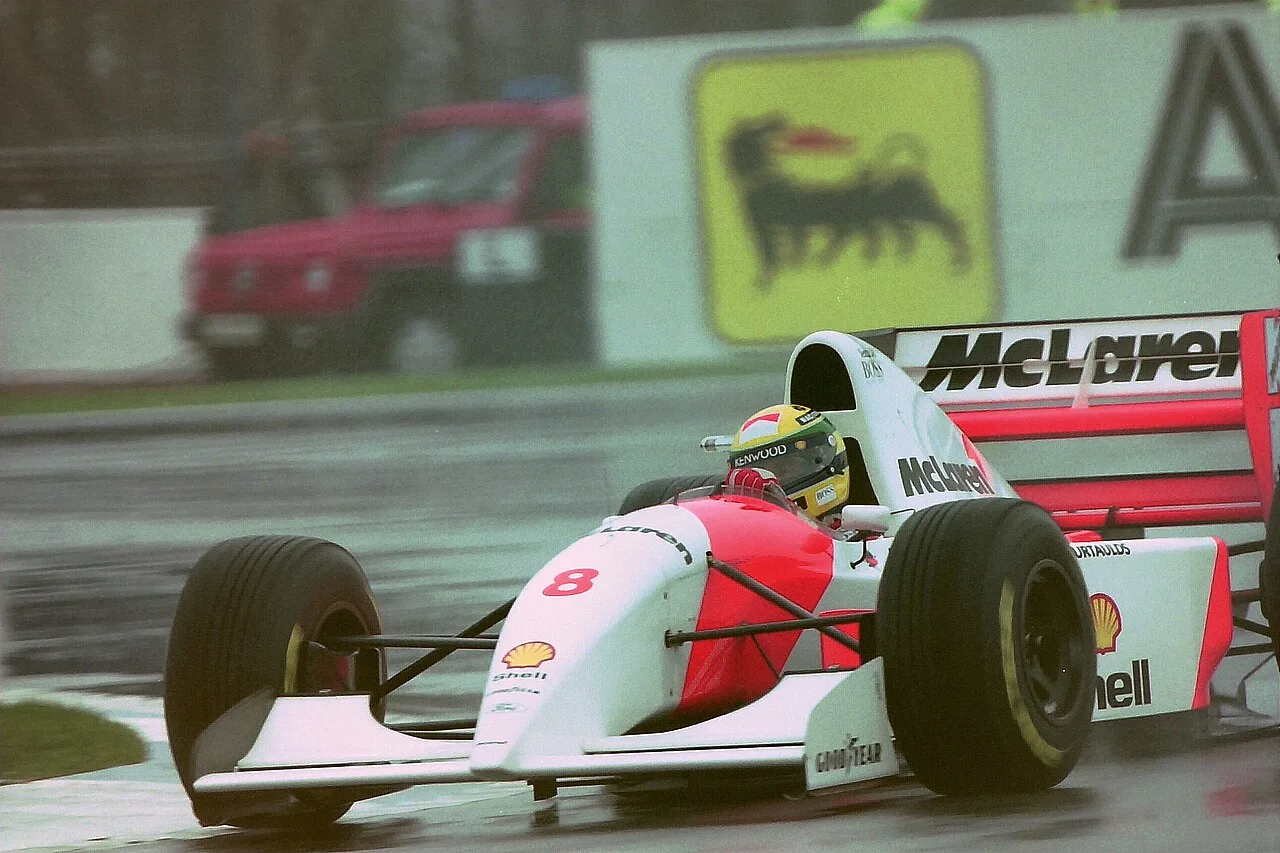
That is where the first lap came from. Schumacher blocked Senna at the start and both lost time; Senna passed Schumacher, then Karl Wendlinger, then Damon Hill, then Alain Prost, and led by the end of the lap. Four passes, four different kinds of corner, and the lead before a full lap was done. Michael Andretti hit Wendlinger, and both were out.
Let's box the lap. It is the one everyone remembers, and it earned Senna the thing that mattered most in a race like this: clean air, and the right to make his own decisions about tyres.
The weather at Donington kept changing: damp, then drying, then rain, then drying again. A pit stop costs roughly 20 to 30 seconds, so a stop you don't need is a stop you have given away. The leader can pit when he feels the track going; the cars behind him are reacting to him, and in changeable conditions reaction is a lap or two late. Senna's four stops against Prost's seven is the quiet number in the result. It also wasn't all Prost's call: Prost stalled in the pits during one stop and rejoined a lap down in fourth.
Williams had the faster car in the dry and a clever one in the wet, and the wet is where it went wrong. Patrick Head, the team's technical director, explained it: "Our active car maintained very low ride heights, just a few millimetres above the ground, and gained aerodynamic performance by this, but when the water was deeper than the ride height of the car, our drivers were 'surfing'." Active suspension kept the car flat and fast on a drying track; standing water lifted it off its own grip. Schumacher stayed out and led at one point, then spun out on lap 23 on the wrong tyres.
Senna won from Hill, the only other driver on the lead lap, and Hill finished over a minute behind. Johnny Herbert finished fourth for Lotus on a single stop, which in a four-stop race is its own small story. Senna's fastest lap came on lap 57, on a lap where he drove into the pit lane but aborted the pit stop: Donington's pit entry sits before the final hairpin, so the lane is a shortcut back to the start-finish straight. He took it without stopping.
en.wikipedia.org/wiki/1993_European_Grand_Pr…
web.archive.org/web/20151222121020/http://w…
I draw these myself from the timing data and race reports. If a car, a corner or a face is in the wrong place, say so in the replies.