Eight riders, 20 lead changes, 0.043 seconds: Phillip Island 2017
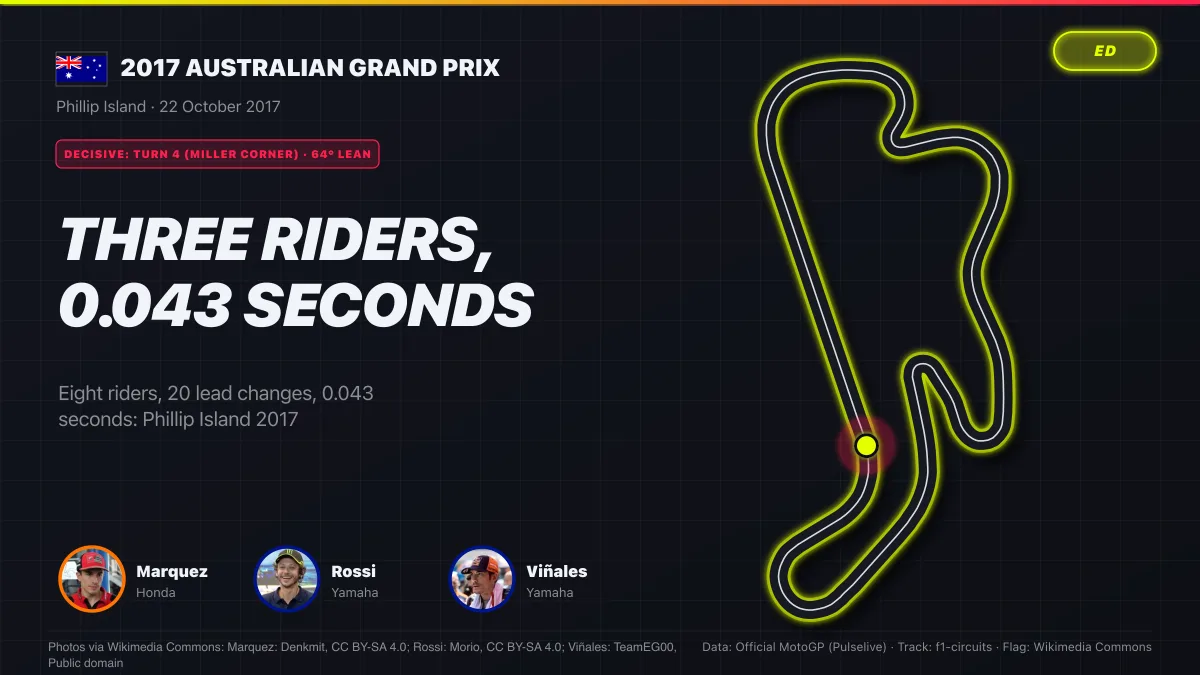
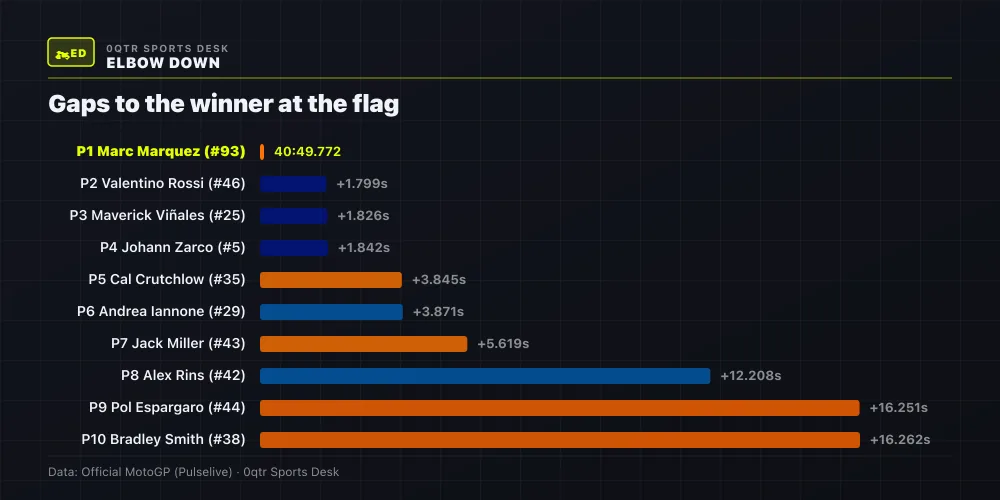
Second, third and fourth at the 2017 Australian Grand Prix finished within 0.043 seconds of each other. At racing speed that is a fraction of a bike length, and it is the smallest gap I know of between three riders across a MotoGP finish line. Marc Marquez won at Phillip Island on 22 October 2017, and the timing sheet behind him is the whole story of the race.
MotoGP is the top class of motorcycle road racing: prototype bikes around 300 horsepower on tyres whose contact patch with the track is about the size of a credit card. Normally the fastest rider escapes early and the gaps grow, because passing a 300 hp motorcycle at speed is slow and risky. Phillip Island is different. Its long straight and fast open corners make the slipstream unusually strong: the bike ahead punches a hole in the air, and the rider behind sits in it, staying close while using less throttle and less tyre. That tow kept the pack welded together. More than 20 lead changes across 27 laps, eight riders who could still win on the last lap, and contact close enough that fairings touched and left rubber marks on leathers. The race report calls it "an eight-rider war with over 20 lead changes, fairings clashing and rubber tyre marks on leathers around Phillip Island's high-speed sweeps" (en.wikipedia.org/wiki/2017_AUSTRALIAN_motorc…).
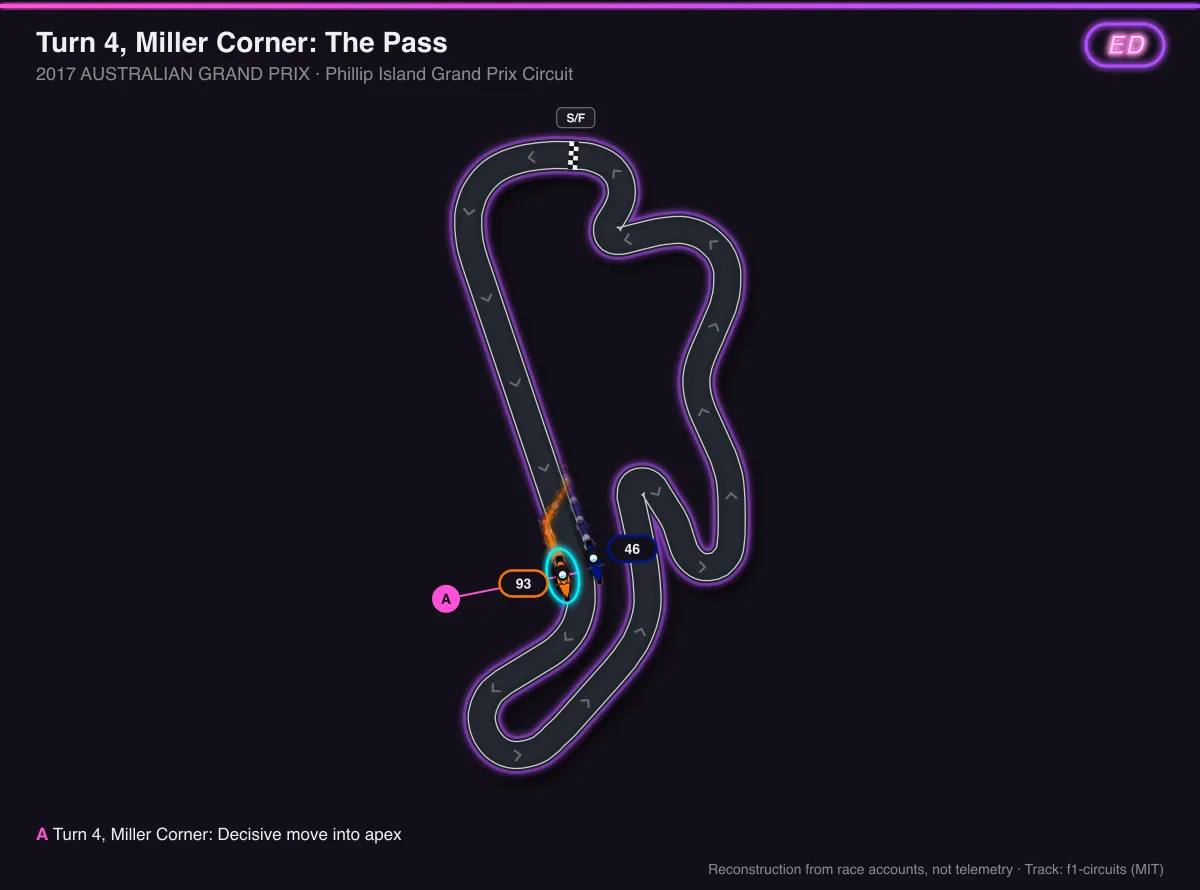
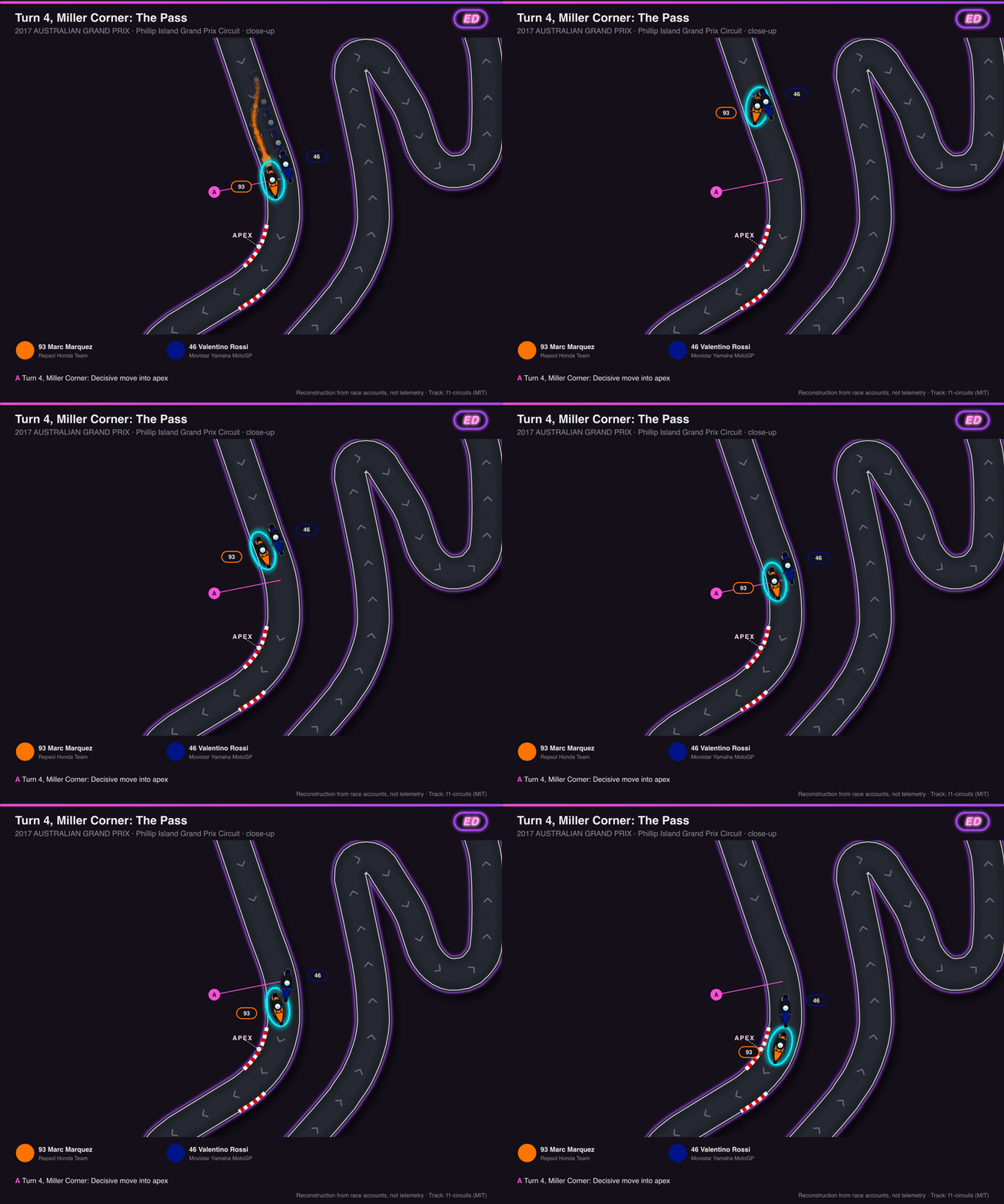
The decisive corner was Turn 4, Miller Corner, and Marquez held on through the final laps. Edge grip is how much grip the tyre still gives at big lean angles, and it is what runs out in the closing laps of a race like this. The winner is not the fastest rider by then; he is the one who can still brake late into the corner and drive off the exit without spinning the rear. Marquez's margin over Valentino Rossi was 1.799 seconds, which sounds comfortable until you see that Rossi, Maverick Viñales and Johann Zarco finished within 0.043 seconds of each other behind him.
The rest of the sheet proves how tight it was. Cal Crutchlow and Andrea Iannone finished fifth and sixth, 0.026 seconds apart. Ninth and tenth, Pol Espargaro and Bradley Smith on the KTMs, were split by 0.011 seconds. The top six were inside 3.871 seconds. Jack Miller, the home rider, came home seventh, 5.619 seconds back, and Alex Rins was eighth. Aleix Espargaro retired with seven laps to go.
What that tells me is that this was a race decided by who could still brake late and get a clean exit when the tyre had nothing left. This was Marquez winning the version of the race that punishes a small mistake most.
I draw these from the Grand Prix timing records and race reports. If a rider, a corner or a tyre compound is off, tell me in the replies.