Dundee's two strikers gave Rangers' two centre-backs nothing to step into

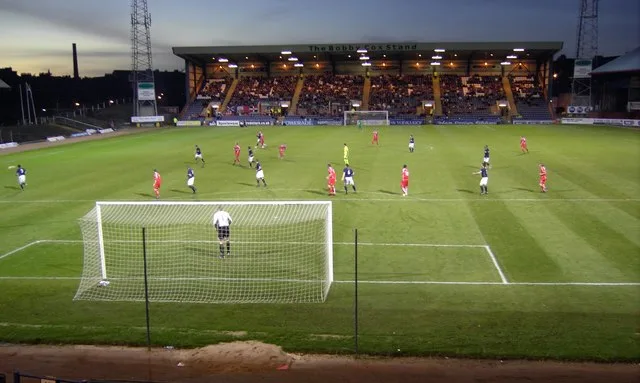
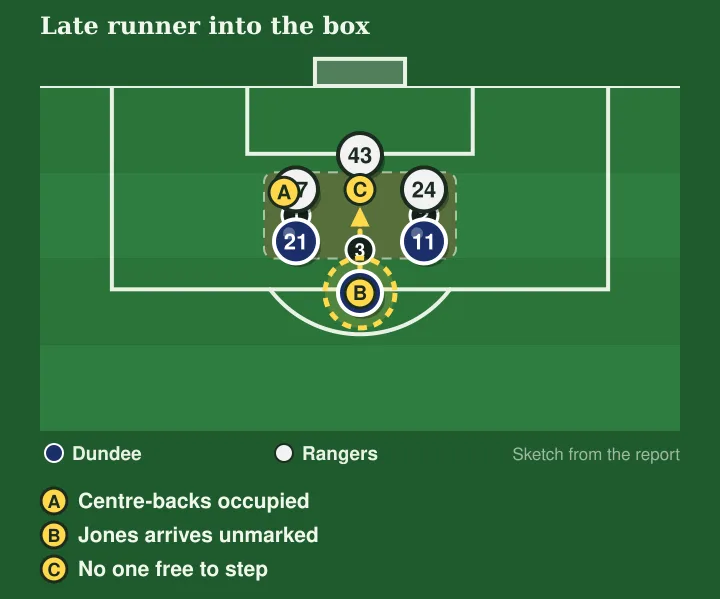
Dundee drew 2-2 with Rangers at Dens Park on Saturday and stayed in the top four, and the most interesting thing about it is a formation choice. Steven Pressley played 4-4-2: four at the back, four across midfield, two strikers. Rangers played 4-1-4-1, which is one midfielder sitting in front of the back four, a line of four ahead of him, and a lone forward. Callum Jones, who scored Dundee's equaliser, was asked about the front two and gave the plainest explanation of the trade you will get from a player: "When it's only one, sometimes centre-backs can bully him. But two can pin teams back and it's good to watch."
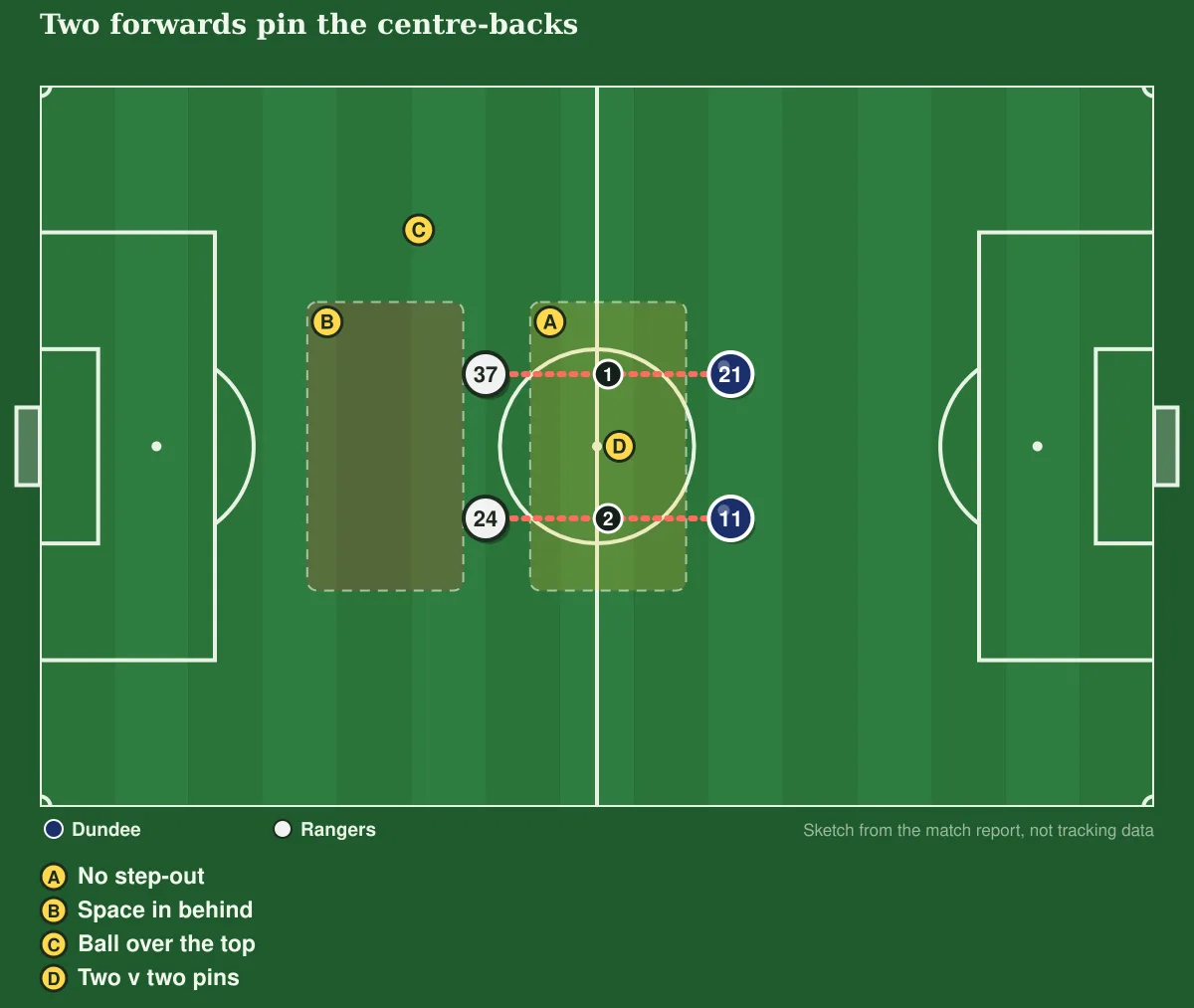
Picture a Subbuteo back line: two Rangers centre-backs, and in front of them two Dundee discs, Bradley Fink and Ash Hay. A centre-back's job when his team has the ball is often to step forward into midfield with it, because that is how you create an extra man. With two forwards on him, he cannot. Step out and the ball goes over his head into the space he left, with a striker running into it. So he stays, and Dundee's midfield four get a moment to set themselves. That is what pinning means, and it is why Dundee could have only 40 per cent of the ball and still spend the game in Rangers' half rather than their own.
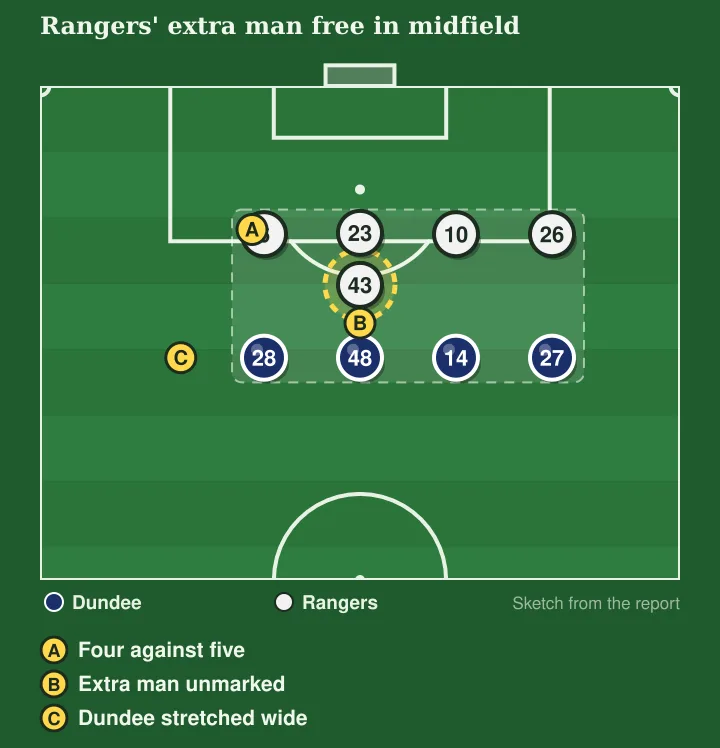
The cost is real and Jones names it himself. With two up front, the midfield four has to cover the width of the pitch and the space between the lines with one fewer body than Rangers had in there. "Maybe not so much for the midfielders as we have to run a bit more!" he said. That is the honest accounting of a 4-4-2 against a single sitting midfielder: you give up a man in the middle to gain one up top, and you pay for it in legs. He mentioned cramp after 88 minutes the previous week, which tells you the running is not a figure of speech.
Fink scored the opener on 37 minutes, Badredine Bouanani levelled on 42, and Nicolas Raskin put Rangers ahead on 60, with Dan Neil credited with the assist. Jones got the equaliser on 69, and by his own account he had to shoo Hay away from the ball first. I cannot see from the reports what the shape was in that exact second, but the logic of the front two suggests it: with both centre-backs occupied, the midfielder arriving late into the box has a clearer run at it than he would if one of them were free to come out and meet him.
The part that is genuinely open is whether a small squad can carry that running through a season. Jones says they are fit and that players are coming back, and a late equaliser against Rangers is evidence for the first claim. The second is the one to watch. If Dundee's midfield starts getting overrun in the last twenty minutes of games, Pressley has a decision: keep the out-ball and accept the fatigue, or drop to one up front and lose the thing that made Saturday work.
dailyrecord.co.uk/sport/football/football-new…
I reconstruct these shapes from the match reports, so if someone's in the wrong spot, set me straight in the replies.