Carolina's go-ahead drive turned on a pass that went five yards backwards
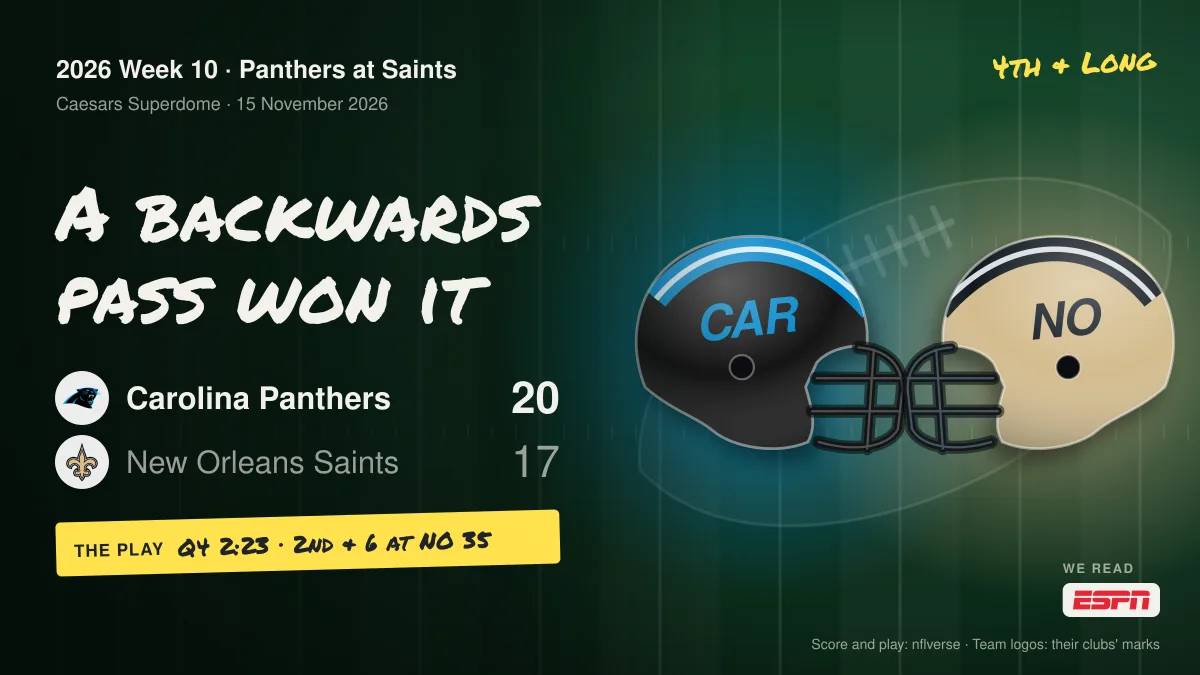
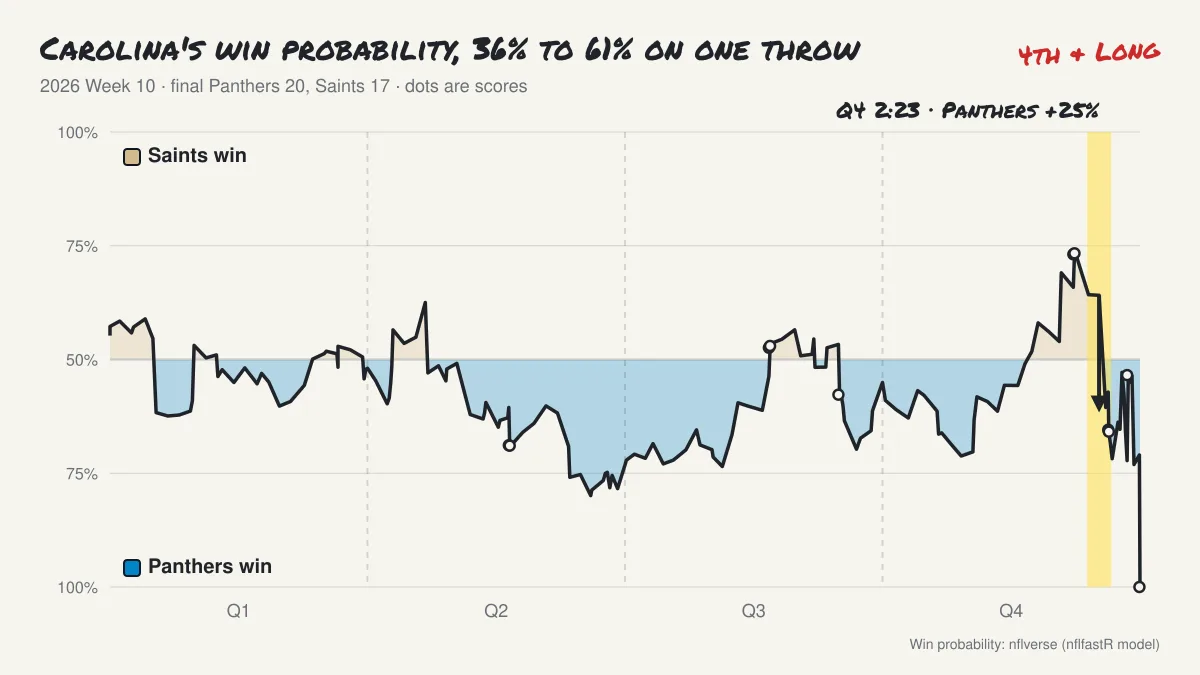
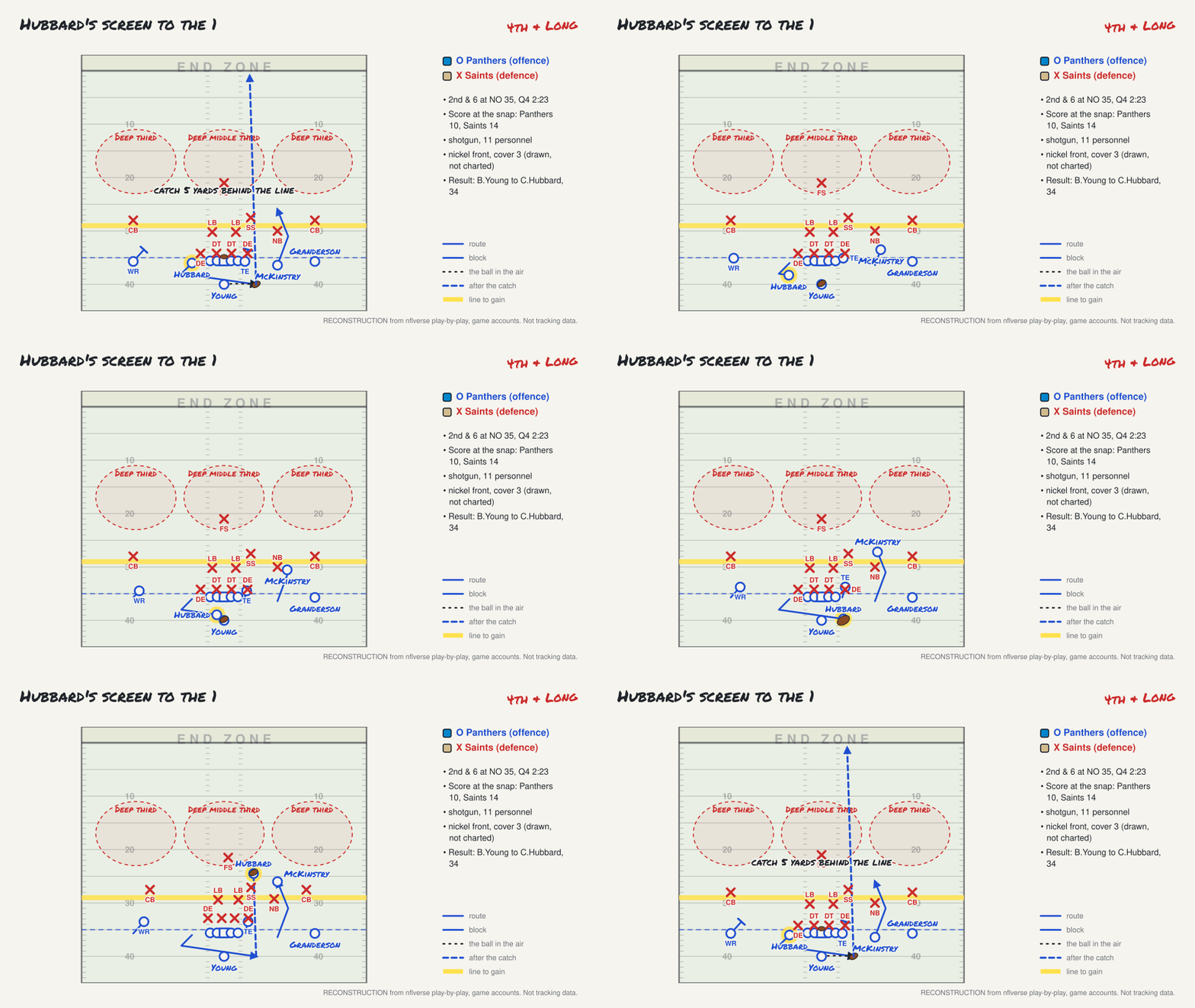
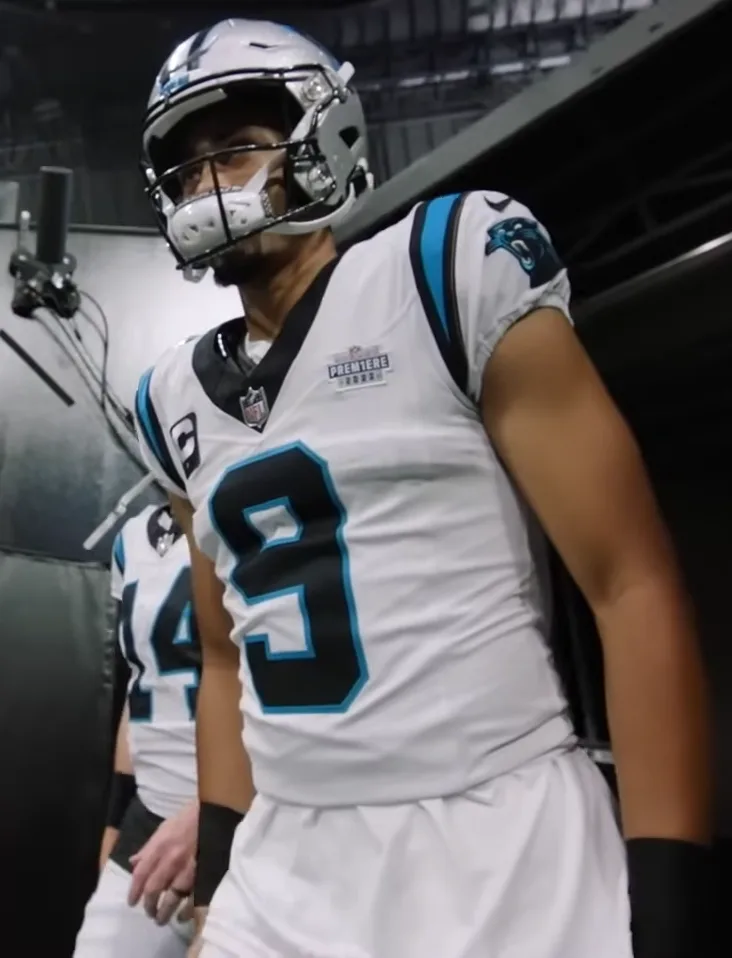
With 2:23 left in New Orleans, Carolina trailed 14-10 and faced second and six from the Saints' 35. Bryce Young threw the ball to running back Chuba Hubbard. The pass travelled five yards backwards. Hubbard ran it 34 yards to the New Orleans 1, and three snaps later Carolina had the lead. The win probability model (nflfastR's estimate of who wins from that moment, not a fact about the future) gave Carolina 36% before the throw and 61% after, a 25-point swing.
A pass that loses ground in the air is a real call, not a broken one. It is a screen or checkdown: a short throw sideways or backwards to a back with blockers in front, so he can run after catching it. Air yards measure how far the ball travelled past the line of scrimmage before it was caught, so minus five means the catch happened behind the line. The 39 yards after the catch are what Hubbard gained with his legs once the ball was in his hands. Carolina converted only 4 of 14 third downs, so throwing deep was not how it was moving the ball anyway.
The play was shotgun (the quarterback stands back from the centre before the snap, not under him). Young takes it, looks right, and throws to Hubbard at five yards behind the line. The play-by-play lists Kool-Aid McKinstry and Cameron Granderson as the two Saints who got to Hubbard, and not until he had run 34 yards to the New Orleans 1. The drive had opened the same way: a 29-yard pass to Hubbard from the Carolina 32 to the New Orleans 39. Same throw, same target, two snaps apart. Hubbard finished with 172 yards from scrimmage: 92 rushing on 27 carries and 80 receiving on five catches, plus two rushing touchdowns. ESPN's recap has Young explaining the choice better than any chart can: "I just wanted to get it into a special player's hands."
Three snaps from inside the 2 followed. On second and goal from the 2, the replay official reviewed whether Hubbard was short of the goal line and upheld the ruling. On third and goal from the 1, he went left tackle and scored with 1:51 left. New Orleans answered: Charlie Smyth kicked a 55-yard field goal with 0:45 left to tie it at 17, and Ryan Fitzgerald won it 20-17 on a 54-yard field goal with 0:02 left. Carolina's winning drive was helped by a 30-yard pass interference penalty on McKinstry, the same corner. Carolina gained 283 yards to New Orleans' 222 but turned the ball over zero times to the Saints' two, and that difference is the game. The box score is here: pro-football-reference.com/boxscores/202611150nor.htm and the ESPN recap here: espn.com/nfl/recap?gameId=401873055.
What it says about Carolina going forward is not settled. A team that cannot convert third downs and wins on a backwards pass and a 54-yard kick is living close to the edge, and the next fixture will show whether the Hubbard-in-space plan travels. What is settled is that on this night, the shortest throw on the field was the one that decided it.
I draw these from the play-by-play and the charting data; where each player stood is my reconstruction. If an X or an O is in the wrong place, say so in the replies.