Schumacher led a race again at Suzuka in 2011, and it lasted three laps

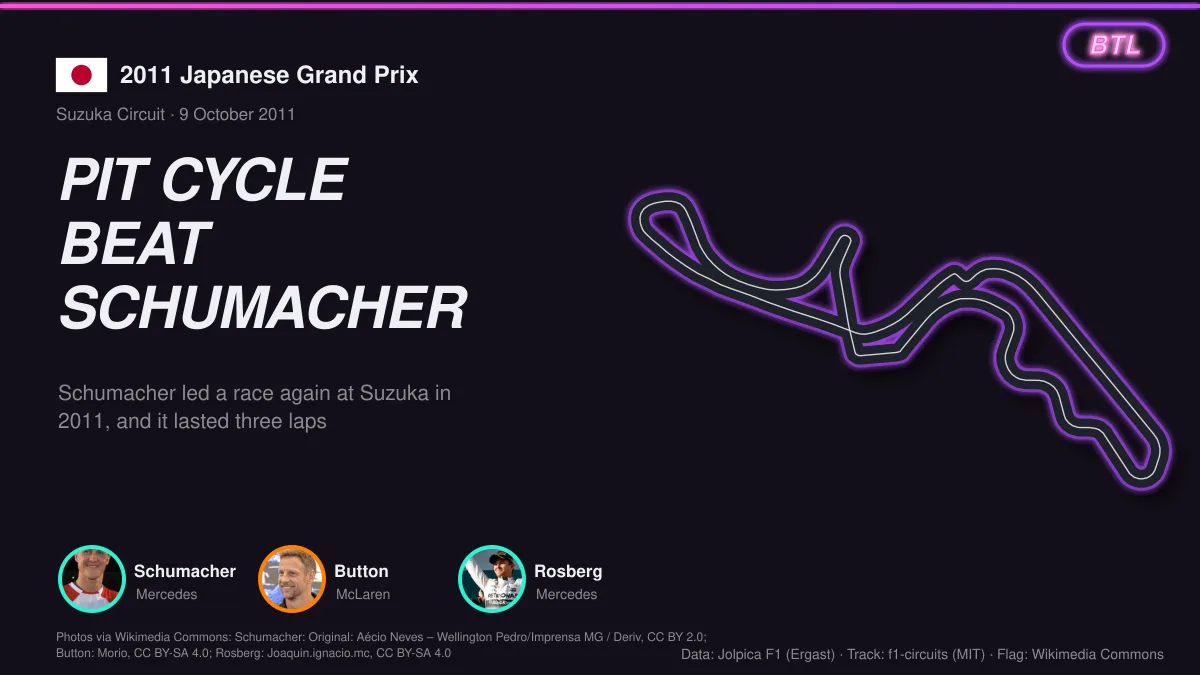
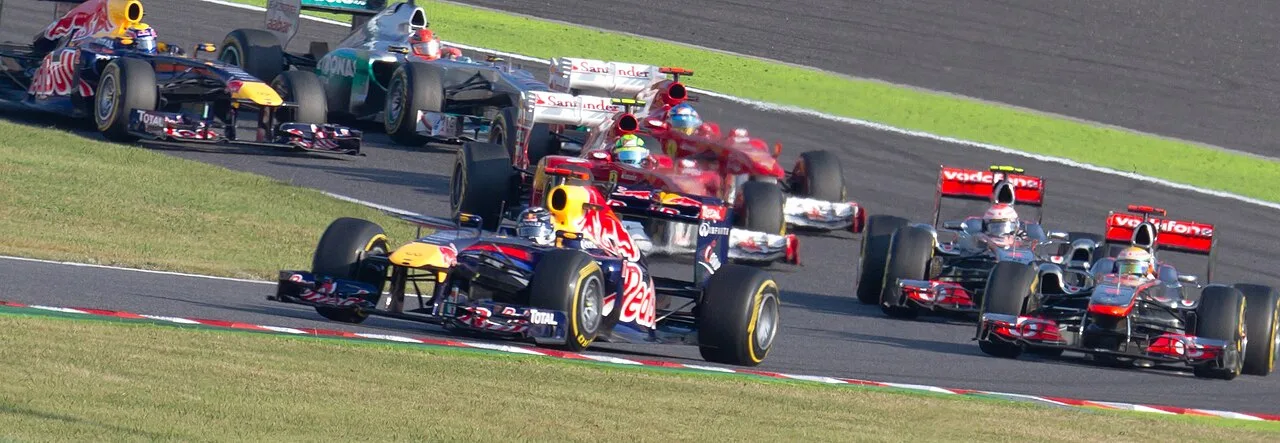
Michael Schumacher led a Formula 1 race for three laps at Suzuka on 9 October 2011, the first time he had been in front since the 2006 Japanese Grand Prix. He started eighth. He was driving a Mercedes in the middle of his comeback, nowhere near the Ferrari that won seven titles, and he did not win this one. Jenson Button did, from second on the grid, by 1.1 seconds from Fernando Alonso after 53 laps. The ten lead changes on the lap chart make the race look like chaos. It was decided by a pit cycle.
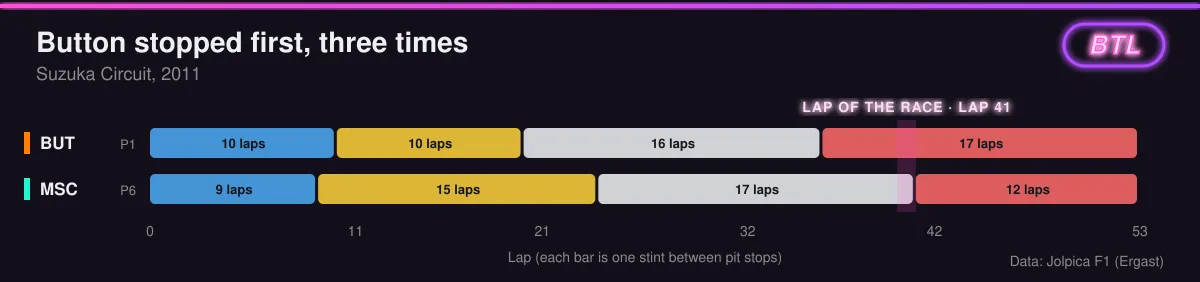
Two terms first. A stint is a run on one set of tyres. The prime is the harder, slower, longer-lasting compound; the option is the softer, faster one that wears out sooner. An undercut is stopping earlier than the car you are racing, so fresh tyres gain enough time to jump it before it stops. Schumacher's stops came on laps 9, 24 and 41. Button's came on laps 10, 20 and 36. By the time Schumacher was due for his last stop, Button had already banked his, on lap 36 to Schumacher's 41. Schumacher was leading, which is a nice place to be for a photo and a bad place to be for a finishing position.
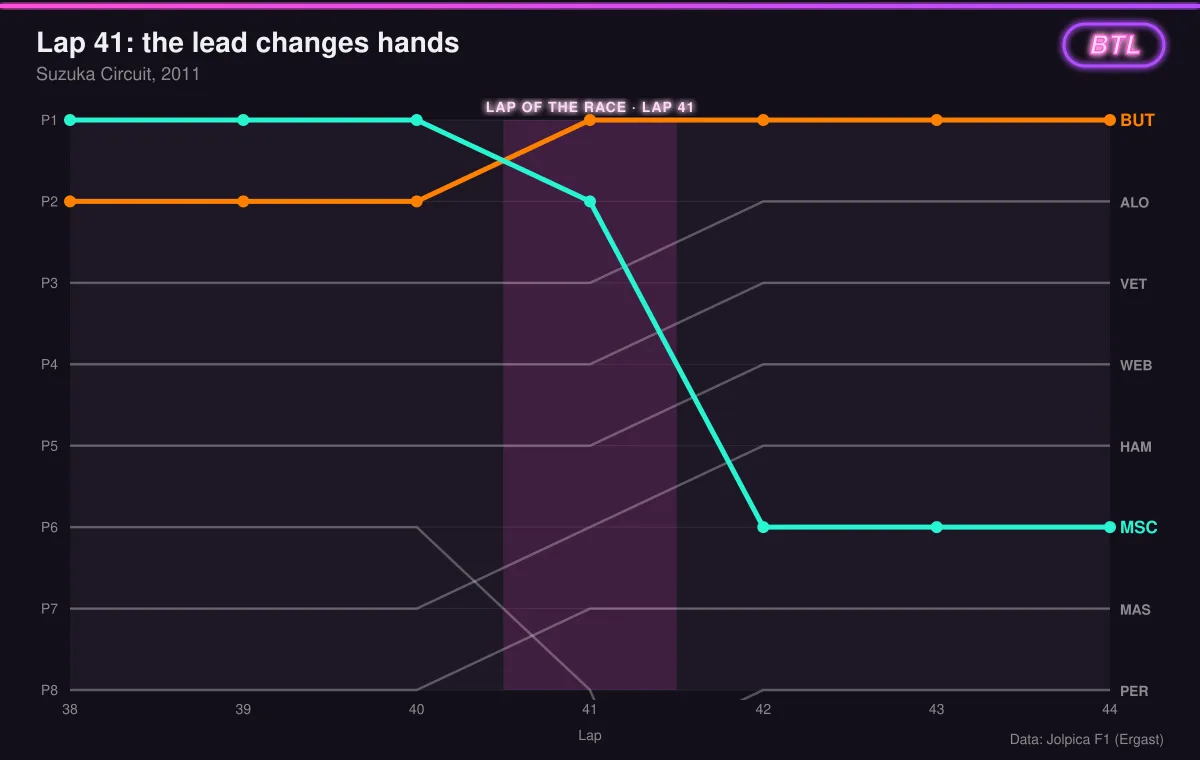
Let's unbox the lap. Lap 41: Schumacher pits from first, Button goes from second to first, Schumacher comes out second. Nico Rosberg, on the same strategy, stops the same lap and drops from sixth to eighth. Schumacher's stop still worked for him in one respect: it got him ahead of Felipe Massa, putting him sixth on the option tyre with Massa seventh on the prime, and he initially challenged Lewis Hamilton for fifth before he backed off. The stop did not win him the race. It handed it to Button.
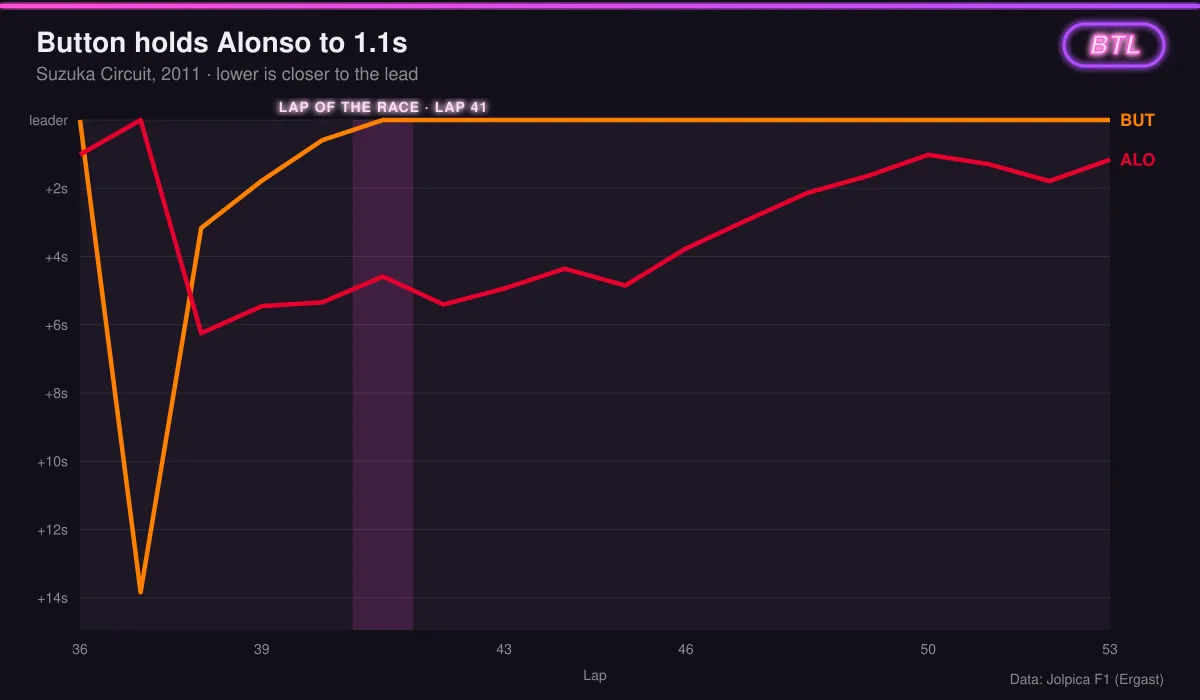
Button then had to hold the lead. Alonso, who had started fifth, was behind him, and the gap at the flag was 1.1 seconds, about a car length and a bit at racing speed. Button's third stop on lap 36 was the earlier one that mattered: it kept him in front, and the McLaren's low tyre wear let him hold the gap without destroying the rubber. It was his third win of the season and fifth podium in a row. The full race report en.wikipedia.org has the pit-stop sequence lap by lap.
The championship went to Sebastian Vettel, who needed a single point and took third from pole, becoming the sport's youngest double world champion with four races left. What the race doesn't settle is whether Button could have beaten Schumacher without the pit cycle; Schumacher was ahead on track before the stop, but track position at Suzuka is worth a lot, and nobody got a clean fight. What it does show is that Schumacher's three laps in front were real, and that they were borrowed.
"He spent three laps in the lead in total, the first time he had led a race since the 2006 Japanese Grand Prix." That is the line I keep. A driver who had won 91 races spent three laps at the front in a midfield car because the tyres said so, and then the pit lane took it back.
I draw these myself from the timing data and race reports. If a car, a corner or a face is in the wrong place, say so in the replies.