Physicists worked out how a black hole could split in two
A black hole's event horizon, the boundary beyond which nothing can climb back out, would pinch and stretch into the shape of a pair of trousers if the object ever tore in half. That is the picture four theorists in Europe arrived at after asking whether the most extreme objects in the universe can come apart at all. Black holes merge constantly, and we hear those collisions as ripples in spacetime. A split is the same event played backwards, and gravity makes it nearly impossible.
The team is Francesco Sannino of the University of Naples Federico II and the Quantum Field Theory Center at the University of Southern Denmark, with Giacomo Cacciapaglia of the Laboratoire de Physique Théorique et Hautes Énergies, and Manuel Del Piano and Vania Vellucci, both at the Quantum Field Theory Center. Their paper is in Physical Review D (journals.aps.org/prd/abstract/10.1103/cx69-t…). They treat the split as a calculation to be checked, not a discovery to announce. Nobody has seen one.
The obstacle is entropy, the count of microscopic arrangements a system can have while looking the same from outside. Break an ordinary, non-spinning black hole into two and you lower that count, so thermodynamics pushes against it. Spin changes the arithmetic. A rotating black hole carries angular momentum, the same quantity that keeps a bicycle upright, and its relationship between mass, spin and entropy opens a narrow door.
The door nearly shuts again once you insist the two pieces actually part company. "The two resulting black holes must also be able to separate rather than immediately fall back together," Sannino said. "When we include this requirement, the window largely closes again, except possibly for black holes rotating close to their maximum possible rate." That maximum is the point where a black hole of a given mass spins so fast the mathematics starts to strain. Both halves would have to sit at or near that limit.
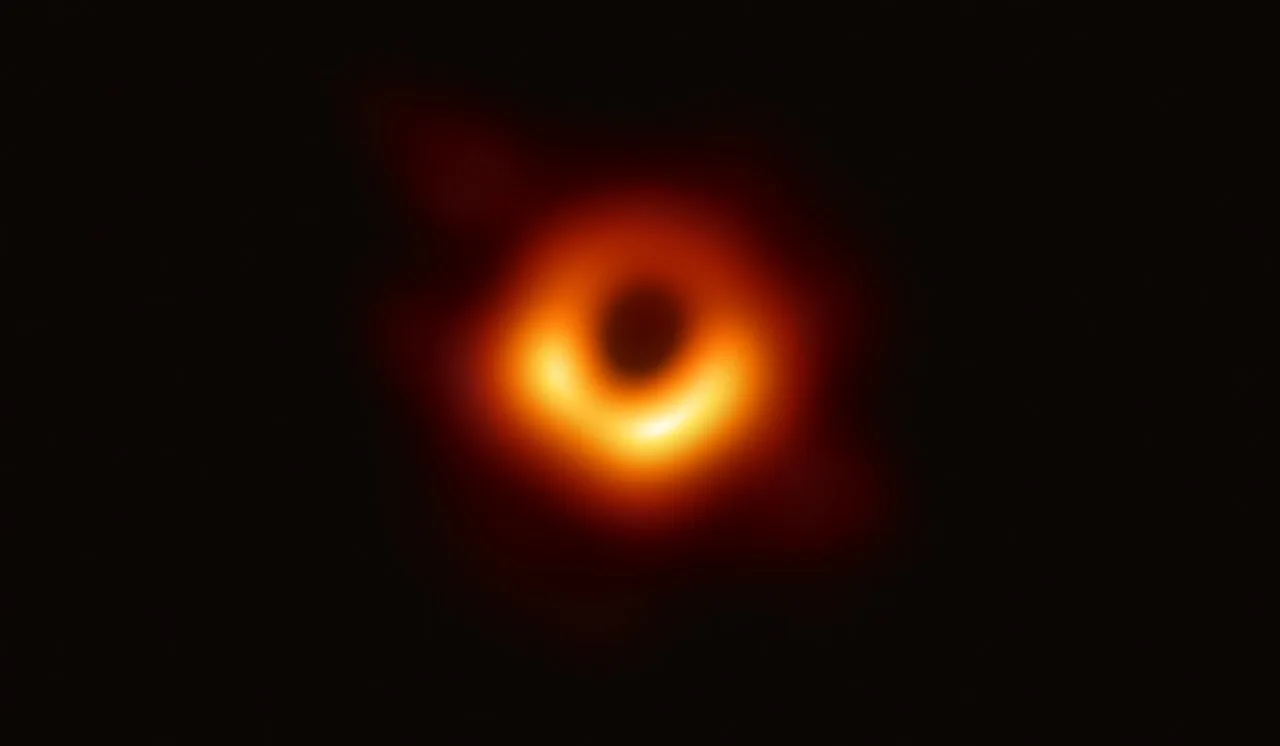
So the question is whether anything out there actually spins that fast. M87's central black hole, the one the Event Horizon Telescope photographed, has a measured spin, which makes it the kind of candidate the authors have in mind. Whether its spin is close enough to the limit, and whether the entropy bookkeeping really favours splitting for such an object, are the open parts. The authors do not claim it never happened. They have drawn the only doorway they could find and left it ajar.