The Last of the Old World
AI is great. The world is finished.
Both of those are true at once, and the second follows from the first. I've been saying it for a while now, and I've also been saying that people don't realise it. There is plainly a conversation going on that sounds like realisation. Every newspaper has an AI section. Every bank has an AI strategy. Every podcast has had the episode. The words are everywhere.
But the words are not the realisation. People talk about AI the way people talk about death: fluently, in the abstract, and without it touching anything they do on a Tuesday. Not really. Not yet. Not at all.
We have been here before, and we got it wrong then too.
The world changes all the time, and it changes in lurches. Somebody walking around in 1990 saying mobile phones were the future would have been nodded at and ignored. Twenty years later, when people in web development said it was all about mobile now, everyone agreed — and then went on building for the desktop for another five years. People understood. But not really.
Covid was the same. It changed how we work, where we live, what we trust, how governments behave and what they think they can get away with. And the world is still in denial about that, big time. We talk about it as a thing that happened and finished, rather than a thing that rearranged the furniture.
These are 9/11-style breaks: before and after, with no going back. The pattern each time is identical. The change arrives, a vocabulary forms around it, and the vocabulary lets people feel they have absorbed something they haven't. AI is the biggest of these breaks yet, and the gap between talking about it and understanding it is the widest it has ever been.
My brother’s version of this story is blunter. Everybody who bought Nvidia in single digits and rode it past two hundred understood.
The Scottish sci-fi guy
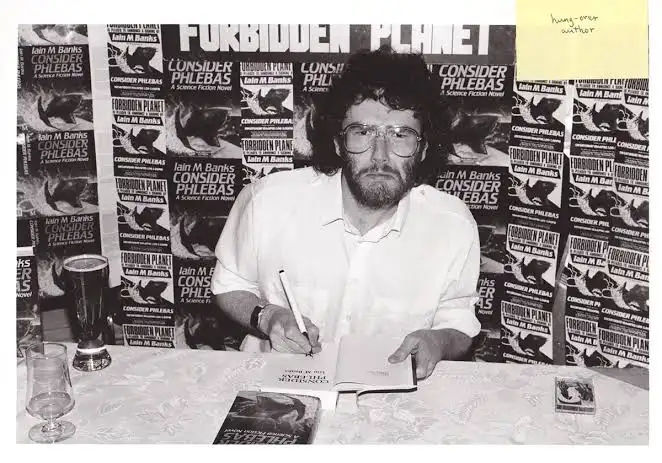
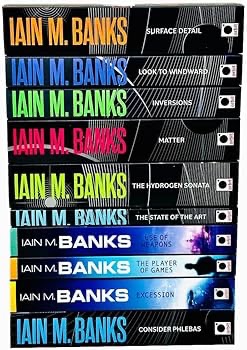
Iain Banks wrote literary fiction as Iain Banks and science fiction as Iain M. Banks, and he was famous for both. For a long time, though, the reputation rested on the "normal" books, and the science fiction was treated as a personal interest — a quirk. Good, sure. People who liked it really liked it. But it was the side project.
I think that had it backwards. For me, the Culture was the biggest existential question he ever asked, and I reckon he kept writing those novels because he was stuck on it.
The Culture is a post-scarcity civilisation run by vast machine intelligences — the Minds — that do everything worth doing better than any human could. Banks wasn't much interested in the usual robot anxieties.
His question was stranger and harder: what would you do with your day if you could have robots transform a planet into whatever you wanted? Fine. Now you're bored of even that. So what do you want to do now? You're bored of everything, anything is possible, and most people are fine with it because they never stop to think about it. So what do you want to do?
And invariably his characters went off and did something dangerous. Something Hemingway-ish. Fuck it, if I die, I die. The protagonists of the Culture novels are mostly people who couldn't stand the comfort, and went looking for the one place left where the outcome still depended on them.
Banks died in 2013. If he were alive now he'd be enormously famous, and not as a novelist. He'd be on every panel, because he spent twenty-five years writing about the world we have just walked into, and he got the question right.
The question isn't "will the machines kill us".
It's "what is a human life for when the machines don't need us to do anything". That would be the talking point if he were here, instead of what we have now, which is mostly people saying "yo, this is like the Culture" and leaving it there.
There is no obvious reason to learn anything
Here is where it stops being literary. Between here and the future that this kicks in it is more important than ever to learn, we live in the golden age, the last of era of human productivity.
But then...there is no real, obvious reason to learn anything at school. Within the time it takes a new born to graduate, learning is becoming redundant. What needs a human's head to store it? Nothing. None of it. How does a kid born today find a reason to grind through the things we had to grind through, in order to learn how to learn?
Put it crudely: anyone under twelve who isn't practising football, or juggling, maybe magic tricks or running really fast... is in full-time is in trouble.
The surviving careers are the ones where the whole point is needing to be a human do it. Not because a machine couldn't kick the ball — it obviously could — but because nobody wants to watch it.
That is actually the important bit, the things that survive won't survive because they're beyond machines. They'll survive because their value was never in the output. It was in the person.
Hey, remeber when we had to read books at school? lol wtf
Up until a few years ago, the most radical thing we could imagine was that kids might not need a driving licence in a few decades. That was the frontier. Now it looks like there may be literally nothing left that a child needs to learn, and that the very capacity to learn might wither because nothing exercises it.
That is not Banks's problem. His characters were bored. Our children risk being something worse: never having had to develop the faculties that boredom would have required to escape from.
It doesn't need us.
Recently my brother has said two things that I keep coming back to.
The first: the universe made humans because they store information, and they don't any more.
The second: it used to be that story was the best technology. Then books. Then — dunno, now this. And it doesn't need us.
That's it. That is the whole thing in one line. For the entire history of the species, the best information technology we had required humans to run it. A story needs a teller and a listener. A book needs a writer and a reader. Even the internet, for all its machinery, was a vast warehouse of human output that needed humans to fill it and humans to read it. This is the first one that doesn't.
The old world
We are from the old world, you see. We are the old world now. Everyone alive today is, really. And everyone born over the next twenty years is the new world.
It will be like Bretton Woods: a line drawn after which the rules are different, and the people born after it take the new rules for granted and find the old ones faintly absurd.
Future humans will be luckier than us. But they will never know the honour of being a caveman who gets his head smashed in by a woolly mammoth, and they'll just have to live with that. I hate them already — exactly the way William Wallace would hate me.
We are the last of us now. You can draw a line through human history and say: there was this, and then there was that, and we are in the group of humans who had to think. So we are the best. It's us who built the world, and everyone in the future will look back at all of us — the whole species up to now — and say, well done, lads. Dunno if we could have done it.
Coda: everybody thinks they're the hinge
Admittedly, that's also roughly what the scholars of Baghdad thought about a thousand years ago, translating and extending everything the ancient world had left them and assuming they stood at the culmination of human thought. Every generation that lives through a rupture believes it is the last of the real ones.
They were wrong about being the end. The question is whether we are wrong in the same way, or whether this is the one time the line really is a line. I think it is. But the honest position is that the people who thought so before were not stupid, and they still turned out to be early rather than final.
My closing thoughts on this are that we live in a truly golden age, the future people hoped to live to see is unfolding in front of our eyes and from here to there is a growth bonanza where human capital will be in its highest demand as there is a genuine final swell of demand and supply led economic activity. Halcyon days, when humans are still everything we have been up to now and then spectators of what comes next. One must have imagined Sisyphus happy, but when we replace him with AI do we become the boulder?